| Figure 1 Through careful observations, astronomers have found clues that help explain how the solar system may have formed. |
|
| a. About 4.6 billion years ago, the solar system was a vast, swirling cloud of gas, ice, and dust. | 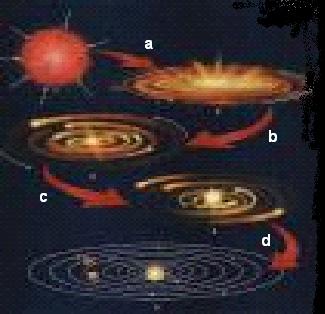 |
| b. Gradually, part of the nebula contracted into a large, tightly packed, spinning disk. The disk's centre was a hot and dense that nuclear fusion reactions began to occur, and the Sun was born. | |
| c. Eventually, the rest of the material in the disk cooled enough to clump into scattered solids. | |
| d. Finally, these clumps collided and combined to become the nine planets that make up the collar system today. | |
A cloud of material in this nebula, shown in Figure 2, was rotating slowly in space. A nearby star might have exploded, and the shock waves from this event could have caused the cloud to start contracting. As it contracted, the matter in the cloud was squeezed into less space. The cloud�s density became greater, and the attraction of gravity pulled more gas and dust toward the cloud centre. This caused the cloud to rotate faster, which in turn caused it to flatten into a disk with a dense centre.
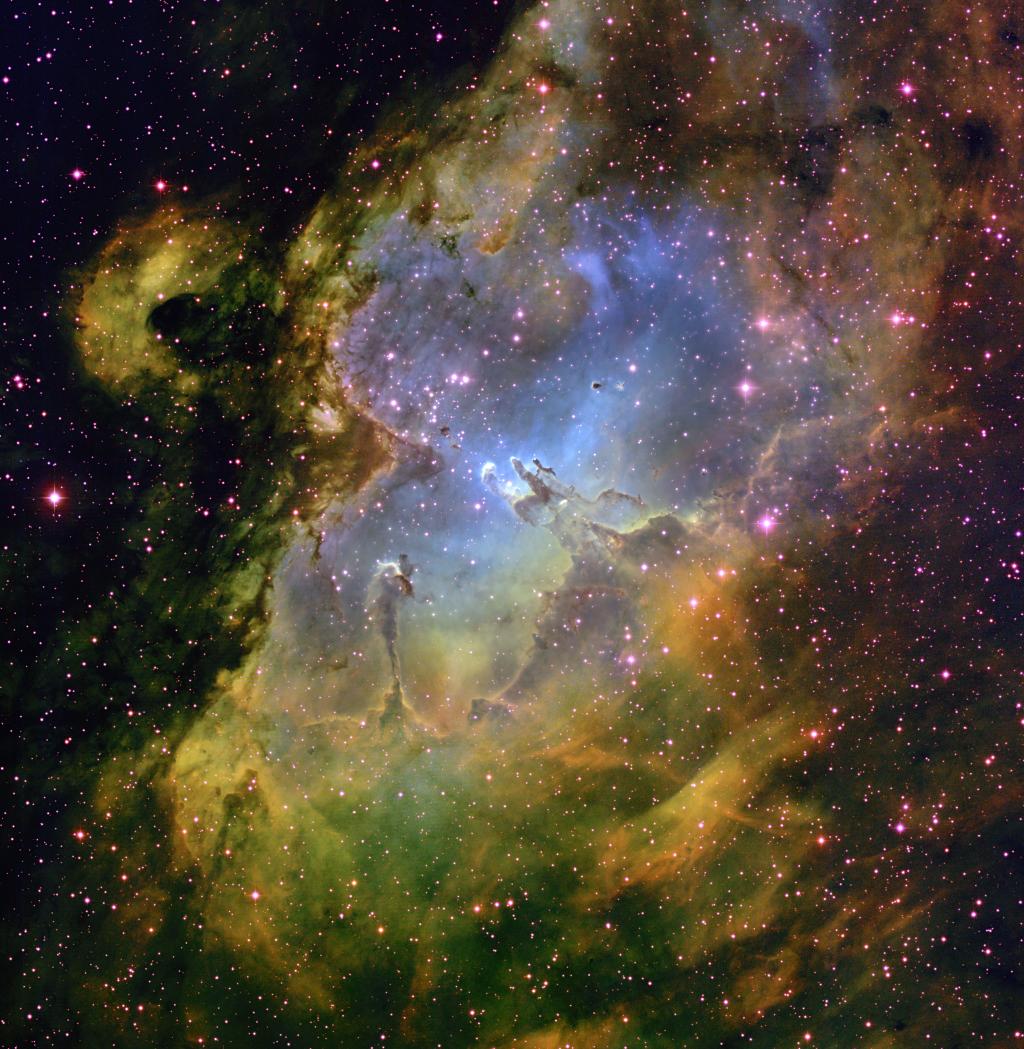 |
Figure 2:Nebula |
Not all of the nearby gas, ice, and dust were drawn into the core of the cloud. The matter that did not get pulled into the cloud�s centre collided and stuck together to form the planets and asteroids. Close to the Sun, the temperature was not hot, and the easily vaporized elements could not condense into solids. This is why lighter elements are scarcer in the planets farther out in the solar system.
The inner planets of the solar system � Mercury, Venus, Earth, and Mars � are small, rocky planets with iron cores. The outer planets are Jupiter, Saturn, Uranus, Neptune, and Pluto. Pluto, a small planet, is the only outer planet made mostly of lighter substances such as hydrogen, helium, methane, and ammonia.
As the cloud contracted, its temperature began to increase. Eventually, the temperature in the core of the cloud reached about 10 million degrees Celsius and nuclear fusion began. A star was born � the beginning of the Sun.
Nuclear fusion occurs when atoms with low mass, such as hydrogen, combine to form heavier elements, such as helium. The new, heavier element contains slightly less mass than the sum of the lighter atoms that formed it. The �lost� mass is converted into energy.
Planet Formation