Stimulus = sensation and perception.
Brain …………..response and cognition
Personal………..psychosocial and cultural
What is flavor? It is the sum total of all the sensations perceived whenever food or drinks are consumed. (Unilever Bestfoods, North America Food service, College of Flavor Knowledge).
What kind of a taster are you?
Place a double backed hole reinforcer on the tip of your tongue and looking
in a "close-up mirror" count the number of taste buds (papillae) you
see showing through the hole. You can also have someone else count for you.
# Humans have 3,000 to 5,000 taste buds on their tongues.
# Chickens have 24 taste buds
# Catfish have 37,000 taste buds
* Babies can taste only sweet and bitter. Never salt a baby's food.
A non taster will have about 9 taste buds
A supertaster will have 45 taste buds.
"Super tasters" make up 25% of the population…they perceive
extremely bitter
The "tasters" make up 50% of the population and perceive moderately
bitter
The "non tasters" make up the last 25% of the population and have
no taste (these people add too much salt to their food. Do you know someone
like that?
Asians had the most tasters and more women than men are tasters.
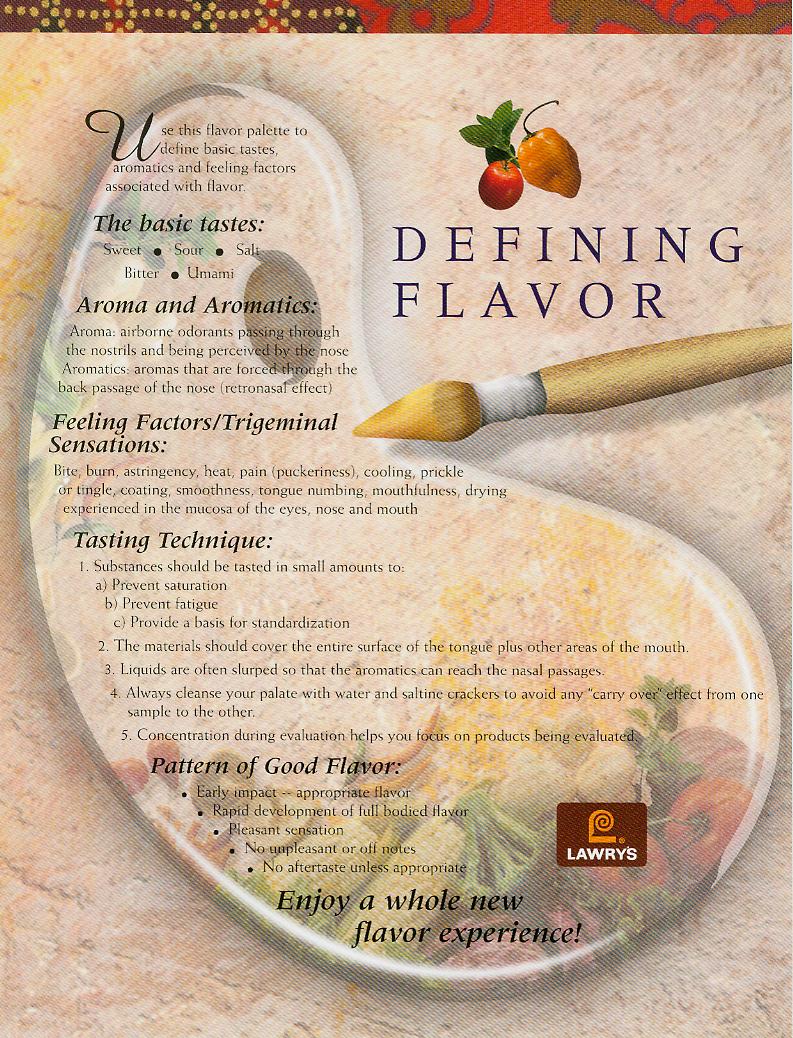
Most flavors come from AROMA (the nose)
Aroma is our most powerful memory sense ( Déjà vu) The molecules
that vaporize reach the nose and dissolve in the mucus.
Temperature determines how much you smell. The warmer a food is the more you
smell it. Adaptation to an odorant takes 1 to 2 minutes.
The untrained nose can recognize 2,000 different odors.
The trained nose can recognize over 10,000 different odors.
If you lose your sense of smell due to an accident or illness (stuffed up nose
also) you can not taste your food.
The human nose can detect parts per trillion in the atmosphere.
The human nose has about 10,000,000 olfactory cells. Dogs have BILLIONS!
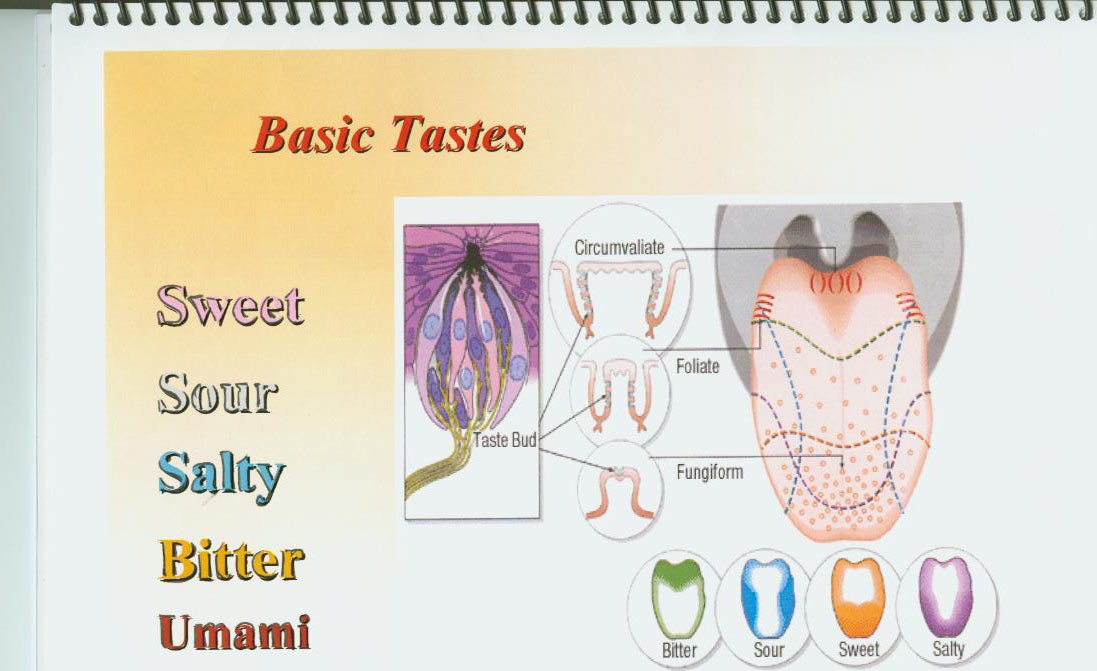
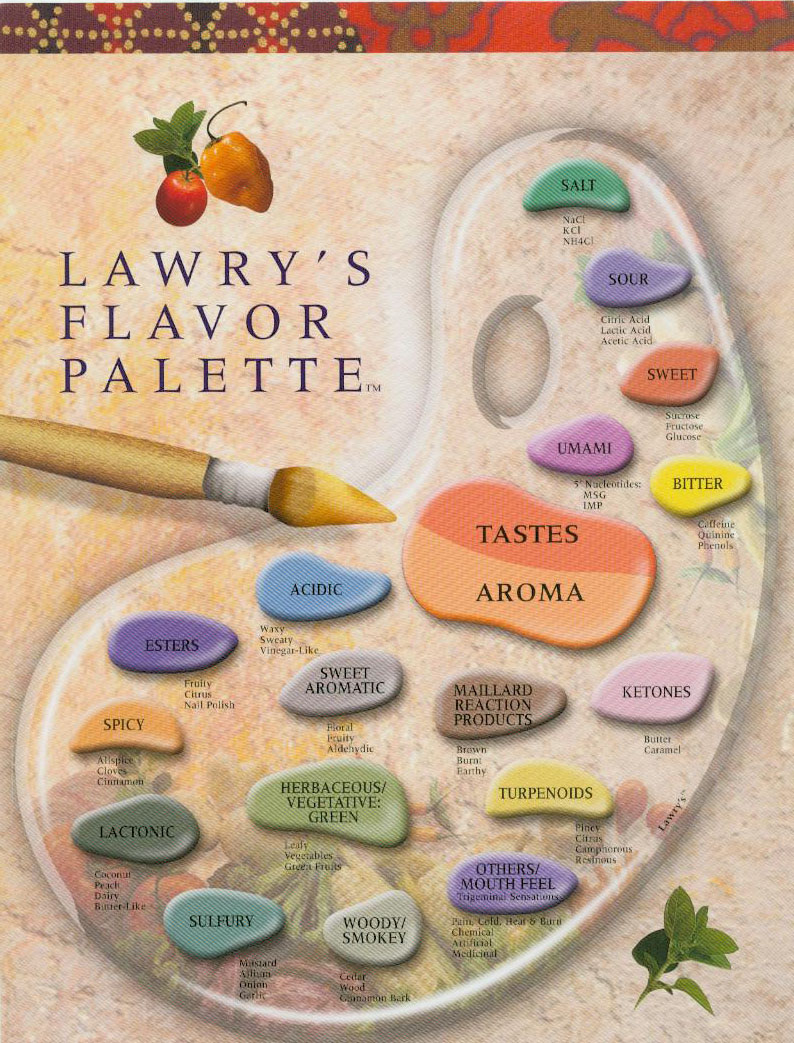
THERE ARE FIVE TASTE SENSATIONS
1. Sweet………..Sugar
2. Bitter…………Caffeine
3. Salty………….Salt
4. Sour………….Citric acid
5. Umami……….MSG, protein/meat (pronounced "oomaymee"
Taste Flash: it takes 100 milliseconds to recognize flavor.
Originally believed that sweet was only recognized at the tip of the tongue;
sour and salty were sound at the sides of the tongue and bitter was at the very
back of the tongue.
We now know that even though these regions are there, we can taste all flavors
all over the tongue.
SALIVA
1. helps with tasting food (blending it all over the mouth)
2. it dissolves food.
3. it cools down food.
4. it warms up food
5. keeps mouth lubricated.
6. keeps mouth clean
THE TONGUE
1. pushes food around
2. strongest muscle in the body
3. never gets tired
4. The taste buds that perceive bitter help us expel bad foods.
TASTING TECHNIQUE
" Take 3 short sniffs (aroma)
" Slurp if it's a liquid (aromatics)
" Take a specified amount
" Record basic tastes and other characteristic attributes.
" Feel for mouthfeeling factors such as bite, astringency, coating and
cooling.
" Note aftertastes
" Cleanse your palate.