


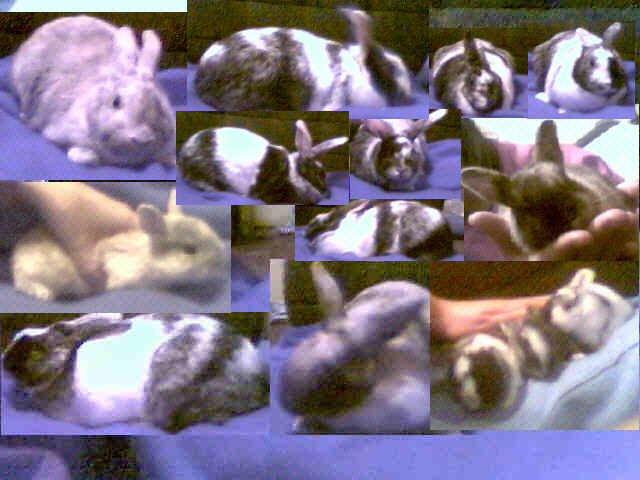
The Harlequin rabbit is a medium sized breed of rabbit, ranging from 6 to 9 pounds in weight. It is a realtively rare breed in the United States. The Harlequin originated in France, and has a commercial body type. This breed is distinctive for its unusually color pattern consisting of two colors found in semi-diagonal bands across the body, as well as a split face, split ears which alternate to the face, split shoulders which alternate to the face also, split-colored front legs which alternate to the split-colored hind legs. This of course would be the color markings of a perfect rabbit, which is a rare find indeed in this breed.
THE VARIETIES:
There are two varieties in the Harlequin breed, Magpie and Japanese. The Magpie variety consists of a white background with either Black, Blue (Gray), Chocolate (Brown), or Lilac (Dove gray...also said to have a pinkish tinge). The Japanese variety has a Pumpkin orange to fawn colored background with the same secondary colors as the Magpie variety (black, blue, chocolate and lilac).
HEALTH/PICKING OUT STOCK:
When you pick out your stock it is best to spend the extra money to get the better rabbits whose genetics will be passed on into your herd. I would recommend that you only buy pedigreed animals, as this will make the offspring more marketable. Check every animal for health problems... look for a runny nose (or wheezing!)or eyes. Check the teeth for correct alignment- the upper incisors should slightly overlap the bottom. Look at the cornea for white spots or clefts in the eyelid. Check the insides of the ears for buildup which may indicate ear mites. Check vent area for matted feces, infections (pus or exteme swelling), and in males a split penis (sometimes literally split into a fork, also if the hole is not on the tip but further down) or injured testicles. If possible look at some of the rabbit's droppings in the cage- do not buy animals with diareaha, very small, hard pellets (especially strung together with hair), or animals which clearly have not passed much (except if a cage has very recently been cleaned). Also check the rabbits for signs of skin problems such as scratching or bald patches. Thouroghly check for any injuries, especially infected ones.
TAKING BUNNY HOME- NECESSITIES
Okay, so you have decided to breed Harleys. What do you need for your new rabbits? Well, housing, to begin with. You can make your own hutch (don't use too much wood, your rabbits will chew it to pieces!)or buy premade welded wire(my personal preferance due to convienience). The wire for the sides and top should be no larger than 1 in by 2 in (NOTE: Chickenn wire is NOT recommended), and the floor wire should be no larger than 1 in by 1/2 in- no smaller than 1/2 in by 1/2 in. If your cages are not sheltered in a garage or barn the top, back, and sides should have either wood, a tarp, or some other form of wind and weather block- as well as to provide shade in summer (NEVER leave your rabbit in direct summer sun without available shade). Heat stroke can be a real killer... making sure your rabbit has water, good ventilation, a cooling system (for larger rabbitries), or a frosen 20oz. water bottle in its cage (smaller rabbitries) can save lives. I would recommend that the open wire fron face opposite of the prevailing winds in your area. For an individual rabbit (not an end-of-term pregnant doe) the minimum cage size I would recommend is a 2ft by 2ft be 18 in. tall hutch. For an end-of-term doe and later a doe with her litter I would recommend no smaller than 36in by 30 in by 18 tall. I would not recommend having a cage more than 30 inches in depth so that you can easily remove the rabbit when necessary. You will also need a feed dish... you can either buy a hopper (my preference due to time efficiency for feeding time) or a bowl. If you choose a bowl I would recommend a heavy crockery one or a metal one that can be fixed to the side of the cage to avoid tipping and wated feed. These materials also are gnaw-proof, important to consider with rabbits. The same types of bowl can be used for watering your rabbits, but it is nessecary to be careful that kits cannot crawl into them and drown. Another option is a waterbottle. For large operations an automatic watering system may be advisable, and can have a heating system for areas which experience freezing temperatures. Another necessity of the rabbitry is feed. You can usually buy quality rabbit food most cheaply in 40-50lb. bags at your local feed store. You can buy either 16% or 18% feed. While different breeders debate the importance of having both as opposed to just one (16% is usually cheaper), I use 16% on my bucks, dry (not pregnant or lactating) does, and any pet or non-show quality rabbits. I use 18% on pregnant and lactating does, juniors (growing bunnies up to 6 months of age) and I feed it to any rabbit I am going to show for a couple weeks prior to that show. Variety, just as in humans, is the spice of life. I highly recommend liberal amounts of timothy hay... it is great for their digestive tracts and sometimes they will eat it when they won't eat anything else. I do not recommend alfalfa hay due to its high calcium content. On days when the temperature is below freezing I add a tablespoon of oatmeal (not cooked) to the food dish right before the temperature drops for the night. Also, most rabbits welcome treats, but these must be rationds and added to the diet slowly. Try to avoid very sugary, salty, and fatty foods. Also avoid veggies with a high moisture low nutrition value, such as iceberg lettuce and celery. Some suggested treats are yogurt (good for gut flora and fauna), pineapple and papaya (both help break up hair), apples, carrots, parsley, dandelion, clover, banana, pumpkin, and oat grass. I also put my rabbits in a pen on the lawn (NOT CHEMICAL TREATED LAWNS!) when it is not covered in snow. Make sure your rabbits have fresh water at all times. Finally, you will want to have nestboxes (the ones I use are 17 in deep by approx. 6 in wide by approx. 6 in tall, and bedding to line the boxes with when your does are expecting.
BREEDING YOU RABBITS:
Most breeders start with a trio ove the variety they would like to breed consisting of one buck (male) and 2 does (females). Medium breed rabbits usually hit puberty between 4 1/2 and 6 months, although I would not recommend breeding before 5 months. when you are ready to breed your rabbits, always take the doe to the buck's cage. Keep an eye on them to make sure the job gets done 9the doe will lift her tail for the buck, and when he is finished he will most likely grunt and fall off to the back or side. Sometimes the doe is not receptive to the buck... in this case put her in a cage next to his and then try to breed them again in a few days (breeding is also less successful in winter). After the doe has been successfully bred twice by the buck, remove her from his cage. To improve chances of pregnancy and litter number, breed her to the buck again in a few hours. At that point mark the date on your calendar 28 days from the day of breeding. This is when you will put the nest box in the cage with some litter (hay or shavings... or both!) in the bottom. Give her fresh hay every day, perhaps twice a day... she will make a nest in the box with it, and will pull fur from her belly to line the box as well. When you see this behavioe the babies will most likely be born shortly. Do not bother the doe while giving birth and keep her surroundings quiet and stress-free to reduce the chances of her eating the babies. Most litters are born between the 30th and 32nd day, and are usually born at night, so make sure you check the box a couple times per day. If the doe has not yet kindled (given birth) keep the box in the cage until the 36th day. At that point she is most likely not pregnant... but if you have palpated (felt for babies- not recommended if you don't know how!) her belly and you are quite convinced she IS pregnant, TAKE HER TO A VET! When the kits (babies) are born they will be blind and hairless. Check to remove any dead babies or placental matter and excessively wet bedding. Does sometimes lose their first litters due to inexperience... they might not feed them (in which case you can attempt to foster them to another doe with babies born withing 3 days of those to be fostered... rub the foster doe's bedding on the foster kits and then put vanilla extract on her nose, the foster kits and her own kits... by the time the vanilla wears off the foster babies should smell like the foster doe. Sometimes the does will aslo eat their babies... chances of this can be reduced by making sure the doe has enough water and is not frightened during birth. If the first litter is lost I always give the doe a second chance- however, if the second litter is also lost I consider culling the doe from my herd, as bad mothering can be hereditary. When the babies are born cull for any that look to sickly to make it of have misaligned teeth (often hereditary). As they get older you can cull for color and marking pattern. By the time they are 6 months old you will be able to cull those remaining for body type. Cull does not nessecarily mean kill- I only kill those animals that are clearly suffering. Cull to me simply means to seperate from my breeding herd. I sell my culls as pets, to pet shops, and on rare occasions to people looking for meat rabbits. The Harlequin rabbit is an excellent meat breed, but I personally have trouble eating mine as it is hard for me to eat sombunny with a name. I give my mama rabbits free feed until the babies are weaned (6 weeks) before working them back down to regular rations (an amount of food about the size of the rabbit's head, give or take a bit). The kits get freefeed until they are 5-6 months old.
ORGANIZATIONS: I highly recommend joining both the American Rabbit Breeders Association and the American Harlequin Club.
MY STOCK:
I am currently breeding for Black Magpies, Blue Magpies, and Black Japanese... please contact me (Monica) at [email protected] for questions, current stock availability and prices. All of my stock are pedigreed.