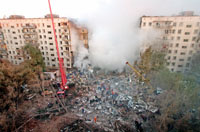
Sept. 9, 1999.
(AP Photo/Tatiana Makeyeva )

|
| Bombed apartment
building, Moscow, Sept. 9, 1999. (AP Photo/Tatiana Makeyeva ) |
The Chechens are a fiercely independent, largely Muslim ethnic group that has lived for centuries in the mountainous Caucasus region. During World War II, the Soviet dictator Josef Stalin accused the Chechens of cooperating with the Nazis and forcibly deported the entire population to the Central Asian republic of Kazakhstan. Tens of thousands of Chechens died; only after Stalin’s death in 1953 were the survivors allowed to return home. Since the collapse of the Soviet Union in 1991, Chechen separatists have sought independence from Moscow. Two costly wars have devastated Chechnya, left tens of thousands of Chechens and Russians dead or wounded, and displaced hundreds of thousands of civilians.
What kinds of terrorist
acts have Chechen groups committed?
Besides the apartment bombings, high-profile incidents include:
Is there a connection
between Chechen terrorist groups and al-Qaeda?
Evidence of a direct Chechen connection to Osama bin Laden’s al-Qaeda
terrorist network remains limited; it focuses largely on the reported ties
between bin Laden and the Chechen warlord Khattab, a Jordanian-born fighter who
apparently first met bin Laden while both men were fighting the 1979-89 Soviet
occupation of Afghanistan. The U.S. ambassador to Russia, Alexander Vershbow,
said shortly after September 11, “We have long recognized that Osama bin Laden
and other international networks have been fueling the flames in Chechnya,
including the involvement of foreign commanders like Khattab.” In April 2002,
Russian officials said Khattab had been killed in Chechnya.
Beyond the Khattab connection, the Wall Street Journal has reported that Zacarias Moussaoui, whom U.S. authorities have charged with being the “20th hijacker” in the September 11 attacks, was formerly “a recruiter for al-Qaeda-backed rebels in Chechnya.” Several bin Laden associates also reportedly provided financing and training for Chechen fighters during the 1994-96 war. Moreover, the Taliban regime in Afghanistan was one of the only governments to recognize Chechen independence, and some Chechen militants reportedly fought alongside al-Qaeda and Taliban forces against the U.S.-backed Northern Alliance in late 2001.
Are there many foreign
extremists in Chechnya?
No. Most experts put the number of foreign militants in Chechnya at
approximately 200, out of several thousand fighters.
Who supports
Chechnya-based terrorist groups?
Islamist charities such as the Global Relief Foundation—which U.S.
officials accuse of being a conduit for terrorist financing—have been active
in Chechnya and are reportedly a major source of financial support for Chechen
militants. The United States is working with Russia and other countries to
staunch the flow of terrorist-related financing, according to Ambassador
Vershbow.