| HOME | LINKS | SPONSERED LINKS | |||
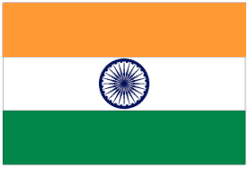
The National Flag of IndiaCourtesy: www.indianchile.comTHE NATIONAL FLAG OF INDIA is in tricolour of deep saffron(Kesari) at the top, white in the middle and dark green at the bottom in equal propotions.The flag is a horizontal tricolour in equal proportion of deep saffron on the top, white in the middle and dark green at the bottom. The ratio of the width to the length of the flag is two is to three. In the centre of the white band, there is a wheel in navy blue to indicate the Dharma Chakra, the wheel of law in the Sarnath Lion Capital. Its diameter approximates the width of the white band and it has 24 spokes. The saffron stands for courage, sacrifice and the spirit of renunciation; the white, for purity and truth; the green for faith and fertility. The design of the National Flag was adopted by India's constituent assembly on 22nd july, 1947. It's use and display are regulated by a code. The Indian flag symbolizes freedom. The late Prime Minister Pandit Nehru called it a flag not only of freedom for ourselves, but a symbol of freedom for all people.
Some interesting flag facts Our national flag was hoisted on Mt. Everest, the highest peak in the world, on May 29 1953, along with the Union Jack and the Nepalese National flag. In 1971, the Indian flag, went into space on board Apollo-15. It flew into space as a medallion on the spacesuit worn by Cosmonaut Wing Commander Rakesh Sharma, during the Indo-Soviet joint space flight in April 1984. On January 9 1982, the first Indian Antarctica Expedition planted the first Indian flag over Dakshin Gangotri. It was hoisted for the first time on the South Pole on January 17, 1989, by Colonel J.K. Bajaj. On April 21, 1996, at 0352 hrs (IST), the first Indian and perhaps the first in Asia, Sqdn. Ldr. Sanjay Thapar, holder of many national and international records in parajumping and skydiving, jumped from an altitude of 10,000 ft from an MI - 8 helicopter and hoisted the Indian tricolour on the North Pole. On Sept 28, 1985, the Tiranga set out on an around the world sailing expedition on board Trishna under Colonel T.P.S. Chowdhry and successfully returned home on January 10, 1987, cruising the high seas of the world and covering over 30,000 nautical miles in 470 days.
|