| Lab 2 of 2LB|http://www.geocities.com/chcyang| Lab 4 of 2LB|
| Lab 3 of 40B|Main Menu Page| Lab 5 of 40B|
Lab 3 of 2LB
Lab 4 of 40B
Pressure-Flow Relationships
Courtesy of Yeuh-feng Chiang
Bernoulli’s equation
P + ½ r v2 + r gz = constant
h
= 0.00890 poise (dyne-sec/cm2) at 25oCThe viscosity of a fluid is very sensitive to temperature. For water, the viscosity changes about 2.5% per oC. (it gets less viscous at higher temperature)
Poiseuille flow.
The discharge rate of fluid from the end of the tube is
Q = D V/D t = (p r2)v
The discharge rate through the capillary tube is related to the pressure difference at the two ends by
|
Q = (p r4/8h L)(P1-P2) |
(Poiseuille Law) |
|
P = P0 + r gz |
(P0 = atmospheric pressure) |
|
Q = (p r4/8h L)( P0 + r gz - P0 ) = (p r4r g/8h L)z | |
| Q = D V/D t = -A(dz/dt) | (minus sign is due to decreasing z) |
dz/z = -(p r4r g /8h LA)dt | |
| z = z0e-(p r4r g /8h LA)t | |
Part 1. Calibration
Use the MPLI software from the main menu.
Use the arrow keys and the space-bar to turn off inputs B and C.
Let the computer guide you through.
| Unit | COLD WATER | |
| The initial height, z1 | ||
| Pressure at the initial height, P1 | 0 | |
| The final height, z2 | ||
| Dz = |z2 - z1| | ||
| density of water, r | ||
| Pressure at the final height, P2 = rgDz |
Calibrate Input
| COLD WATER | |
| Calibrated by: | |
| Date calibrated: | |
| Input Label: | |
| Input unit: | |
| Reading #1 in Volts: | |
| Entry #1: | |
| Reading #2 in Volts: | |
| Entry #2: | |
| Calculate slope: | |
Part 2. Pressure versus time data
Set the time length as 2.5 minutes (use 02:30 since is MM:SS).
Select 150 readings (one per second).
Part 3. Data Analysis – Room Temp Flow
Exit MPLI and start Graphical Analysis.
The data was stored in the MPLI directory, so you need to
C:\APPLCTNS\MPLI
And use the arrow keys to move to the file you want.
Use this slope to estimate the viscosity.
We should expect
|
ln P(t) - ln P(0) = (p r4r g/8h LA) t | Y = MX + B |
So fitting a slope we get
| M = (p r4r g)/(8h LA) | h = - [p r4r g/8(slope)LA] |
|
Using A = p d2/4 for the column |
h = - [r4r g/2(slope)Ld2] |
STOP HERE TO MEASURE the capillary length L and the inner diameter of the column . The diameter of the capillary itself is hard to measure, but you can use the value 3mm (r = 0.15 cm).
Calculate the value of h
Capillary length, L = __________ cm |
| Inner diameter of the column, d = ___________ cm |
| Inner radius of the capillary, r = 0.15 cm |
|
Temperature, T, (oC) |
Slope of "ln P(t) vs time" |
h measured, unit: ( ) |
h CRC data table, unit: ( ) |
|
|
Ice water | ||||
|
Cold water | ||||
|
Hot water |
Question 1: Does water become more or less viscous at high temperature?
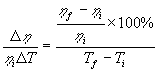
Question 2: What is the fractional change of viscosity per oC?
Additional Question: Please write down a simple conclusion of the whole Lab 4.
| Lab 2 of 2LB|Main Menu Page| Lab 4 of 2LB|
| Lab 3 of 40B|Main Menu Page| Lab 5 of 40B|
