 .
.|http://www.geocities.com/chcyang| Lab 2 of 2LC|
| Lab 1 of 40B|Main Menu Page| Lab 3 of 40B|
Lab 1 of 2LC
Lab 2 of 40B
Harmonic Oscillation
Courtesy of Peng Wan
Notes, Cautions, and Basic Measurement,
It is better to use that gravitational constant, g= 9.80´102(cm/sec2).
We use two unit systems in physics, SI unit system, or so-called MKS system, and CGS unit system.
"MKS" means "meter", "kilogram", and "second." Hence, the SI unit of force is exactly kg-m/sec2. We call it "Newton".
"CGS" means "cm", "gram", and "second." Therefore, the CGS unit of force would have to be g-cm/sec2. People use to call it "dyne".
|
OBJECT |
Mass, unit:( ) |
||
|
MSpring |
|||
|
mPlastic Plate |
|||
|
mHanger |
|||
|
Every Metal Mass |
|||
Procedure - Hooke's Law,
Choose at least 5 rows in the following data table. And mark those rows.
|
Added Mass, including the hanger, m, unit: ( ) |
Added Force, F=mg, unit: ( ) |
Position, xf, unit: ( ) |
Displacement, Dx = xf - xi, unit: ( ) |
|
| C |
0.0 |
0.0 | xi= | 0.0 |
| C | mHanger= | |||
|
350 |
Procedure -Simple Harmonic Oscillator,
.|
Added Mass, including the hanger and plastic plate, m, unit: ( ) |
Time Period, T with SDOM, unit: ( ) |
||
| C | mPlastic Plate + mHanger= | ± | |
| ± | |||
| ± | |||
| ± | |||
| ± | |||
By filling out the following data table, see how well you have measured!
Print out GRAPH "m versus T2."
For a massless spring, T = . We will have m= (k/4p
2)(T2) + 0, as Y= MX + B. Treat your spring as a massless one and fill out the following table.
For a massive spring, T = 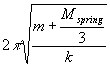 . We will have m = (k/4p
2)(T2) -
. We will have m = (k/4p
2)(T2) -  , as Y= MX + B. Treat your spring as a massive one then fill out the folloing data table.
| Graph "m versus T2" |
Slope, unit: ( ) |
a massless spring |
a massive spring |
Regression |
|
Theoretical |
k/(4p 2) = |
0 | -= |
1 |
|
Measured |
||||
|
%error |
% | N.A. | % | % |
Print out GRAPH " versus T2."
Now, based on your GRAPH " versus T2",
(0.5) What is the unit of the y-intercept, B, on that graph?
For a massless spring, we have: T = .
For a massive spring, we have: T = = [1 + ()/m]1/2.
(0.5) Now, assuming that the added mass, m, is equal to . i.e. m @, in order to calculate the time period, T, which formula should we apply? why?
(0.5) Now, assuming that the added mass, m, is much smaller than , in order to calculate the time period, T, which formula should we apply? why?
|Main Menu Page| Lab 2 of 2LC|
| Lab 1 of 40B|Main Menu Page| Lab 3 of 40B|
