|
Step |
D, Diameter, Unit: ( ) |
r, Radius Unit: ( ) |
|
smallest |
|
|
|
Middle |
|
|
|
largest |
|
|
Procedure 6: Because of no time, we have no print-out but one and only one Graph regarding "Velocity vs. Time" in Procedure 6 on page 51. And you have to indicate “m”, the hanging masses and “r”, the radius of step pulley associated with your graph.
After plotting the original Graph "Velocity vs. Time" on screen, we keep only 5 points, from the 2nd to the 6th. Go back to data table and see which lines you are going to delete. Select ”Delete Data” to delete these lines. Then plot the five points. You will see the new slope is greater than the original one because friction is smaller at lower angular speed. Record the new slope as the measured angular acceleration, a.
Procedure 7: Refer to Set 1 on page 51. Use the medium step. Remember that the hanger itself counts roughly 5 grams.
The "r" is the radius of your step pulley; "a" is the angular acceleration.
g = 9.80 ´ 102 cm/sec2 or 9.80 m/sec2
(I+mr2 )measured = mgr/a; Imeasured = (I+mr2 )measured - mr2
Here, we are changing the acting force to find the experimental IPlatter
|
m
Unit:( ) |
r Unit:( ) |
a Unit:( ) |
mgr Unit:( ) |
mr2 Unit:( ) |
(I+mr2 )meas Unit:( ) |
Imeasured Unit:( ) |
|
60 |
2 |
|
|
|
|
|
|
80 |
2 |
|
|
|
|
|
| 100 | 2 |
|
|
|
|
|
|
Average |
|
|
||||
Question 7-1 on page 51: How big is the "mr2"? Is it negligible? (1 Point)
Requirement: All comparison should be quantitative and better in percentage. Or you can use the concept of "Significant Figures" to answer this question. Also, no matter how you answer this question, use only 2 sentences to finish it. Your calculation stands 0.5 points. Your final answer stands 0.5 points.
Question 7-2 on page 51: Print out Graph "mgr vs. a" (0.5 points) and find the slope [M] of Graph "mgr vs. a" and tell me its physical meaning (0.5 points).
Procedure 8, Refer to Set 2, on page 51. Use all 3 different steps. Fix the acting force to 9.80´ 104 dynes.
Here we are changing the acting radius on the platter to find the experimental IPlatter.
|
m
Unit:( ) |
r Unit:( ) |
a Unit:( ) |
mgr Unit:( ) |
mr2 Unit:( ) |
(I+mr2 )meas Unit:( ) |
Imeasured Unit:( ) |
|
100 |
||||||
|
100 |
2 |
|
|
|
||
|
100 |
|
|
|
|
|
Remark:
We use two unit systems in physics, SI unit system, or so-called MKS system, and CGS unit system.
“MKS” means “meter”, “kilogram”, and “second.” Hence, the SI unit of force is exactly kg-m/sec2. We call it “Newton.”
“CGS” means “cm”, “gram”, and “second.” Therefore, the CGS unit of force would have to be g-cm/sec2. People use to call it “dyne.”
Part II, Moments of Inertial: (Total 4 Points)
Procedure 1: Use the medium step. Fix the acting force to 9.80´ 104 dynes.
| Object |
m Unit:( ) |
r Unit:( ) |
a Unit:( ) |
mgr Unit:( ) |
mr2 Unit:( ) |
(I+mr2)meas Unit:( ) |
Imeasured Unit:( ) |
|
IPlatter |
100 | 2 |
|
|
|
|
|
|
IPlatter + IRing |
100 | 2 |
|
|
|||
|
IPlatter + IBar |
100 | 2 |
While measuring “IPlatter + IBar”, you may tape the metal bar on your platter to prevent spinning. However, please remove all scotch tapes after you are done, or you lose 1 point for carelessness.
Procedure 4: Calculate the measured Iring (0.5 Points) and Ibar (0.5 Points).
Procedure 5: Here, "R" means "radius"
| Object |
Mass, Unit:( ) |
Dimensions, Unit:( ) |
|
|
Platter |
R = |
||
|
Ring |
R1= |
R2= |
|
|
Bar |
A = |
B = |
|
Procedure 6 and 7:
| Object |
ITheoretical Unit:( ) |
IMeasured Unit:( ) |
%error |
|
Thin Ring |
|
% | |
|
Thick Ring |
|
% | |
|
Bar |
|
% |

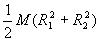 =
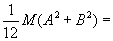
=
Procedure 8: Answer these three questions in procedure 8. (1 Point)
Requirement: All comparison must be quantitative and in percentage. All your judgement should have a reason based on a theoretical equation or a quantitative experimental calculation. You may incorporate your answers among three questions. Finally, use only 4 sentences to finish them.
