| Lab 6 of 2LC| http://www.geocities.com/chcyang| Lab 8 of 2LC|
Lab 7 of PHYS 2C LAB
Physical Optics
Courtesy of Holiday
|
Typical Wavelength of colors |
|
|
Color |
Wavelength (nm) |
|
Violet |
410 |
|
Blue |
470 |
|
Green |
550 |
|
Yellow |
580 |
|
Orange |
610 |
|
red |
660 |
The Information on the Diffraction Plate from the PASCO guide.
|
Pattern |
No. Slits |
Slit Width (mm) |
Slit Spacing center to center (mm) |
|
A |
1 |
0.04 |
N. A. |
|
B |
1 |
0.08 |
N. A. |
|
C |
1 |
0.16 |
N. A. |
|
D |
2 |
0.04 |
0.125 |
|
E |
2 |
0.04 |
0.250 |
|
F |
2 |
0.08 |
0.250 |
|
G |
10 |
0.06 |
0.250 |
|
H |
2 (crossed) |
0.04 |
N. A. |
|
I |
225 Random Circular Apertures |
0.06 (diameter) |
N. A. |
|
J |
15*15 Array of Circular Apertures |
0.06 (diameter) |
N. A. |
Lab 7,
Physical Optics
Section 1,
Wavelength measurement with diffraction grating:
Refer to Equation (12) on page 43.
Show me your work to obtain the grating spacing "d".
Skip the work of 1(b)(iii).
1(b)(i)
L from the grating to the diffraction scale =
The grating spacing "d" =
X at the violet end of the spectrum =
l violet, Your wavelength for the violet end of spectrum =
The percent error of your l violet =
Calculation:
1(b)(ii)
L from the grating to the diffraction scale =
The grating spacing "d" =
X at the red end of the spectrum =
l red, Your wavelength for the red end of spectrum =
The percent error of your l red =
Calculation:
1(c)
Skip the work with green and blue filters and USE RED filter only.
1, L from the grating to the diffraction scale =
2, The grating spacing "d" =
|
Observation on your red spectrum, Filter Color: Red |
|||
|
X, Position |
The closest position to the center of your scale |
The farthest position to the center of your scale |
The Brightest position within your red spectrum |
|
Unit: ( ) |
|||
|
l red, Wavelength |
Range of Wavelengths FROM |
Range of Wavelengths TO |
Brightest Wavelength (Or Centered Wavelength) |
|
Unit: ( ) |
|||
Lab 7
Section 2,
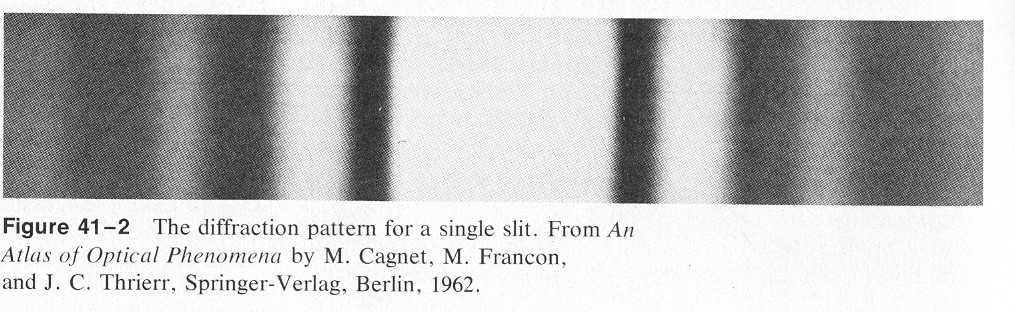
Single slit diffraction pattern:
Use Pattern "A."
Show me your work to determine your slit width, "a".
Refer to Equation (3) on page 40.
l red, Your wavelength of red light =
L from the pattern plate to the diffraction scale =
Xm1 of the first diffraction "minima" =
Xm2 of the second diffraction "minima" =
The average of your slit width, "a" =
The percent error of your slit width, "a" =
Calculation of "a":
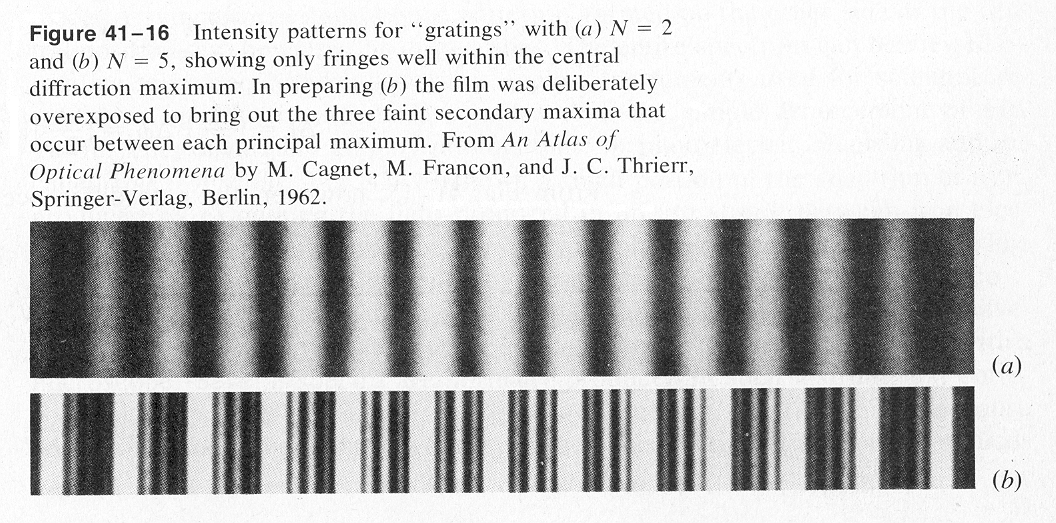
Lab 7
Section 3,
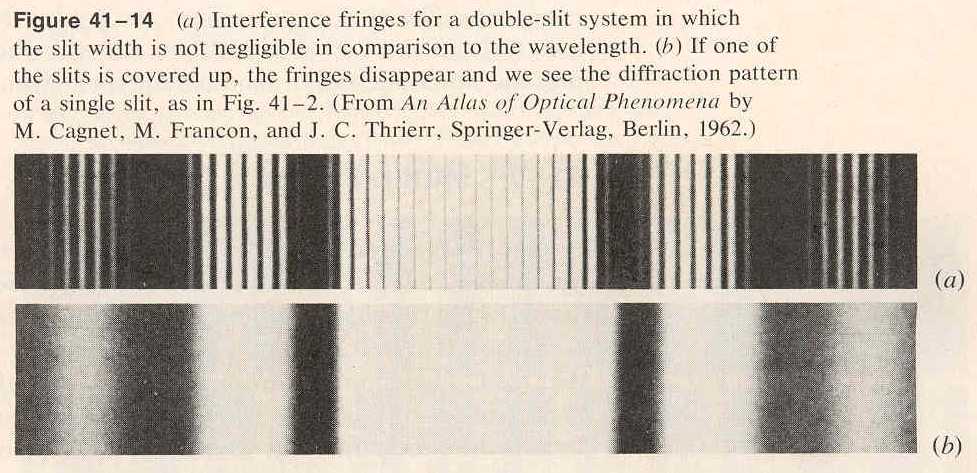
Two slit interference and diffraction:
Skip the work of 3(c)
Use Pattern "D" to do 3(a)-(b)
Show me your work to determine your slit spacing, "d" and your slit width, "a".
Refer to Equations (9) and (10) on page 42.
l red, Your wavelength of red light =
L from the pattern plate to the diffraction scale =
Xm of the first diffraction "minima" =
The number of interference fringes within the first diffraction "minima" =
XM of the interference "maxima" =
The percent error of your slit spacing, "d" =
The percent error of your slit width, "a" =
Calculation of "a" and "d":
Lab 7
Section 4,
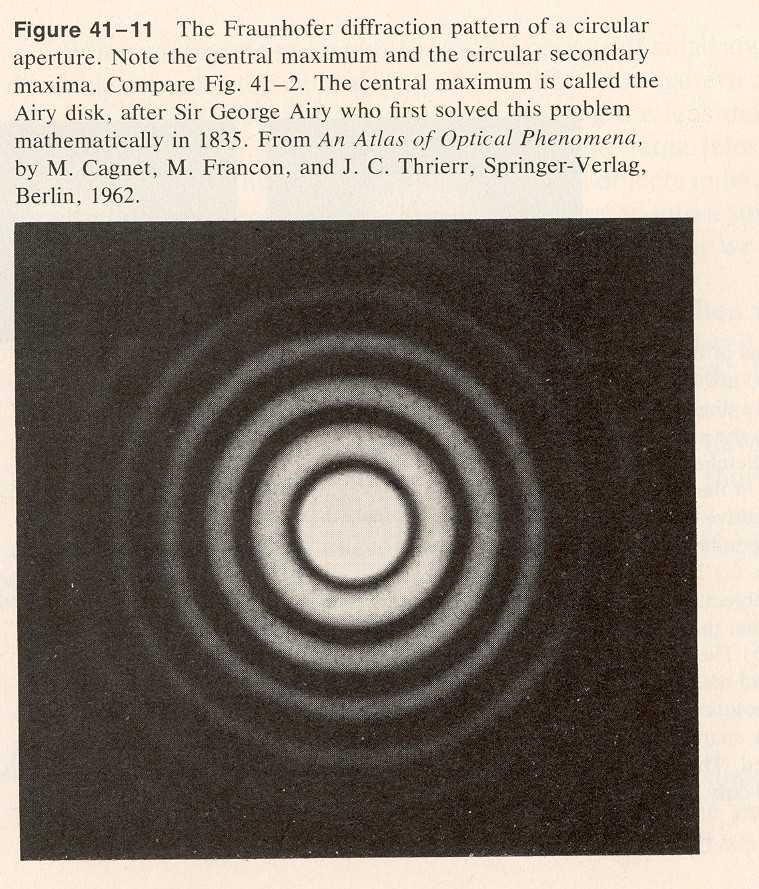
General Diffraction:
Skip the work of 4(d) and 4(e) and do 4(c) only.
4(c)
Use Pattern "I" to do 4(c)
Show me your work to calculate the hole diameter.
Refer to Equation (13) on page 46.
l red, Your wavelength of red light =
L from the pattern plate to the diffraction scale =
Xm of the first diffraction "minima" =
The percent error of your hole diameter, "D" =
Calculation:
Conclusion:
What is the reason that we use red light in Section 2, 3, and 4?
Or, why don't we use blue or green light to be our probe beam in Section 2, 3, and 4?
(This conclusion will cost you 1 point!)
Hint: (You have 5 options and choose one only.)
Option 1, (Physics)
Treat your incident beam as a tiny machine gun. Then, you may let the wavelength of red light be the size of your bullet, 650 nm. Therefore, if you reduce the size of your incident bullet to 470 nm, what will happen?
Remember that 470 nm is the wavelength of blue light.
Write down your theory and make your conclusion.
Option 2, (Apparatus)
For example, in Section 2, using the formula  , what is the percent difference between the slit width, "a", and the wavelength of red light?
And, what is the percent difference between the slit width, "a", and the wavelength of blue or green in Section 2?
It does NOT concern the concept of errors.
Compare your results and make your conclusion.
Option 3, (Mathematics)
For example, using another formula (D sin q
= 1.22l
) where sin , in Section 4(c), what will X do if you change the incident beam from red to blue?
In Section 4(c), X is the position of the first diffraction "minima".
Finish your prediction and make your conclusion.
Option 4, (Experiments)
For example, use your green or blue filters to repeat the work of Section 3.
Record your observation and make your conclusion.
Option 5, (Creativeness)
Write down your conclusion in your own word and make it reasonable.
EXAMPLE Conclusion from Option 2: (for your reference only!)
From the given wave lengths of red, green, and blue light as 660 nm, 550 nm, and 470 nm,
and the slit width of pattern A as 0.04 mm, applying the formula
,
we have three percent differences between the visible light wave length and the slit width
as 98.35%, 98.625%, 98.825% with respect to red, green, and blue,
if we disregard the significant figures.
Obviously, there is some interaction between the color light wave and the single slit,
which mechanism we do not and need not know.
Naturally, the closer between the wave length and the slit width,
the more intensivitive interaction between them, therefore,
the more observable phenomena we will have.
For the sake of convenience, we, of course, will choose red light with the smallest difference,
98.35%, referring to the single slit width 0.04 mm, of Pattern A,
which should be able to create the most dramatic pitcure for us.
| Lab 6 of 2LC| Main Menu Page| Lab 8 of 2LC|
