
November 12, 2000 the History of the Lemp Mansion
The Brewery
Home The Mansion The Family The Mansion Today
 |
|
|
|
|
|
|
History of Lemp Brewery
The Lemp Brewery of St. Louis began in 1836, when John Adam Lemp moved
from Germany to the United States. In
Germany he had been employed as a brewer, and in 1838 Lemp started to brew bee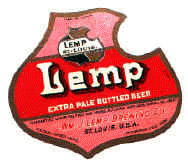 r
for his mercantile store in downtown St. Louis.
Lemp’s lager beer, arguably the first lager brewed in the U.S., became
so popular that Lemp opened a brewery on Second Street.
r
for his mercantile store in downtown St. Louis.
Lemp’s lager beer, arguably the first lager brewed in the U.S., became
so popular that Lemp opened a brewery on Second Street.
The Second Street brewery, known as Lemp’s Western Brewery, continued
to grow after its founding in 1840. Just
a few years later, in 1845, Lemp’s beer became so popular that more brewing
space was needed. Mr. Lemp bought
the land above Cherokee Cave, to the south of the city, and used the caves as
space for the storage vats. The
Lemp Brewery which stands today at Cherokee and Thirteenth was actually Lemp’s
second brewery.
The Cherokee Street brewery continued to expand in the next few decades. In 1864 William J. Lemp, John Lemp’s son, began construction of a brewing complex above the caves. By the 1870s this brewery was the largest in St. Louis, beating out Anheuser & Company’s, and was the 19th largest in the nation. The brewing complex continued construction until the grain elevators were added in 1911. It would cover a full five city blocks. Steadily expanding, the William J. Lemp Brewing Company would become the third largest in the nation by 1904.
Innovation
John Lemp was the first brewer to make lager beer in the United States. His children would continue this innovative spirit. The Lemp Brewery would be the first to ship its beer from coast-to-coast by the mid 1890s. It used refrigerated railcars to keep the beer fresh. The Brewery was also the first to have its own national shipping plan, and used its own railroad company to transport its beer. Before the end of the century, Lemp’s beer were also being commercially shipped overseas, available in such exotic locations as Japan, Hong Kong, South America, and Europe.
Downfall
The Brewery’s prosperity would not last, however.
In 1904, the company’s leader, William J. Lemp, Sr., committed suicide.
In 1906, nine competing St. Louis breweries merged to form the
Independent Breweries Company. This
left Lemp as one of only three remaining independent breweries in St. Louis.
The most damage was caused by the First World War, which cut the beer
market, and the Prohibition movement.
The growing movement against alcohol prompted the Lemp Brewery to make a
non-alcoholic beer called Cerva. However,
sales were not high enough to cover the operating costs of the brewery.
In 1919, at the start of Prohibition, the brewery was shut down, without
notice.
Three years later, in 1922, the International Shoe Company bought the Cherokee Street brewery for around $600,000, which was less than 10% of the brewery’s value before Prohibition. International Shoe used the complex as a warehouse for the next 70 years. In 1992, International Shoe sold the Lemp complex to L. B. Redevelopment for around $200,000, an all-time low.
The redevelopment company which bought the brewery has proposed plans that would give new life to the complex. Some plans have the brewery becoming a hotel and event center. Others have the brewery leased-out to small businesses, like the Cherokee-Lemp Studio which now operates out of the complex. Only time will tell what happens to the world famous Lemp Brewery.