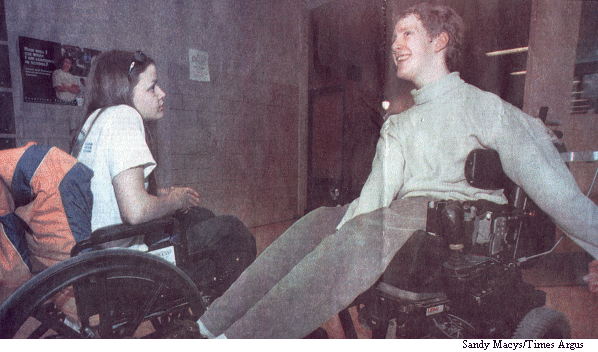
MONTPELIER -- Four times in an afternoon this week Tania Richards skidded into a snow bank, unable to control thin bald tires. Tania was in a wheelchair. She was struggling to negotiate pocked, and mushy sidewalks of Montpelier. For most pedestrians, winter sidewalks are a nuisance, but nothing boots can't solve. They brought Tania to tears. She was one of 50 non-disabled high school seniors who voluntarily spent a full day in a wheelchair this week to learn what it's like to be unable to walk. The experiment was the brainchild of the students' sociology teacher, Bonnie Duke, whose own inspiration was a student with cerebral palsy. The students learned what it's like not to be able to see over the counter at a coffee shop, or to try to reach a can of soup on the top shelf of the grocery store. They discovered that simple stairs can be insurmountable barriers. More than the frustrations of physical limitations, the students said they were surprised by how people reacted to their apparent infirmities. The sight of a person with a disability elicits two very different responses, they said. "They'll get out of your way. They won't look at you," or they'll be "hyper-sensitive," solicitous, said Kate Clemente as she sat in a wheelchair in Capitol Grounds coffee shop. Numerous students reported the same thing in "debriefing" sessions in Duke's classroom at Montpelier High School. The students sat in a semicircle, now freed from their wheelchairs, and recounted how strangers often helped them, or smiled, or chatted, while an equal number seemed uncomfortable. "I was so surprised about how no one would look at me when I was in a store, no one would make eye contact with me. It was like they were self-conscious about making eye contact," Rachel Zunder said in a report about her experiences. This was the first time Duke tried the wheelchair project, but she's been getting students out of the classroom for years to expand their horizons. Every year she takes students to a maximum security prison in New York, where they sit in a room with 100 hardened criminals and ask them questions about their lives. Duke seems to have a passion for people on the fringe of society, whether murderers or students who pierce their eyebrows. She preaches inclusiveness, seeing people for who they are, not what they look like. She notes that high school students who turn rifles on fellow students are often social pariahs. Ben Chater is one of Duke's students. He spends most of every day in a wheelchair, and it's not an experiment. He has cerebral palsy. Getting around town isn't his only challenge. Speaking a single sentence is a thrashing struggle that brings beads of sweat to his brow. Duke said getting to know Ben inspired her to make the wheelchair assignment. "I said to myself, 'How can I get everyone to feel what it's like to be in a wheelchair?'" she recalled. She borrowed 20 chairs from five organizations. Her three sociology classes took turns using the chairs for one day. Under rules set up by Duke, the pupils had to visit at least one clothing store and one grocery store, and had to remain in the chairs even at home at the end of the school day. More than a few parents objected, and Duke had to call them to explain. Many students came back angry from the assignment, at society mostly. One was upset that city fathers had spent so much money on a bikepath but hadn't repaired sidewalks. Another said she was angry at her mother, who worried her wheelchair might nick the good furniture. Richards said one Montpelier police officer became angry at her when she tried to cross the street and was unable to hoist herself over a snow bank onto the sidewalk. She said she would write a letter to the editor of a newspaper to vent her spleen. "I was trying so hard to get up, but he was like, 'Is this for real?'" Richards recalled. All students said they had gained immense understanding about the ordinary plights of people with disabilities. As he listened to his classmates' tales yesterday, Chater broke out into wide smiles. He wasn't just an onlooker in the experiment, however. He told Duke when she announced the assignment that he wanted to participate. She suggested he could wear darkened goggles for a day to simulate blindness. He did. And he learned a valuable lesson. "I learned how much vision really helps," even in simple conversations, he said. "You rely on seeing the person to know when you have their attention." |