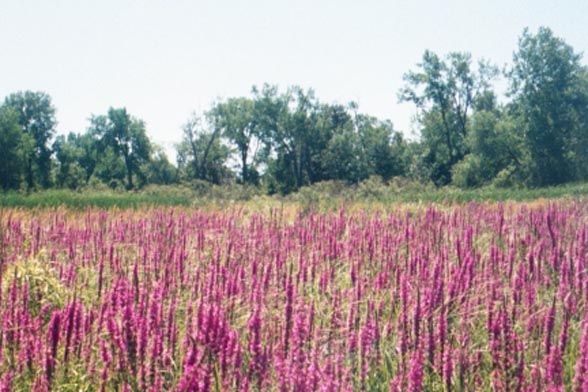
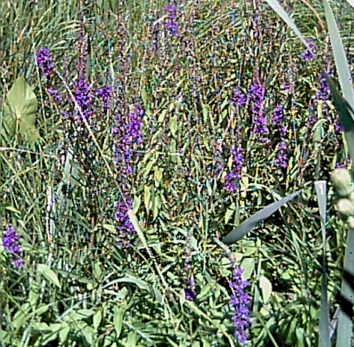
Control methods for dealing with loosestrife include digging and removal of the rootstock, spraying with herbicides, and biological control.
Biological control is where one organism is used to control another. In this case, beetles(Gallerucella) are used to control Purple Loosestrife. These are the beetles that Purple Loosestrife left behind in Europe, and are the same beetles that keep it from becoming a problem in its native land.
Anytime an exotic species is introduced as a biological control in the ecosystem, the consequences need to be thoroughly studied. There are many examples of cases where animals introduced to control another population quickly became a problem itself. The scientists working with Gallerucella studied it very carefully. They found that this beetle is host-specific which means that it will only eat Purple Loosestrife. In this way, we can be sure that Gallerucella will accomplish our goal of lessening the amount of loosestrife, without becoming a problem itself.
The beetles not only eat the loosestrife, but they then lay their eggs on the loosestrife. The eggs hatch and the caterpillars also feed on the loosestrife. As with most caterpillars, the Gallerucella caterpillars� main function seems to be to eat. The caterpillars do a lot of damage to the loosestrife plants. Many times the damage that the caterpillars do will kill the plant entirely - which is the goal of this program of biological control.
The caterpillars eventually burrow into the soil beneath the plants where they pupate. They hatch and overwinter as adults. In the spring, adults lay their eggs and die soon thereafter.
~*~It is illegal to raise purple loosestrife in Wisconsin. In order to participate in the Biological Control Program, you or your group must be working in cooperation with the Department of Natural Resources, or other cooperating agency. ~*~
Procedure
1. Dig root crowns
Root crowns should be dug up as soon as you can get into the wetland in the spring - in Wisconsin this is usually late March or early April. Dig the plants before the buds begin to appear. The loosestrife that you remove and take into the uplands will likely grow much more quickly than they would in the marsh.
2. Pot the root crowns
Place each root crown in a 3 - 5 gallon pot with a mixture of potting soil and sphagnum moss. You may want to spray the roots and leaves gently with a hose to remove debris and spiders (that may eat your beetles!).
3. Pool set-up
A child�s plastic wading pool will be your miniature wetland! Place the pool in full sunlight in an area protected from the wind. Put the potted plants in a circle around the pool, and place a couple of pots in the center.
Fill the pool with water to a level that is 2� below the soil height. If the water level goes much higher than that you may want to drill a drain hole at the proper height, or bail water as needed.
Adding a plant fertilizer to the water will help your plants get a head start!
4. Prepare Sleeves
Sleeves will keep your beetles in place and on their respective plants. A mosquito netting fabric is used in the sleeve construction. You will need a piece of material 54 inches x 72 inches to make the sleeve. Fold the material in half to make the piece 27 x 72 and seam the long end.
You will have a bag with two long, closed sides and two open ends. You may want to close one end by folding over and making a pocket for a drawstring, or you may want to close it with string or wire. In either case, make sure that the opening at the top can be securely closed to prevent bug escapes.
Devise some way to keep the sleeves suspended above the plants. You may want to build something as elaborate as in the photograph on the preceding page, or you may simply attach the sleeves to a clothesline.
5. Collect Beetles
Beetles will either be supplied to you by cooperating agencies, or you will be directed to a site where you can �pick� your own. If you pick your own, the beetles are easily flicked into a collecting jar, or even an empty water or soda bottle. Make sure that the bottle has adequate airflow, and is not stored in the sun.
6. Introducing Beetles to Plants
Before introducing your beetles to the loosestrife, inspect the plants and remove any spiders or predacious bugs that might harm your beetles. Your plants should be about 18 inches to 2 feet tall to ensure enough food for your beetles.
Place the sleeves around the potted plants and secure around rim of pot with string or duct tape.
Place 10 beetles on each plant and secure the top, either with the sewn drawstring, or with wire or string.
Leave one or two plants without sleeves in the middle of the pool to catch escapees.
7. Release of Beetles
Beetles can be released after the new adults have begun to emerge from the soil. Carefully transport the entire pot and sleeve to the wetland. Make sure that the beetles are kept cool and out of the sun during transport. It is best to put 2 or 3 pots together in a site.
Choose a site close to other loosestrife plants, lower the net sleeve, and expose the plant.