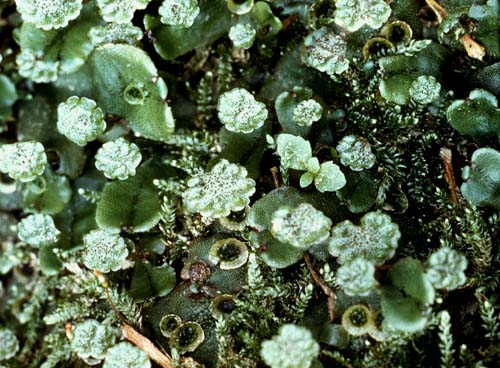
 Hepatophytes
Hepatophyta were the first nonvascular plants. This is
evidenced by the fossil record and their lack of stomata, which all other
divisions have. They have rootlike rhizoids and bodies which are lobed
and flattened. Liverworts reproduce sexually when the flagellated sperm from
the male antheridia swim to the female archegonia, both on the gametophyte.
This produces a sporophyte, which releases spores formed by meiosis. They
reproduce asexually by forming balls of diploid tissue in gemmae cups. Gemmae
are dispersed when rainwater splashes on them.
Back to:
Phylogenetic Tree
Nonvascular Plants
Geologic Timeline
Back to:
Phylogenetic Tree
Nonvascular Plants
Geologic Timeline