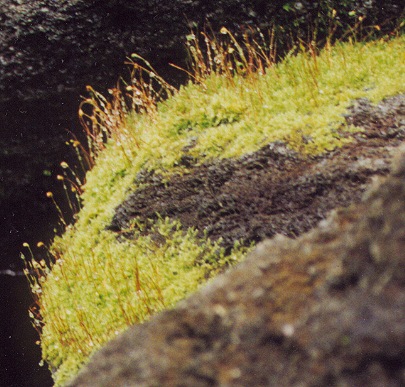
While liverworts and hornworts shared a direct common ancestor, Bryophyta diverged before. These grow densely, in spongy carpets that help them absorb water. Each individual has rootlike rhizoids, a stemlike upright body, and leaflike blades. In mosses, the sporophyte grows out of the gametophyte, rather than staying closely attached. Herein lies the major evolutionary advantage of Bryophyta. They are taller, and therefore can receive more light for photosynthesis and shade their competitors. Bryophyta produces the same tissues that liverworts and hornworts have, but in sufficient quantity for verticality. This is one reason mosses are so successful.
Back to:
Phylogenetic Tree
Nonvascular Plants
Geologic Timeline