
Much has been discovered about birds by watching and counting them, but such methods rarely allow birds to be identified as individuals. This is essential if we are to learn about how long they live and when and where they move, questions that are vital for bird conservation.
Placing a lightweight uniquely numbered metal ring around a bird's leg provides a reliable and harmless method of identifying birds as individuals.
Each ring also bears an address so that finders can help by reporting its whereabouts and fate. Some ringing projects also use colour rings to allow individual birds to be identified in the field. After over ninety years of bird ringing in Britain and Ireland, we are continuing to discover new facts about migration routes and wintering areas.However, the main focus of the Ringing scheme today is the monitoring of bird populations. Ringing allows us to study how many young birds leave the nest and survive to become adults as well as how many adults survive the stresses of breeding, migration and severe weather.
Changes in survival rates and other aspects of bird's biology help us to understand the causes of population declines. Such information is so important for conservation that the British Trust for Ornithology (BTO) runs two special projects to collect this data.
The Constant Effort Sites (CES) Scheme provides information on population size, breeding success and survival of bird species living in scrub and wetland habitats. Ringers work at over 130 sites each year. The Re-trapping Adults for Survival (RAS) project gathers survival data for a wide range of species, particularly those of current conservation concern.
Ringing allowed us to show that declines in the number of Sedge Warblers breeding in Britain and Ireland was linked to lower levels of rainfall in their African wintering quarters. We have also found that the recent dramatic decline in the numbers of Song Thrushes has been caused by a reduction in the survival rate of young birds. This information will help us identify the environmental factors responsible for the decline.
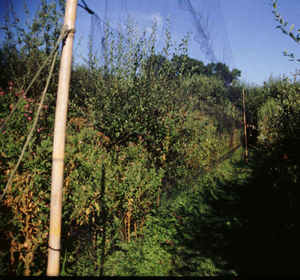
Birds are caught in a variety of ways. About twenty percent are ringed as chicks in the nest, this is valuable because their precise age and origin are then known. The method most frequently used to catch fully-grown birds is the mist-net, this is a fine net erected between poles and is designed to trap birds in flight.
This method is very effective, but birds can only be removed safely from mist-nets by experienced ringers who have received special training.
The British Trust for Ornithology (BTO) organizes the British and Irish Ringing Scheme. Around 800,000 birds are ringed in Britain and Ireland each year by just over 2,000 trained ringers, most of whom are volunteers. On average fewer than one out of fifty birds ringed is subsequently reported to the BTO, so every report of a ringed bird is of value. More about the BTO
Does ringing affect the birds?
The simple answer is no. It is essential that birds are not affected unduly by the fitting and wearing of a ring; if they were, ringing would not tell us how normal birds behave. Many studies have shown that birds ringed during the breeding season quickly return to incubating eggs, or feeding chicks, once they are released, and long distance migrants continue to travel thousands of miles between breeding and wintering grounds.
Birds will not be affected as long as ringing is carried out by skilled ringers with the utmost consideration for the birds welfare. It is not surprising that ringing has little effect on birds because, relative to a bird's weight, a ring is similar to a wristwatch on a human.
go to next page