
WANLIP SOUTH REED BED.
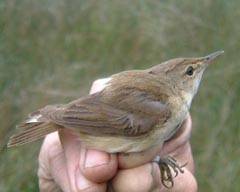
Mist netting of the expanding reed bed at Wanlip south has been carried out in the summer months since 1998. Up to nine nets are positioned in set places, which have been chosen to try and sample different parts of the reed bed habitat. This includes wet and dry areas of phragmites as well as scrub. Although we catch a variety of species we are particularly focused on monitoring how the number of breeding Reed Warbler increases as the reed bed develops.
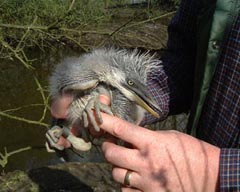
We have been ringing Grey Herons at Watermead since 1998. Ringing is carried out on about three occasions in the spring. With larger birds recovery rates of 10% can be expected. It has therefore been pleasing to receive the following recoveries:
1288448-ringed 24/04/99 found dead 07/09/99 Stratford on Avon.
1290009-ringed 08/05/99 found dead 07/04/01 Howth, Co. Dublin, Eire
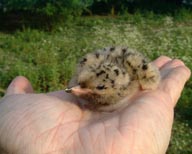
We have been ringing Common Tern at Watermad since 1999. We had a recovery of a bird ringed in 2001 that was found at Accra in Ghana (see Recoveries) in 2002.
In all our ringing efforts at Watermead the Country park wardens have been wonderfully supportive. We congratulate them on their magnificent efforts to extend the reed bed and improve the habitat for wildlife. Our sincere thanks go to Tim, Dale, Jenny and Richard.
We have been trapping Wheatears from late April into May over the last three years at several 'traditional' sites. The results (based on measurements) show that almost all of the birds trapped in this period are of the 'Greenland' race leucorhoa. They are usually very heavy indicating a slow over land migration north, feeding up as they go. This late movement through the UK is consistent with birds heading for high latitudes (Iceland and yes ... Greenland) where an earlier arrival would often be met by a frozen landscape.
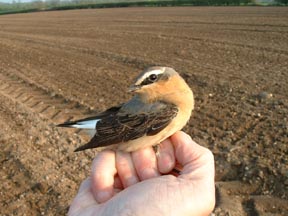
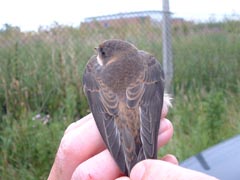
The bird in the photo is a juvenile (note the pale 'scallops' and fringing. This is a feature you can see on perched birds.
We are lucky in having two artificial nesting banks within our study area. The first to be built was at Watermead Country Park in the River Soar valley near Leicester. A few years later a second larger bank was built, again near the River Soar. This bank is situated on land owned by AstraZeneca Plc at Loughborough. The bank was built in a partnership between Charnwood Wildlife Project and AstraZeneca Plc. It was used by Sand Martins in the first summer after it was built. Unfortunately, there have been a couple of years without nesting but the birds were back at both sites in 2002. In total we caught 110 birds, with some birds from previous years. Sand Martins usually have more than one brood in a season but the bank at Watermead was not used after the first brood had fledged. Interestingly one female bird was caught at this site and was later caught at the Loughborough site. It appears that the bird had vacated Watermead after its first brood and laid a second brood at Loughborough. This phenomenon is mentioned in the literature and is a fact that can only be established by ringing.
go to next page