..::Altars::..
The Core of Taoism Magic
Placement & Blessings
To set-up
an altar, you need to choose one deity that you feel most ‘connected’ with.
Taoists only place an odd number of statues/idols on their altar - one or three
will do. Three is considered a spiritual number by I-Ching experts as it stands
for Heaven, Earth and Man. Since even numbers suggest 'coupling' (Number two is
associated with weddings and 'Double Happiness'), odd numbers are regarded as
the Yang/male sign of nature.
It is advisable to get the statues blessed by a Taoist priest in any Taoist
temple. Choose one with good reputation. Otherwise, rely on your instinct when
visiting the temple. This is best done during a quiet time, when it is not
packed with pilgrims (Eg. Qing Ming), or it’s bound to be a bustling (albeit colourful) affair!
Observe any rites while you are there…The general atmosphere should put you at
ease and provide some solace. Although it is difficult to judge if one is a
qualified Taoist priest, try to observe his behaviour. If he seems alright to
you, then it’s ok. You may also approach other Taoists with altars in their
homes for a recommendation.
The altar should be at the heart of your home and there should be no beams or
obstructive objects on top of the altar or in front of the altar. On the altar,
an urn should be placed right in front of each deity, possibly with rice at the
bottom to keep Joss Sticks standing upright. As time goes on, ash will gather to
reinforce the base of rice.
Red candles or red bulbs, one on each side of the urn are usually lit every night. And joss stick/incense lit twice a day…morning and evening. Again, one or three or five joss sticks for each deity. Some devotees would light three on usual days, and increase it to five on auspicious occasions.
When
placing the statue, the deity of highest rank should be in the middle, then the
second one on the left and lastly on the right. Choose an auspicious moment for
the ceremony. The set-up of the altar can be done earlier but the placement of
the statue and 'official' beginning when deities are invoked or invited to watch
over your home needs to be done on an auspicious date and time. The priest who
blesses the statue will know.
If you want, you may setup an urn outside your house or by a window. The urn can
rest on a raised board (height of a bird-table) or be hung up. It is to honour
Heaven (Tai Shang Lao Jun, San Qing, Jade Emperor and all heavenly deities), and
is a common practice for many Taoists. You may also create a small place under
your main altar, on the floor which would suitable location for the Earth deity.
This is not compulsory but an option. The earth deity is not a high-ranked deity
but he is definitely the most 'easy-going', 'friendly' and one of the more
compassionate deities.
Offerings & Rituals
This varies
from person to person (and deity to deity). It is NOT compulsory, often, flowers
would do...But if it is your wish to do so, ensure that the placement is neat
and even on both sides. You can't have two offerings on the right and one
offering on the left.
For easy maintenance, I suggest some fruits (five of the same in one plate), one
oil lamp (glass bowl of oil with wick) to light joss sticks, one glass of water,
three wine cups with rice wine, or three tea cups with Chinese Tea in front of
the urn (You may have only tea or wine or both). Water/Wine/Tea has to be
replenished daily.
Consult the Almanac for auspicious prayer dates when offerings are meant to be laid out (usually the first and fifteenth day of every lunar month). Some people also make offerings when they have a certain ‘request’, and are in need of divine intervention.
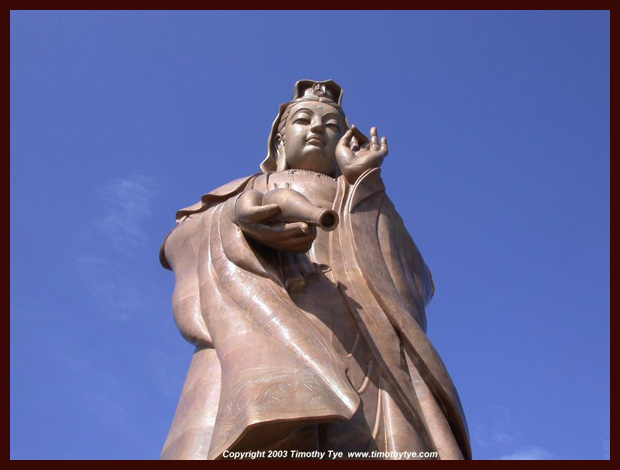
Guan Yin advocates vegetarianism, so offerings should be free of meat. It is, however, not uncommon for roast meat and other food to be part of the ‘heavenly menu’ when paying homage to other deities. It is best to use red dishes…or you could paste a strip of red paper around each dish. Avoid white/black/dark blue. At other times, flowers (stalks in a vase/buds in a dish) would be enough to adorn the altar, but you need to change the flowers before they wither. Remember to change the water in the vase to keep them healthy. It is traditional to burn Joss Paper in a huge metal urn/furnace as offerings on important dates…the amount is your choice. This is usually done after prayers have been made. Food offerings are usually left on the altar (or a table before the altar) all day, apart from bowls of rice (can be left for several days). Do not forget to include chopsticks and Chinese soup spoons with each bowl. Some believe that the taste and essence of such food have been absorbed by the gods, so it is a good idea to re-cook them before eating…Eating food that’s been ‘blessed’ by the gods is supposed to bring good luck.
There is a reason why basic offerings like water, rice, incense etc. are so significant. They represent the five essential elements that make up the universe, balancing the Yin & Yang, thus paving The Way...another reason why the number five is considered lucky. The symbolic qualities of these items are as follows:
Lit Candles - Fire
Rice - Earth
Water - Water (Obviously)
Altar - Wood
Incense - Air
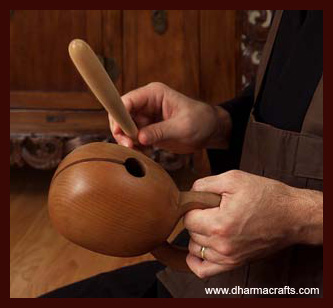
Some of the more devoted may meditate before the altar with a rosary or amulet (that’s been blessed by Taoist priest or medium), chanting some of the well-known mantras. Most people simply ask for blessings in their own way, by first invoking the name of the deity. Prayers can be made standing or kneeling, with both palms together. The beat of the Korean-inspired Moktak (picture below) can often be heard in temples, keeping time to the various chants.
Maintenance
Spring cleaning of the altar must only be done after the 24th of the twelfth lunar month when all deities have adjourned to Heaven for what would probably constitute as their ‘AGM’. The altar must be kept tidy and clean ALL the time. When cleaning the altar and statue, use a clean damp cloth each - one for the altar and one for the statue. Do not use that cloth to clean other things but only the altar or the statue. Always inform the deities beforehand. Make a small prayer with joss sticks before cleaning the whole altar. You can use a duster on other days, but keep it away from the face of deities. It has also been said that women should not pray or make offerings to male gods during their time of the month as it would be disrespectful, nor should one point a finger at an idol when gesturing towards it, or wear shoes while at prayer. These notions are sometimes viewed as superstition, but when paying respects in locations elsewhere such as a temple, shrine or altar in another individual’s home, it is best not to offend. When in doubt, ask!
Having said that, it is more important that you keep this saying in mind, 'Be sincere and true and the deities will answer you'.