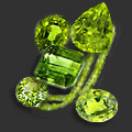
Peridot is
the modern August birthstone and the gem designated for the 16th wedding
anniversary. See other August
birth stones: Traditional, Contemporary, Mystical, Ancient,
Zodiac and Star signs.
Peridot
(pronounced pair-a-doe) is a transparent yellowish-green Magnesium/Iron
Silicate. It is a gem variety of the mineral Chrysolite or Olivine and its
chemical formula is given by: (Mg,Fe)2SiO4.
Peridot
ranges in color from light yellow-green to the intense bright green of new
spring grass to olive. Because of the way peridot splits and bends the rays of
light passing through it, it has a velvety appearance, a rich glow, and a
slightly greasy luster. The purer green a peridot is the higher the value. Any
tinges of brown or visible flaws greatly diminish the price
The
best-colored peridot has an iron percentage of less than 15% and includes nickel
and chromium as trace elements. It is not clear whether the word peridot comes
from the Arabic word faridat, which means gem or if it is derived from the
French word peritot which means unclear. In the 18th century, the French were
the first to call this yellowish-green stone peridot. Before this time, peridot
was called topaz. Peridot has been mined as a gemstone for an estimated four
thousand years and is mentioned in the Bible under the Hebrew name of pitdah.
It is said
that miners searched for peridot crystals at night because the moonlight made
the crystals easier to see. They would mark the location and come back in the
daylight to dig them up. It was used by the Egyptians as early as 1500 BC and
was considered the gem of the sun.
Gem quality
peridot comes from Zagbargad Island in the Red Sea, Myanmar (formerly known as
Burma), Pakistan, Brazil, Germany, Mexico, Australia, Arizona and Hawaii, USA.
The best quality peridot has historically come either from Myanmar or Egypt but
in 1994 a new deposit of peridot was discovered in Pakistan which produces some
of the finest stones. This mine is located in the Nanga Parbat region in the far
west of the Himalayan Mountains in the Pakistani part of Kashmir. Large crystals
have been found in this area, one stone was more than 300 carats. The gem
material found in Arizona is of lesser quality, and because it is an abundant
source, it is much more affordable.
The most
unusual olive green gem is that which comes from meteorites called pallasites.
Moldavite is found in the Czech Republic and believed to have arrived from space
in a meteor about 14.8 million years ago. Because this stone contains crystals
of olivine and has a similar color it is often confused with peridot. Some of
these extraterrestrial gems are very beautiful though and have been faceted and
set into jewelry.
Most of the
world production of peridot comes from Arizona while peridot from Myanmar,
Pakistan and Egypt is more rare and finer quality. Price for stones from these
areas will be higher and similar to prices for other top quality colored gems.
Peridot gems
were probably used in the fabled Breastplates of the Jewish High Priest and
historical legend says that peridot was the favorite gemstone of Cleopatra,
although at the time they were called emeralds.
Peridot has
been confused with emeralds although peridot, being a more yellow or olive
color, is a completely different shade of green than an emerald. Other green
gemstones that may be confused with peridot are apatite, green garnets and
moldavite.
Peridot is
considered a tonic for the whole body and protects the wearer from negativity.
It is associated with stress reduction and relaxation. Egyptians used peridot to
clean and heal the heart. Powdered peridot has been used to cure asthma and a
peridot placed under the tongue of someone in the grip of a fever is said to
lessen his or her thirst. Legend has it that drinking from a peridot goblet can
increase the potency of medicines.
Many gem
scholars agree that the tradition of birthstones arose from the Breastplate of
Aaron described in the Bible (Exodus 28, 15-30). The breastplate was a
ceremonial religious garment set with twelve gemstones that represented the
twelve tribes of Israel and corresponded with the twelve signs of the zodiac and
the twelve months of the year.
There are 13
different stones listed as birthstones for the calendar month of August, or as
Sun/Star, Planetary, or Talismanic stones for the Zodiac sign of Leo or Virgo.
Because these two Zodiac signs span part of August, both are listed in this
table.
Birthstones
for the calendar month of August are peridot, sardonyx, diamond, sapphire, ruby,
alexandrite, and carnelian.
The Zodiac
signs of Leo and Virgo include six additional stones: tourmaline, onyx, citrine,
zircon, jade, and jasper.
|
|
Peridot
(Chrysolite) |
|
Sardonyx |
|
|
Diamond |
|
Sapphire |
|
|
Ruby |
|
Alexandrite |
|
|
Carnelian |
|
Tourmaline |
|
|
Onyx |
|
Citrine |
|
|
Zircon |
|
Jade |
|
|
Jasper |
|
|