And caught our youth, and wakened us from sleeping,
With hand made sure, clear eye, and sharpened power,
To turn, as swimmers into cleanness leaping.
Glad from a world grown old and cold and weary,
Leave the sick hearts that honour could not move,
And half-men, and their dirty songs and dreary,
And all the little emptiness of love!
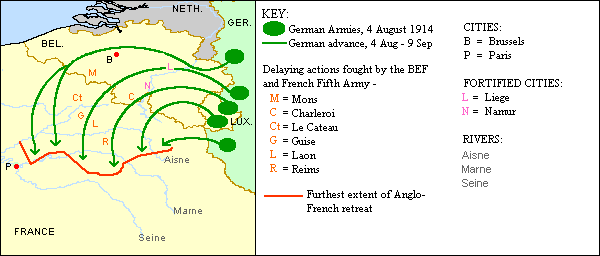
In the Great Retreat of August and September 1914, the Allies are inexorably pushed south as far as the River Marne, until by 3 September the most advanced units of the German First Army stand within 9 miles of Paris. France urges her ally, Russia, to launch an early offensive against Germany's eastern frontier, in the hope of relieving the heavy pressure on the allies in the West. The huge and cumbersome Russian army is not yet fully mobilised for war, but Russia nevertheless commits her First and Second Armies to a hastily-organised offensive into east Prussia on 17 August. The Russian advance into Germany meets with early success, but both Russian armies are decimated on 30 August at the Battle of Tannenburg - "the greatest defeat suffered by any of the combatants during the war". Russia loses 110,000 men at Tannenburg, but the offensive has served its wider purpose: in response to the attack on East Prussia, Germany has to divert two Army Corps and a cavalry division from the decisive final stages of the advance on Paris.
On 3 September, the French resolve that Paris will be defended to the end. Two days later, at the First Battle of the Marne (5 - 10 September), Allied forces finally halt the German advance and take the offensive for the first time, pushing back the German First and Second Armies 60 miles to the River Aisne.
August-September 1914.
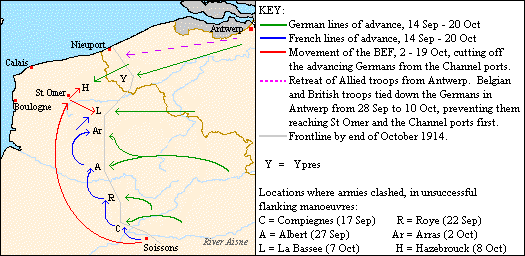
First Ypres marks the turning point from a war of rapid movement to a war of stalemate: as it becomes apparent that German hopes of pushing through to the Channel ports will not succeed, the battle becomes a struggle just for Ypres itself. This will be the pattern for much of the rest of the war, as two entrenched armies fight costly, localised battles not for breakthroughs and outright victory, but for small-scale objectives - individual hills, villages, roads and local landmarks. As 1914 draws to a close, the armies on the Western Front are at work building a more permanent defensive system of frontline trenches, communication trenches, dug-outs and strong points, in recognition of the fact that the war which was supposed to be "over by Christmas" will instead be a long and drawn-out struggle.