
King David's Palace Found in East Jerusalem?
December 28, 2005
By Robert Morley
The Trumpet
Does an amazing new discovery show that the Bible is supported by science?
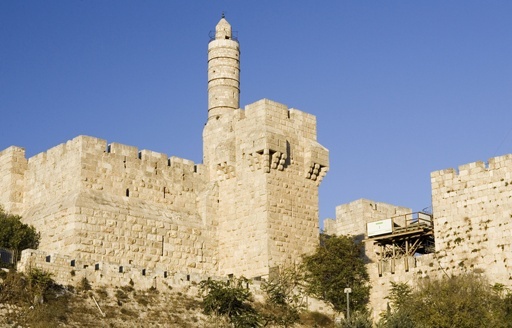
Photo: Near the Tower of David (pictured) in Jerusalem�s Old City, archaeologists have uncovered what they believe is King David�s palace.
Many archeologists are calling the latest Israeli archeological discovery "the find of the century" (Canadian Jewish News, October 20). Eilat Mazar, an Israeli archeologist, is claiming to have unearthed, in East Jerusalem, the palace of biblical King David.
King David was the 10th century b.c. poet-warrior and slayer of Goliath, whom the Bible says consolidated and expanded the ancient Israelite kingdom into a regional power. In approximately 1000 b.c., King David conquered Jerusalem from the Jebusites (Washington Post, December 2), and subsequently made it his capital. According to the Bible, King David's palace was partially built by workers sent to him by the Phoenician king of Tyre as a gesture of friendship, as is described in 2 Samuel 5:11.
Eilat Mazar relates that, although the location of King David's palace was very elusive, the Bible itself played a significant part in being able to locate it. Ms. Mazar speculated that a previously uncovered and famous stepped-stone structure located below her proposed excavation site was actually part of the Jebusite fortress that King David conquered. Also, in the same area and slightly lower than her proposed dig-site, Phoenician capitals (the tops of Phoenician-made columns) had been previously unearthed. To her, this too suggested that a monumental building may have stood further up the hill.
Combining these two known archeological finds with the Bible's description, she then theorized where David's palace would have been built. The Bible indicates in 2 Samuel 5 that when the Philistines came to fight, King David "went down to the hold," or fortress, to meet them. Ms. Mazar said that, after reading this, she often wondered, "down from where? Presumably from where he lived, his palace" (New York Times, August 5)
According to Ms. Mazar, the area above the fortress ruins and Phoenician capitals was a logical location for King David's palace because it would have placed it outside the original walls of the cramped city of Jerusalem and on the road to Solomon's Temple on the Mount.
Within weeks of beginning the dig, Ms. Mazar's team was uncovering the remains of many rooms. At first, most were more recent Roman structures, like baths and pools, but then, within the boundaries of the limited excavation area, she found the remains of "massive older walls underneath the Roman structure, running toward the rim of the Kidtron Valley" (Washington Post, op. cit.). The size of the walls, which constructed with boulders are on average two yards thick and extend at least 30 yards (Times, op. cit.), give credence to the importance and grandeur of the structure.
Below the walls, they first found 11th-century pottery. Then, within one room above the 11th-century fill, 10th-century pottery, dating to the time of King David and free from any other material from another period, was found. According to a relative of Ms. Mazar who is also an archeologist, "the sample was among the finest from that time found in Jerusalem" (Washington Post, op. cit.).
Up to this point, only a small fraction-up to approximately 10 percent of the structure-has been exposed, but the finds have been remarkable. In fact, Ms. Mazar described her discovery which is potentially David's home as "not just a house, but a fantastic house" (ibid.). In another uncovered room, dating to the 6th century b.c., a bulla, or seal, was found inscribed with the ancient Hebrew name of Jehucal, son of Shelemiah, son of Shevi (Canadian Jewish News, op. cit.). Jehucal is a Judean prince mentioned in Jeremiah 37:3. This fact suggests that the site was an important seat of Judean royalty for four centuries after King David. It also matches the biblical account of the palace being in continuous use from its construction until the conquest of Judea and Jerusalem by the Babylonians in 604-585 b.c. Several years ago, another royal seal was found in the general region. It showed the name of Gemaryahu, son of Shaphan, who is also mentioned in the book of Jeremiah (New York Sun, August 1).
Also lending support to the conclusion that this was David's palace is that up to this point there have been no finds of idolatrous statuettes or ritual crematoria which are found in contemporary Phoenician and Philistine settlements. "Furthermore, the building appears in a time period where such massive constructions were extremely rare and represented the greatest sort of public works" (Canadian Jewish News, op. cit.).

