The PIN
Opening - Middlegame - Endgame
       Rule:   Release all pins immediately.


        Q? - What is a pin?   (See Diagram 1)
      The position in Diagram 1 comes from the following moves:
      1.e2-e4 e7-e5 2.Ng1-f3 Nb8-c6 3.Bf1-b5 d7-d6
| Diagram 1 |
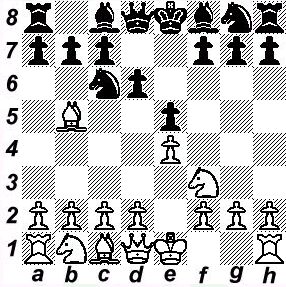 |
       Diagram 1 shows an "absolute pin". In an absolute pin,
       the piece that is pinned (the c6-Knight here) cannot move
       because the Bishop at b5 would put the Black King in check.
      The position in Diagram 2 comes from adding the moves:
      4.d2-d3 Ng8-f6 5.Bc1-g5
| Diagram 2 |
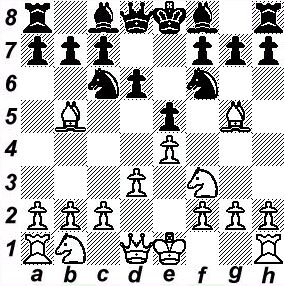 |
       White has moved his Bishop to g5 to put Blacks Knight
       on f6 in another "pin". Here, the Knight can move, but
       if it does, the White Bishop will capture Blacks Queen
       which is behind the Knight (f6).
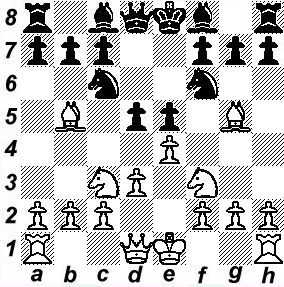
      The position in Diagram 3 comes from adding the move:
      5. .... d7-d6?

      This move is bad because it violates the opening rules,
      but it also makes d5 an attack point. BEFORE Black
      made this move, Black should count how many of Whites
      pieces attack d5 AND how many Black has defending d5.
      White has a Knight (c3) and a pawn (e4) attacking d5.
      Black thinks he has two protecting d5 - the Queen (d8)
      and the Knight (f6). This is WRONG. If the Knight (f6)
      moves, White will play Bg5xd8 capturing the Black Queen.
| Diagram 3 |
 |
       Essentially, a pin is a lower valued piece preventing
       the movement of an equal valued piece (and in some cases
       a higher valued piece) because behind it is a piece of
       even higher value.
       There are some exceptions where a side will move the
       piece (and lose the Queen), but checkmate his opponent.

Free Hit Counter