Pawn Breaks
Opening/Middlegame
     What is White or Black playing for when the center pawns
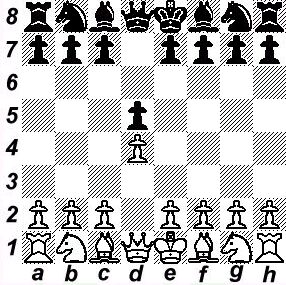
     are locked head-to-head as in 1.d2d4 d7d5 (Diagram 1),
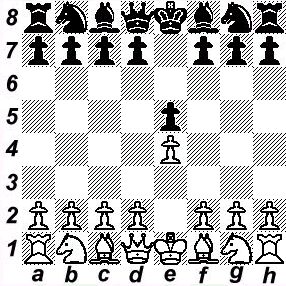
     1.e2e4 e7e5 (Diagram 2) or on some other file?

     I call this "Pawn Breaks".

     White and Black are playing to move the pawn on either side
     of their head pawns out to their 4th rank repectively.
     (Remember, the pawn break must be protected!
     Do not just play the pawn break or you will lose material.)

     Whoever does it first - usually gains an advantage in
     space and/or initiative.
 |
|
 |
| Diagram 1 |
|
Diagram 2 |
     In Diagram 1, (1.d2d4 d7d5), White wants to play c4 or e4
     for the advantage. How do we know this to be true?
     Look at the following openings:
       Queens Gambit - 1.d2d4 d7d5 2.c2c4 e7e6
       Slav Defense  - 1.d2d4 d7d5 2.c2c4 c7c6
     (This is true in other openings as well: the Colle and
     the London System, etc.)

     In Diagram 2, (1.e2e4 e7e5), White wants to play d4 or f4
     for the advantage. How do we know this to be true?
     Look at the following openings:
       King's Gambit - 1.e2e4 e7e5 2.f2f4
       Scotch Game   - 1.e2e4 e7e5 2.Nf3 Nc6 3.d2d4
     (This is true in other openings as well: the Ruy Lopez,
     the Guioco Piano, etc.)
     Let's add a few moves AND show an opening that did not
     start with the head-to-head pawn lock. From the French
     Defense:

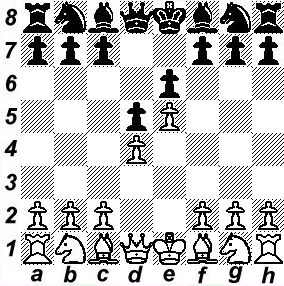
           1.e2e4 e7e6 2.d2d4 d7d5 3.e4e5 ....
 |
| diagram 3 |
     In diagram 3, we have 2 head-to-head pawn structures.
     First is the original with pawns at d4 - d5 and the
     second is the the pawns at e5 - e6.
     Let me describe both.

     With the d4 - d5 pawn structure,
     Whites' pawn break is at c4 and e4 (already played).
     Blacks' pawn break is at c5 (easiest - next diagram)
     and e5 (impossible as Whites pawn is at e5).

     With the e5 - e6 pawn structure,
     Whites' pawn break is at d5 (impossible as Blacks pawn
     is already there) and e4 (already played).
     Blacks' pawn break is at d6 (impossible as Blacks pawn
     is already there) and f6 (which is dangerous if Black
     is castled on the King side).

     In condensed form:
       Whites pawn breaks are at c4 and f5,
       Blacks pawn breaks are at c5 and f6.
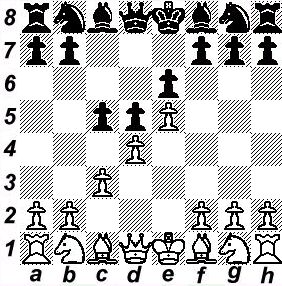
     In diagram 4, Black played 3. ... c7c5 (the c5 pawn break)
     and White protected his pawn center with 4.c2c3.
 |
| diagram 4 |
     This "pawn break" is also true for pawns separated by 1 row!
     (i.e. - 1.e2e4 c7c5 (the Sicilian Defense - diagram 5);
           - 1.f2f4 d7d5 (Bird's Opening - diagram 6);
           - 1.c2c4 e7e5 (the English Opening - diagram 7);
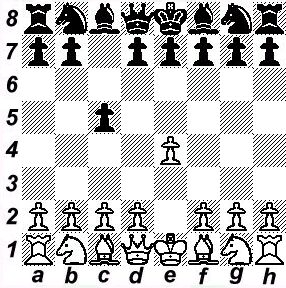 |
|
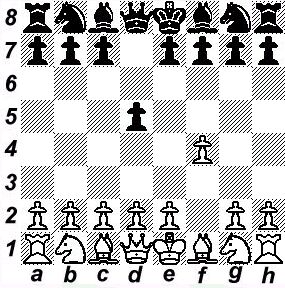 |
|
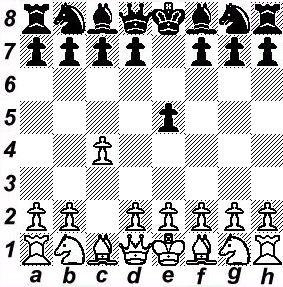 |
| diagram 5 |
|
diagram 6 |
|
diagram 7 |
Look up these openings and play over a few games to
verify what I am discussing.
In conclusion,
these "pawn breaks" are usually played early in the
opening, but can be played later (after opening development
is finished as in the Colle or London System that I recommend)
or not at all.

Free Hit Counter