Charles' key interests for reflection have been ...
- Higher Education
- Behavioural Issues in society ...wwith a slant for 'road behaviour'
- Politics & current events ... more limited than earlier
especially after the health crisis
Higher Education ... articles
My reflections on Higher Education are to be found in different places within this collection. The website above is one. The March 2007 article (accessible from the main menu) presents some ideas in systematic manner. Given the sad situation regarding Sri Lankan Higher Education and its relevance (when taken as a whole, and the few exceptions only proving the rule!), and the fact that I have oriented Higher Education to be an academic support service working on 'Employability Skills' to in some way make up for what is lacking, reflections on Higher Education are to be found also in the section on Career Guidance.
The three articles referred to below are not being made available at the personal website due to
storage/bandwidth restrictions. They may be obtained by emailing Charles at:
charles_fernando at yahoo dot com.
In the CD copy they are accessible via the item "Charles' Articles" in the main menu.
- Forming the Sri Lankan Graduate for Tomorrow
Paper presented and included in
“Conference Proceedings – Fourth International Conference on Business
Management 2007” published by the Faculty of Management Studies and
Commerce, University of Sri Jayewardenepura. March 2007
- Transferable Skills for Competitive Advantage in Entry to the World of Work
( Resource Pack for use by undergraduates)
This is not totally original but tries to
guide the student to reflect a little on what a graduate needs to be,
using also many extracts from a number of sources. It replaces handouts
that would have been used at workshops on self-assessment, marketing
oneself, preparing CVs etc..
- Sri Lanka: Transition Higher Education to Labour Market
Chapter in book
by Ehlert H and Cordier H (eds.) (2002) The Transition
from Higher Education to the Labour Market -
International Perspectives and Challenges. Peter Lang: Frankfurt
Do forgive the occasional shift from the 3rd person to the 1st person or vice versa in commentaries below.
I do not think it is worth spending a lot of time on polishing these.
Charles
Since late 2003, I have been running a website at www.sjp.ac.lk/careers. It has been a solitary effort without any support at all from anyone or any organisation. As I was Director of Career Guidance I was able to have it hosted on the university server in that section. Now that I have completed that work, the site may still be continued on the university server but at a different place.
It was meant to be a pilot project ... and the plan was to build up something more complete targetting staff and students who did not have easy access to the web (and that not only in Sri Lanka ... but also in other countries with limited internet access). I am hopeful that even though no development took place after December 2004, with me starting my sabbatical (in April 2007), some development may be possible in the months ahead.
A graphic copy of the main page is given here below.
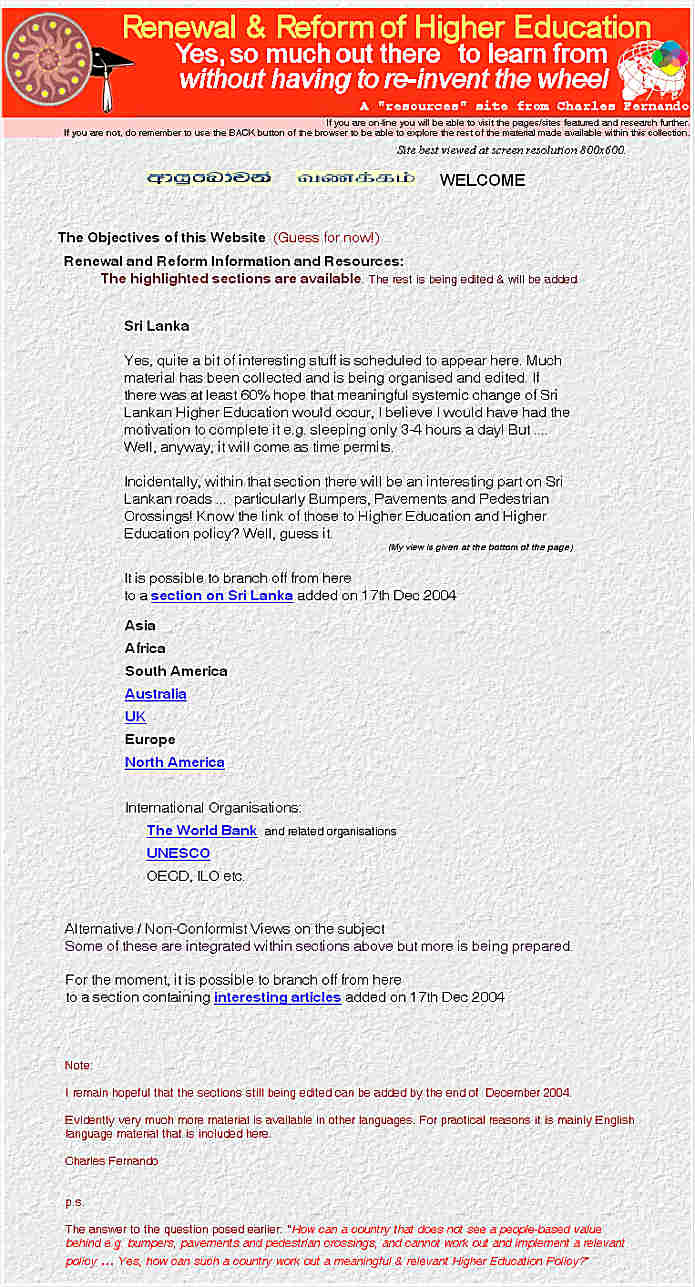
Within that page you
may have noticed the sections shown again here below:
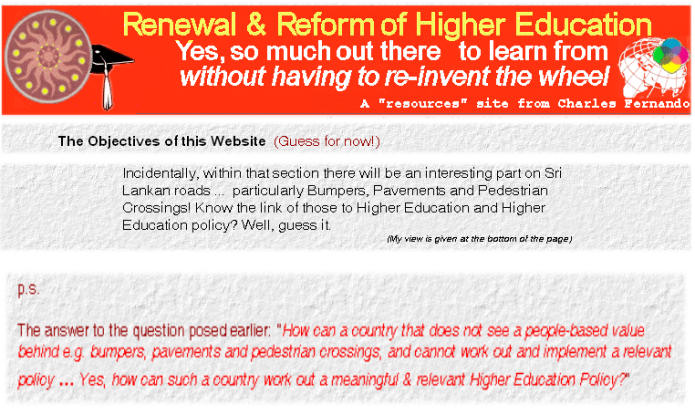
That links the first interest of mine "Higher Education" with the second "Behavioural Issues in society ...with a slant for 'road behaviour" .
The section above highlights the point that there is no "policy". (Incidentally, when there is no policy within a centralised system of power, I dread what might happen if and when things are de-centralised given the typical trend for everyone who comes to power to think "I know everything!")
To me the situation concerning transport is a reflection of what is happening to and within the broader society. In fact, if I ever did a PhD ... it would have been either on a topic related "Higher Education Policy / Reform" or it would have been on a theme such as "Sri Lankan road behaviour as a reflection of the dominant culture"!
This is not the forum to go into a lengthy discussion on the above ... I have been taking and collecting over the year many hundreds of photographs linked to evidence of policy connected with road matters. Let me provide a few.
Pavements ... as they exist ... are a clear indication of ?
That links the first interest of mine "Higher Education" with the second "Behavioural Issues in society ...with a slant for 'road behaviour" .
The section above highlights the point that there is no "policy". (Incidentally, when there is no policy within a centralised system of power, I dread what might happen if and when things are de-centralised given the typical trend for everyone who comes to power to think "I know everything!")
To me the situation concerning transport is a reflection of what is happening to and within the broader society. In fact, if I ever did a PhD ... it would have been either on a topic related "Higher Education Policy / Reform" or it would have been on a theme such as "Sri Lankan road behaviour as a reflection of the dominant culture"!
| To Charles, situations and behaviour on Sri
Lankan roads is a clear manifestation of at least the following: on the part of the state
on the part of the people
on the part of both:
|
This is not the forum to go into a lengthy discussion on the above ... I have been taking and collecting over the year many hundreds of photographs linked to evidence of policy connected with road matters. Let me provide a few.
Pavements ... as they exist ... are a clear indication of ?
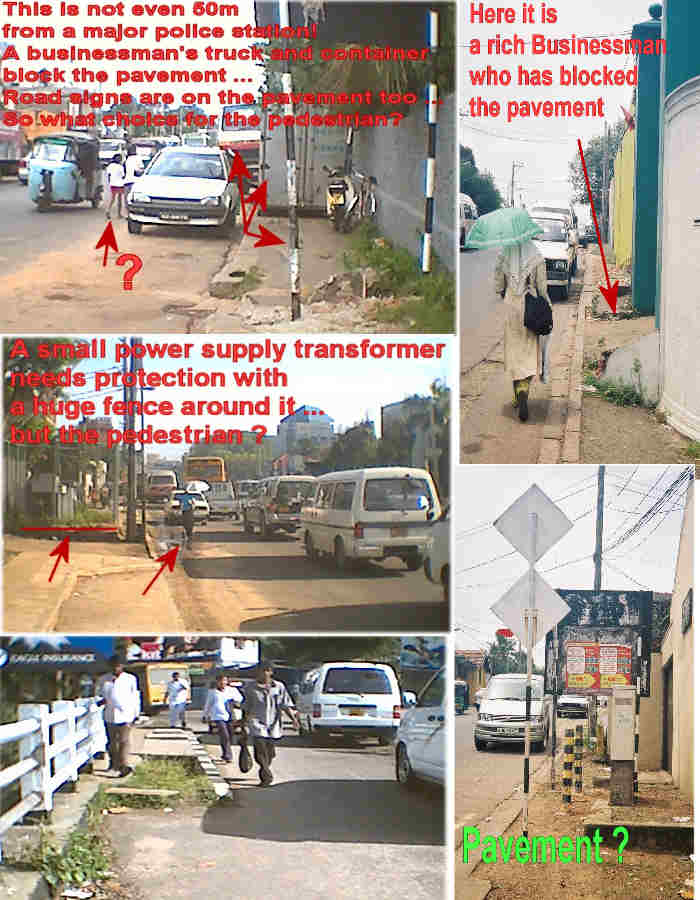
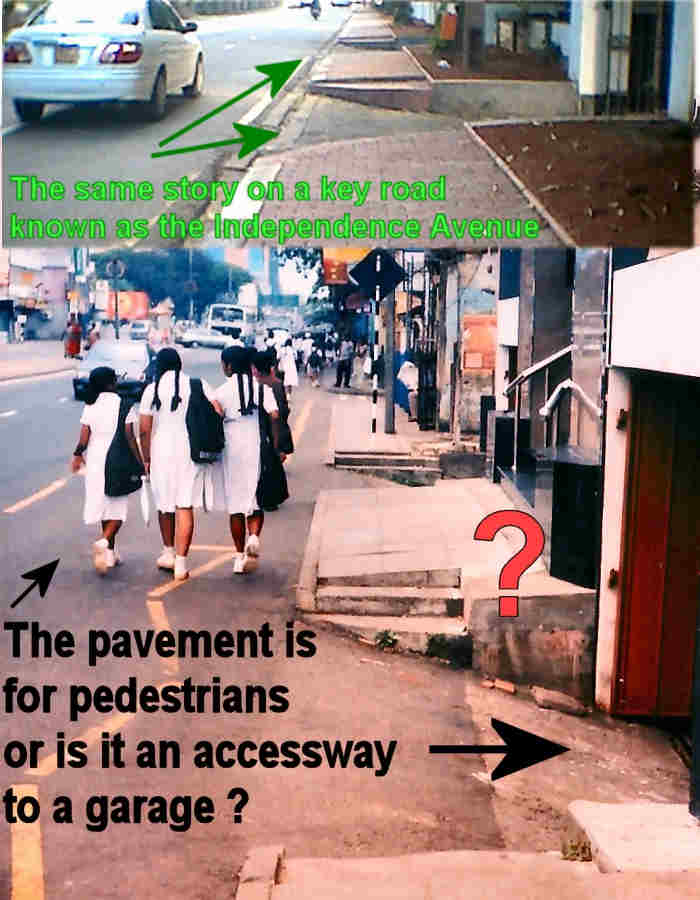
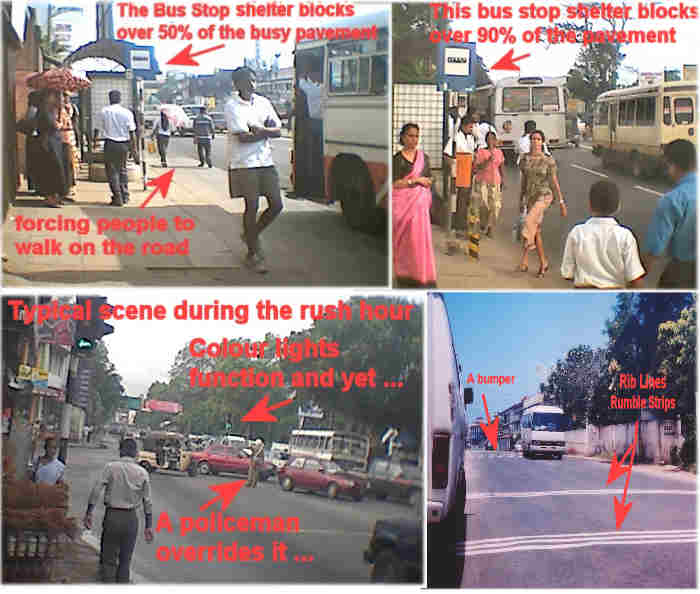
- What is the purpose of a pavement? What ccan take priority over a pedestrian?
- Is there evidence of a policy regarding tthe use of bumpers? ... or the use of 'rib lines/ rumble strips'?
Have the engineers looked at the
user side and the psychological aspects?
- And what about our tradition of keeping ttraffic lights on and the
police directing traffic in a manner contrary to what is indicated by
the lights. I have no objection regarding doing that in an emergency.
What if a driver does not see the police officer but follows the
lights and gets involved in an accident? Why were lights fitted in the
first place? While the police officer's 'ego' may be enhanced that
he/she is in control, if technology is available, couldn't such
person perform better supervising things and seeing to it that
rules are observed? But even more
important it is known that these traffic lights are designed by
a private business set up by the academics of a certain university.
Haven't they reflected on this? All that is required to sort this out
is a manual control (through a remote device or a key) ... and the
traffic lights would change in a systematic way with only the timings
being over-ridden as needed. The police officer (and sometimes there are two or three at a
junction) can do his/her primary job of supervising ... rather
than doing gymnastics on the road!
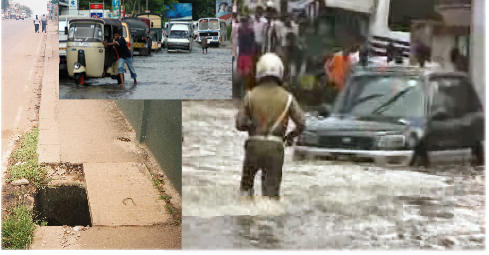 The leftmost photo in the montage was taken by me in
July 2004 close to Dehiwala Junction on the main road to Maharagama.
The leftmost photo in the montage was taken by me in
July 2004 close to Dehiwala Junction on the main road to Maharagama. In 2005 a friend of mine from Belgium injured himself while walking on the pavement by falling into an open manhole.
A cousin of my wife is still on crutches after an accident a year back.
And now with the flashfloods in May this year, a young lady fell into one such on Horton Place in the plush area of Colombo, was sucked away into an underground drain and lost her life.
Incidentally ... Charles believes that the connected problem of management of rainwater (which causes flash floods, inundations, creates problems to neighbours due to the way some handle it, damages road, causes accidents etc) is an issue where one needs to think 'out of the box'. For over 15 years Charles has experimented with a way to manage the rainwater of his home property and it has been successful
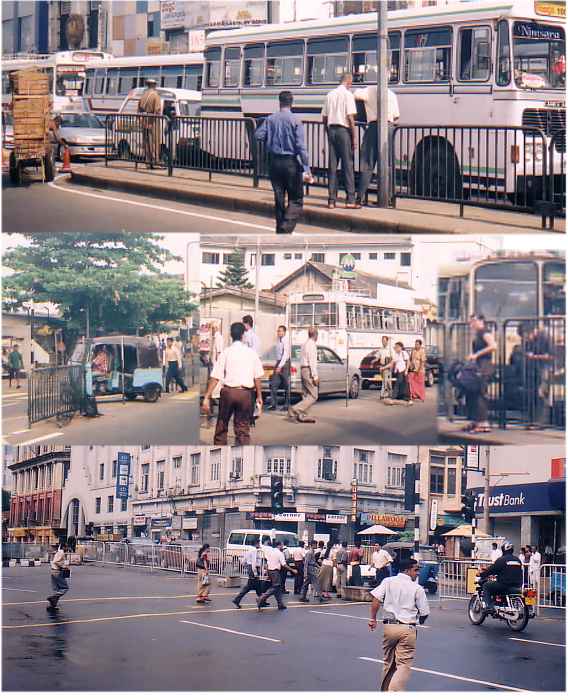 |
My dear
fellow citizens, forgive me when I say that we are a nation of creepers ... ready to creep through any little space, any small loophole! My dear fellow academics, yes forgive me ... but if we analyse critically ... on the whole we creep and allow others to creep through the system! The location in the two photos on left had metal barriers... but people broke them little by little. "When in Rome, do as the Romans do" is a useful saying ... and even foreigners learn to creep as seen in photo above. But the fact is that (even though there are the exceptions such as this young man) a reasonable amount of progress has been made through physical barriers. |
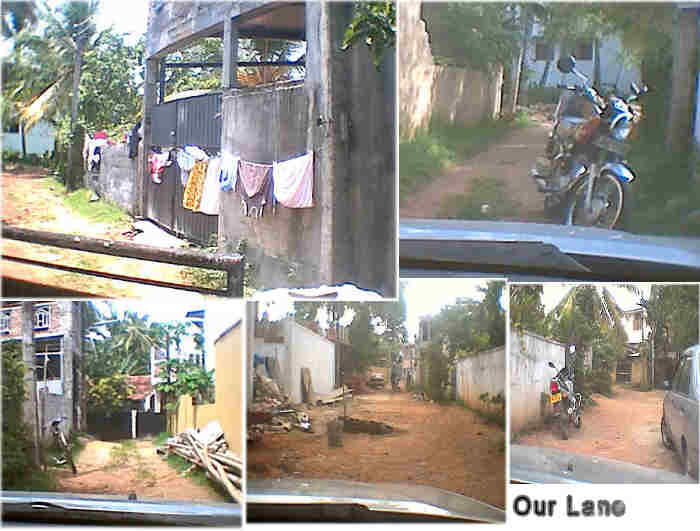
from top to bottom ... left to right
The first picture shows typically what Charles and family see everyday as they come out of their gate... clothes hung on the road. Is there a sense of "decency" and respect for the others who live on the road?
All the other photos are taken from within the car. Photo two: Once again, with the same neighbour ... who has already grabbed land making the 10-foot wide road to be less ... one parks without thinking of the other users of the road. One has to wait sounding the horn. Photo three: Same neighbour again ... bamboos brought for construction work dumped on the narrow road, and a bicycle is parked on the other side.
When Charles wanted these things to be changed ... the response he got from the neighbour was that his head would be smashed and not to talk of "rights" if one wanted to live.
The last two photos were taken a little beyond but on the same lane. (As is so common in the country) People take over the road for storing construction material, for mixing cement, for dumping waste and garbage etc.
"Preacher, practice what you preach" ...
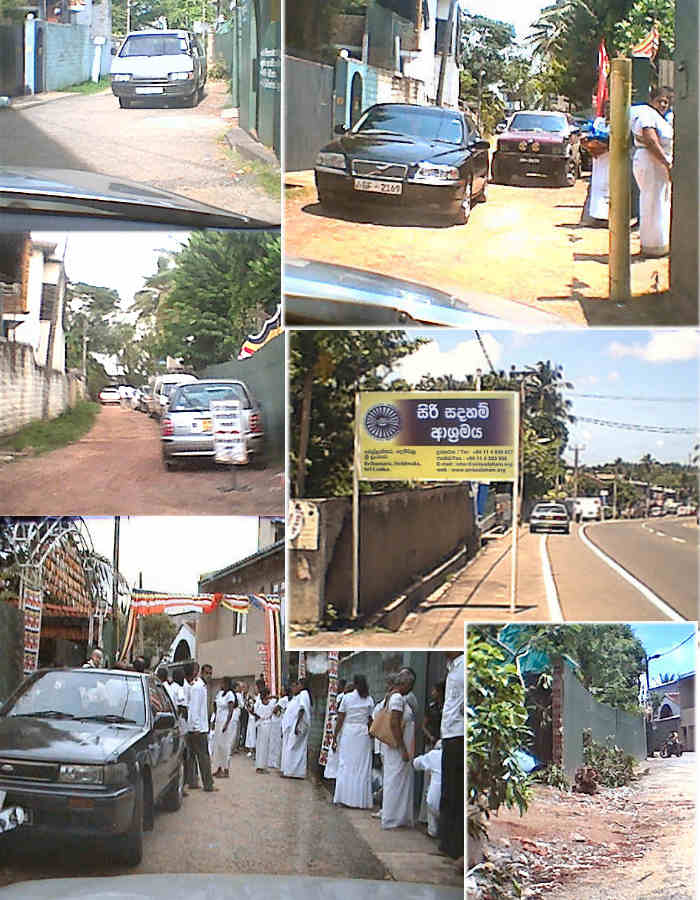
(comments on photos ... top to bottom and left to right)
About 4 years back a famous Buddhist monk (TV personality etc) paid many millions and bought the "Jayatilleke Waluwa" (the second house of Sir D B Jayatilleke, one of the leaders of the freedom for Sri Lanka campaign of the early 1940s). What happens there (one does not see what happens inside ... but what happens on the road) has now become a nuisance to others living on the lane. Some visitors/worshippers just don't care and simply park on the road and disappear into the monastery! There is a whole lot of land inside the property but the monk does not allow vehicles of non VVIPs inside. The monk even has security people etc but cannot ensure that the rights of the others users of the road are respected. VVIPs and society ladies frequent the place and see to it that the monk has all the power (and the money!)
Photo 3
Sorry the 'board' is not clear ... but it says 'no parking on the road' but see the line of vehicles parked on the road. This lane is a cul-de-sac without a place for the vehicles to turn. Visitors coming to Charles' place are forced to reverse right back to the main road. Can one reverse easily when vehicles are parked as seen? Is the monk concerned? Is he trying to educate 'his worshippers' about respecting the rights of others.
Heard about a Buddhist Monk organising a huge celebration for his 32nd Birthday? Well the photo (bottom left)
is merely an indication of the fuss on the road. According to the law, as owner of a property on the lane, he has right to the 'use' of the road but that is without detriment to the rights of others. He takes over the road to plant poles to support decorations etc. But we never gave him that right ... but what can one do given that the monk is powerful!
On another occasion, when the road was blocked as in the photo ... Charles went to the monk and asked him whether he as a resident of the lane could not use the road without hindrance ... and the answer of this learned monk (that is how he is referred to in some TV Channels ... because the lady who is the owner of those is one of his worshippers) his answer was "You can wait at a security check-point ... So why can't you wait a little?".
Moving to the photos on right:
The monk has placed the signboard on the main road blocking the road. This has lasted for nearly 3 years now. It was done up recently indicating the e-mail address and the web address etc. The authorities don't see a problem ... and even more importantly the monk does not see that he is violating public property!
Last photo at bottom right:
The monk appears to be building a second gate. As done by others, all indications are that the gate will be at a higher level and that the slope will start from the common road. He does not seem to be able to think that he must give an example of respect the distinction that should exist between "private property" and what is not.
When a learned Monk is behaving as above, ... what others on the lane seem to be doing by way of not respecting the rights of others users needs to be thought as relatively minor!
A Buddhist friend of Charles commented : "Charles, if a Church was there ... what a furore there would be?"
Other friends of Charles have warned him saying "Act carefully. Don't argue alone. You are a Catholic and it will be taken as an issue related to religion".
Rukmal and Nilmini … No Citizenship! Another interesting problem for Charles:
(Charles has had many more … which may get into his memoirs some day!)
On 8th February this year, Charles goes to the office that issues passports. Rukmal was trying to get entry into an MSc abroad and having done GRE and TOEFL, he discovered that he could not sit for IELTS without a passport. And so even if typical academic years in the western world start only around August-September, we had decided to apply for his passport already in February. Further as the passports of Charles and Felicia had expire, and as there was an idea of going abroad for 12-18 months during the 2-year sabbatical of Charles, we decided to apply for the whole family. But we were in for a big surprise.
Even though both Rukmal and Nilmini came back to Sri Lanka as babies (Rukmal was 2½ and Nilmini 1 in January 1985 which was when we came back) and never left the country … and studied here, have their National Identity Cards, have had voting rights (with items to prove that) and are working here … the Department of Immigration and Emigration claims they are not citizens of Sri Lanka …because of a technicality. They want a fine of Rs 50,000/- to be paid on behalf of the two of them. Charles went through the legislation and found that there is nothing in the law that denies citizenship. The officials at the Department could not provide an answer to Charles’ question as to the legislation which justifies their refusal to issue passports except to say that this is on the basis of section 5.2 of the Ceylon Citizenship Act No.18 of 1948 (which act, one notes, Tamil websites -- e.g. www.sangam.org of the Association of Tamils of Sri Lanka in the USA -- still proclaim internationally even today as “The law that deprived over a million Tamils of their citizenship” … but Rukmal and Nilmini are not Tamils but it is still to this day 25-May-2007 claimed that they are not citizens of Sri Lanka).
Charles prepared a 4-page note giving all the details (available here). He gave it to the Department … and circulated it to a number of persons … but to his surprise, many who talk much about peoples’ rights and human rights, have had nothing to say about this case! Three other friends helped in a personal way, contacting the senior officials and explaining the situation … and are trying to see whether this can be sorted out. Given time constraints, Charles’ option just now is to sort things out in a simple way and obtain the passports if such is possible … and then to try to rake up the issue. But the message is … yes, Charles is able to question and to try to get things sorted out … but is the ordinary citizen able to have such privilege other than to do all that officialdom imposes including heavy fines!
Recently Charles had submitted an application for a 3-month fellowship to his own University in Louvain (which he continues to respect deeply in spite of the issue being referred to). Charles had referred to the fact that most Sri Lankan academics tend to do research primarily to obtain points for their promotions and not on matters that can be if real benefit to the ordinary citizen. (It would become too long if one goes into details of that here! But I am ready to even write an article on it and show areas that need to be covered.) Further in the current conflict context numerous issues of concern/relating to “peace”, human rights, rights of minorities etc have surfaced and that they have been and are being studied. In the context of social/political/economic development, macro issues too are being taken up for study. These are being undertaken by Sri Lankan or foreign researchers, either as independents or as part of various NGOs or as part of local projects/programmes with different agendas underlying them.
(Having referred to a number of problems affecting the ordinary person, where structural changes were the only way out) the objective of the 3-month research (to put it briefly) had been stated by Charles as: "Keeping in mind a number of problems of the type referred to, I wish to look at Belgian laws, procedures and practices concerning such issues (and if time permits a little into the European arena). I would even attempt looking a little at evolution over a period of 2-3 decades and see what we can learn from such in caring for the simplest and weakest of our citizens." The intention was to proceed to publishing a book in the local languages as part of an effort at ‘conscientization’ to make the ordinary person aware of what kind of protection of the weakest is available in other countries. But those who made the decision had thought the topic was not sufficiently stimulating! Charles is not against their views nor rebelling against such ... but thinks that decision-makers in foreign lands cannot be expected to understand the true and real problems of another country … and that in any case in spite of the good will they have their decisions can lead to the same cycle of oppression going on in a place. It happens that all the humanistic concerns of theirs are often hijacked by certain vested interests and the concerns of the very ordinary persons get no attention. It becomes necessary for such decision makers to “think out of the box”!
One other recent incident connected with my own university (which as I said earlier I respect deeply) comes to my mind. As part of a final year degree project a student was doing a project on Sri Lanka. Someone known to the student, who knows me, had suggested to her that she contacts me to get a little feedback. Several months passed, and the student contacted me only at the last moment. I found that she was doing a study on a topic related to the ethnic issue. So I sent her about 10 questions and I asked her to provide me one-sentence answers just to indicate to me what she knew. Unfortunately she was able to comment only on one or two which indicated that she knew very little. But the topic was vast: “Sri Lanka : de l'indépendance au tsunami : l'incidence du conflit ethnique sur la politique intérieure du Sri Lanka de 1948 à nos jours” ( Sri Lanka – from Independence to the Tsunami : the impact of the ethnic conflict on internal politics of Sri Lanka from 1948 to today). It was presented in Louvain in 2006 and is catalogued in the library. Her sources have only been books of the more journalistic type such as those of Eric Meyer, Alain Lamballe and Paul Lionel … all in French, and not one from Sri Lanka itself. I hope she made it very clear at least in her introduction that this was a very limited study, more to gain experience in methodology and that the content was relative --- and that the examiners pointed that out. The problem however is that others read such studies and take the conclusions to be valid and true. And of course such things happen all over all the time!