
In view of the Scout's continuing popularity, the management decided that a slight modernization of its overall design was now in order. Up to this time the only visual modification from its original 1920 form had been the fitting of the wider and more fully valanced D-section mudguards in the Fall of 1926, although there had been several technical improvements in the engine-gearbox unit which have been mentioned. Charles Franklin repaired to his drawing board and the result was the Scout which was to make him immortal in the world of motorcycling.
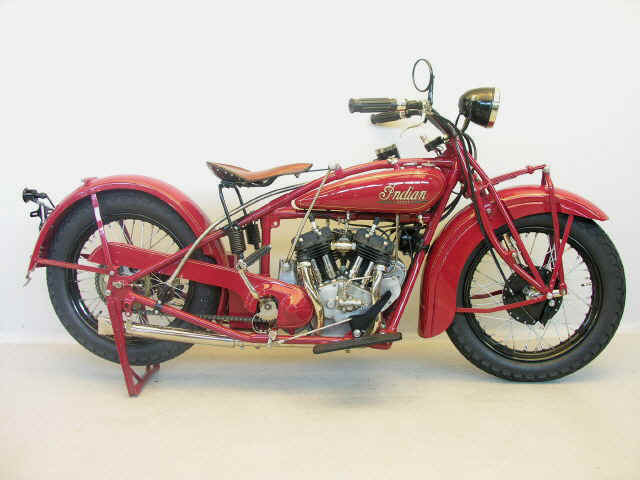
The frame was lowered at the seat post, which afforded a saddle height of only 25 inches. This innovation, while generally new to American riders, had been popular in both England and on the continent, and often lowered the silhouette in some designs to the point where all parts of the machine, except the steering head, were on a level with the top of the wheels.
The wheelbase was lengthened to 57 1/2 inches and while the original fork and suspension were retained, the rake and trail were altered slightly in the light of recent experience with factory racing machines. The lowered frame necessitated a somewhat shorter fuel tank of smaller capacity, which was redesigned in a more bulbous but streamlined form. It proved most attractive and was still of the one-piece between-the-tankrails pattern.
The original Scout engine in both original 37 inch and later 45 inch, had for its forward mounts a pair of cast iron angle brackets that were bolted on either side to lugs, in the forward ends of the cradle frame. Under severe usage these were sometimes prone to fracture. To obviate this weakness, the new Scout now had the mountings cast integrally with the crankcases, which were formed as an elongation of the latter and were throughbolted to the frame lugs by means of a single, heavy stud.
Another very useful feature was the fitting of a front wheel brake. While such had been fitted as standard for several seasons to most English and continental machines, the idea appeared to be slow in occurring to American designers. Stopping power in most domestic designs was mediocre at best, as the standard externally contracting band type brake lost much of its efficiency in wet weather. A double-shoe arrangement with an internally expanding band inside the drum was fitted to the last Hedstrom Indians and was a definite improvement, but this was not seen on the later postwar Franklin models. At any rate, the internal expanding front wheel brake on the 101 was a great improvement and was also fitted to the Four and Chief.
The new Scout was a lithe, compact, and highly functional machine, seemingly poised for flight even when standing at rest, and it attracted widespread attention immediately. The new model, now designated as the 101, superseded the previous Scout design in March, when it was placed in production.
[Page 8]