
The 1919 production program consisted of three models. The now well proven big twin was offered in both standard form, designated the Model N, and electrically equipped, as the NE. There was also the option of either spring frame or solid rear section at a lower price, although the latter was not shown in company catalogs. A single cylinder commercial model was also offered, to all purposes a standard spring frame model without the front cylinder. The remaining cylinder was given a longer stroke, for a piston displacement of 33.50 cubic inches. The machine carried the standard three-speed transmission with rather low gearing, for both enhanced pulling power and to promote longevity by preventing over-revving of the engine. This model was intended to haul a sidecar chassis fitted with a commercial box body, and was sold almost entirely as an export model, as its performance capabilities as a solo machine were severely limited. This model was offered for two seasons and for many years later was to continue in commercial service in many countries overseas. Both this and the Standard N model were designed for the fitting of acetylene lighting sets, which had been standard on the previous military models.
The most significant event of 1919 was the undertaking of prototype work on the soon-to-be-famous Indian Scout, which was wholly the brainchild of Charles B. Franklin. In anticipation of extensive postwar sales, Weschler and others in top company management had decided that an entirely new type of machine was in order, that might attract a wider range of buyers, and which would be lighter, more easily controlled, and, above all, easier to start than the heavyweight V-twin, which by this time had come to dominate nearly all of the domestic production. It was clearly evident from past experience that there was by this time only a very limited market for ultralight machines, but at the same moment the heavyweight V-twin was unsuited to-a large portion of a hopefully potential market.
In anticipation of launching a new type of machine, Weschler had previously dispatched Franklin and Butler on a tour of the New England and Eastern area in a Powerplus sidecar outfit, in order to interview dealers and riders as to their opinions of various types of machines as well as their personal likes and dislikes concerning different makes. From the results of this survey, Franklin, with some help from Butler, evolved the design of a machine which he had under consideration since 1912, when he had first begun to undertake serious studies in motorcycle design.
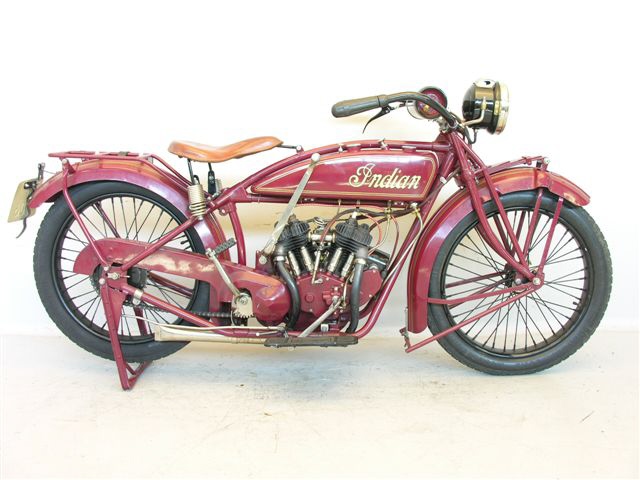
Discarding previous concepts, Franklin boldly attacked the problem with an entirely fresh approach to motorcycle design. The engine was a V-twin of 37 cubic inch displacement, with a cylinder angle of 42o and side-by-side valves - essentially a scaled-down version of his successful Powerplus engine. The three-speed gearbox was connected to the engine with a solid primary drive, consisting of three helical pinions running in an oil-tight case, the whole being contained in one unit. All the component parts were of very substantial construction, with large diameter main and upper end bearings and very large valves to provide efficient breathing for good power output. While the cubic capacity of the engine was modest compared to the conventional large displacement V-twin, Franklin reasoned that it was of sufficient power to provide adequate all-around performance to a machine of moderate size and weight, that could be easily handled by the average rider and yet be easy to start.
The frame was of the cradle type, with twin down tubes diverging at the bottom to form a substantial base under the engine and effectively hold the machine together in one solid unit.
The front suspension was similar to that previously fitted to the standard Powerplus models, but was supported by a straight-ended leaf spring, without a scroll. The fuel tank was of a pleasing contour and was carried between the upper and lower top tubes, with two chambers, the larger holding the gasoline, and the smaller forming an oil reservoir to feed the engine's total loss lubrication system.
[Page 8]