
An Indian team was again entered in the 1914 TT races, with Billy Wells as manager. Six specially built machines were dispatched to the island in May, along with Paul Derkum, who, by this time, had gained considerable fame as a road racing star and who was selected by Indian management as the team captain. Franklin, already heavily involved in design work at Springfield, had not planned to participate, but at Wells' insistence he was given leave of absence to join the Island contingent. Without Hedstrom's mechanical wizardry, victory again eluded Indian. Oliver Godfrey, the 1911 winner, could manage only second place. Franklin tied for eighth place with Howard R. Davies, on a Sunbeam.
Indian switch to side-valve layout to cut costs
In the Spring of 1915, Indian's top management, headed by Frank Weschler, conferred with the Engineering and Design Departments on the matter of changing the basic design of Indian engines. While the Hedstrom type had well proved its worth during the past decade of continuous improvement, it was decided that it had by this time undergone its maximum economical development. Another factor under consideration was that it was an expensive engine to manufacture and there had been continuous pressure from the Board of Directors to consider ways and means of cutting production costs. It was also a fact that both the standard engines lately developed by Excelsior and Harley-Davidson, and of the same cylinder displacement, had somewhat of an edge in power development. It was becoming well known that many amateur mechanics had experienced some difficulty in adjusting the rather sensitive Indian overhead valve gear and otherwise keeping the engine in proper tune.
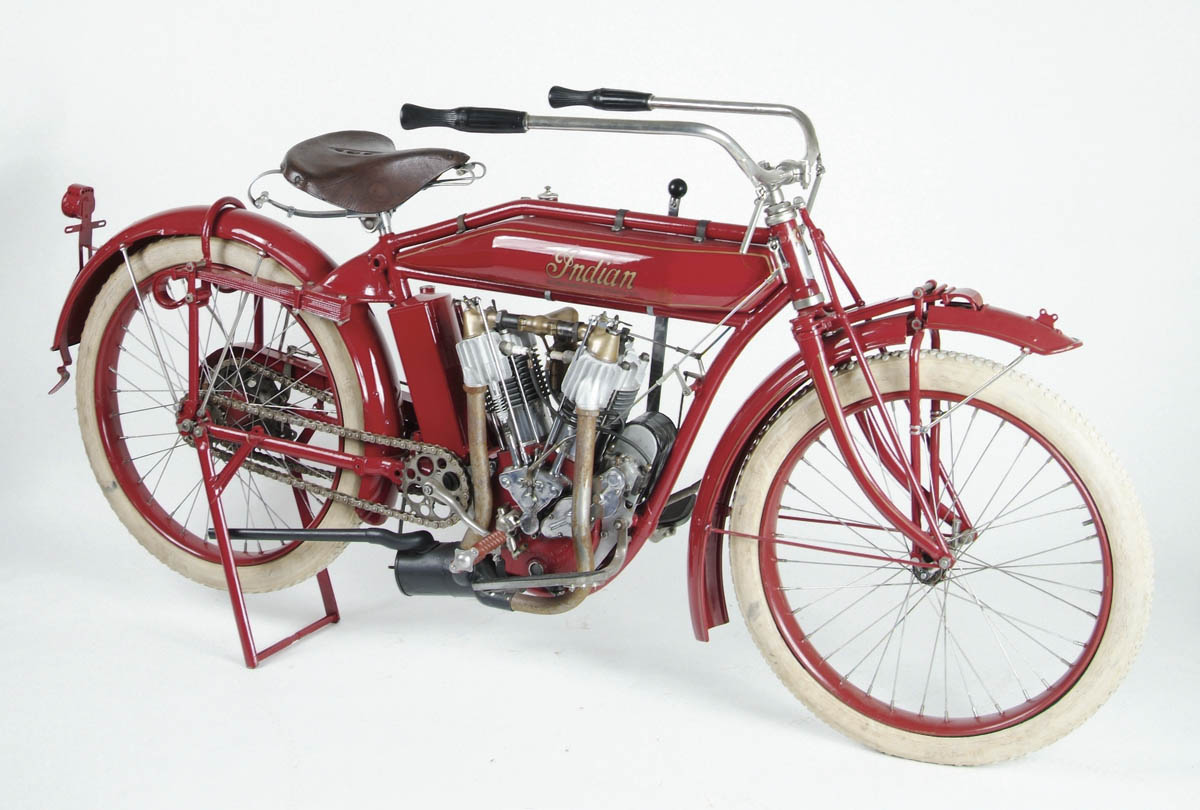
Charles Gustafson offered the opinion that a well-designed side valve type could be a simplified improvement, such as the modified Peugeot V-twin that he had perfected for the Reading-Standard Company, and which had subsequently undergone refinement for both enhanced reliability and economical manufacture. Franklin agreed with him, and experimentation with various prototypes was immediately undertaken, over the objections of some of the Scandinavian contingent in the engineering shop who were still loyal to the Hedstrom type.
The new engine was laid out to conform to the then standard 61 cubic inch displacement employed for all American V-twins, but still adhering to the 42o cylinder angle, which was considered to give the best balance.
The new engine, which was designated as the Powerplus, was rated, as was its predecessor, at 7hp with the standard SAE rating. However, it actually developed 16 to 17hp on the dynamometer, a substantial increase over the last Hedstrom models.
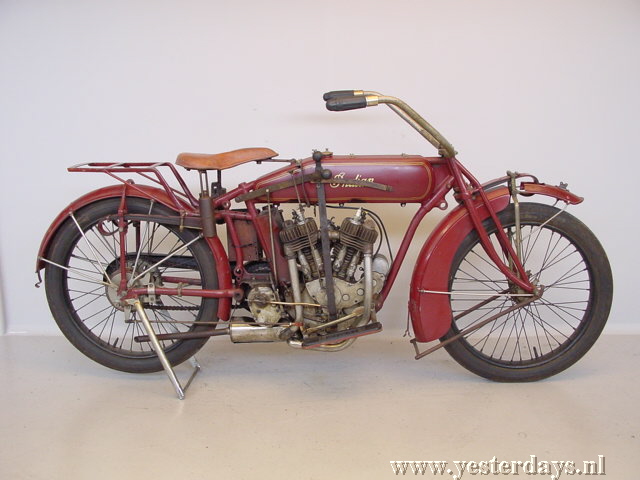
In order not unduly to interrupt the normal flow of production, the Powerplus engine was built with the same crankcase dimensions as the last Hedstrom type, so that it could be fitted to the current frames and engine plates without major changes in the standard big twin models. The only other modification was the fitting of a slightly improved three-speed gearbox and a somewhat heavier clutch.
Tommy Butler, who took a lively interest in the development of the new engine, not only from the sales standpoint but for his keen knowledge of motorcycle engineering, was happy to report to both Frank Weschler and the Board of Directors that the new model could be produced much more economically than its immediate predecessors, a critical ractor in increasingly difficult times.
Butler's interest in the Powerplus project brought about the close friendship between himself and Franklin, as they shared the same enthusiasm for both Indian and progress in motorcycle design. Some of their associates marvelled at the relationship between the ebullient Butler and the quiet, taciturn Franklin, who had made few close friends within the company, although he was well respected for his obvious abilities as a designer and engineer. Their friendship continued on through the years, with Butler later filling the role of Franklin's biographer after the latter passed away in the Fall of 1932.
[Page 6]