
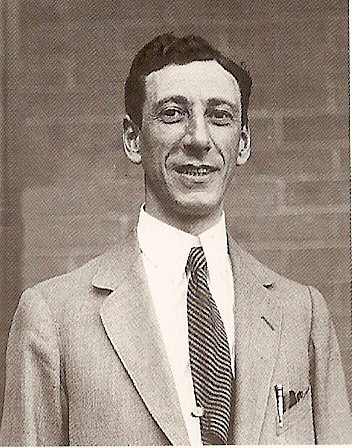
MOTOR CYCLING AT THE BEGINNING
by Charles Jarrot
I do not think motor bicycles ever appealed to me until, in the spring of 1897, I was strolling through the Bois de Boulogne one morning when I saw Fournier come flying along the road mounted on a motorcycle.
The machine was of an extraordinary length - almost as long as one of the ordinary triplets used for pacing purposes; a little motor was carried out near the back wheel which extended some four or five feet behind the rider - and it was fitted with a pedalling gear of huge dimensions. The whole appearance of the machine was so racy that I did not rest until I had bought it.
I saw another motor bicycle about two days afterwards, which I also bought. This machine was one made throughout by Messrs. De Dion-Bouton, whereas Fournier's machine had been built by some enthusiastic cycle maker merely as a freak. The De Dion machine, however, was in the possession of Charron. He demonstrated its running capabilities to me in his usual dashing style. It was a very neat machine, with the motor suspended between the frame, which was a shade longer than an ordinary bicycle, and was built of specially strong tubing.
The motor drove the back wheel of the bicycle by means of a flat leather band. One had to start it by running alongside, getting the gas and ignition rightly adjusted, then switching on the spark, and jumping into the saddle after the first two or three explosions. Of course, if you missed the saddle it was a serious matter, because, as happened to a friend of mine who attempted to ride the machine, it would then dash off by itself. I do not know that I ever cared very much for this little bicycle - it never seemed to go fast enough. It had to be geared fairly low for hill-climbing purposes, and also it was impossible to assist it by pedalling, as the pedals were fixed.
The other speed-instrument, however, which I had bought from Fournier was quite a different machine. In the first place, it required tremendous muscular effort to get it going at all. It was all built of very heavy tubing, and weighed some hundreds of pounds. The high pedalling gear - which was very useful when the machine was actually going made it difficult to start from a standstill. One had to be very careful in switching on the motor, because, unless sufficient way was obtained on the machine, the force of the explosion of the motor acting on the long connecting chains invariably broke them. I do not know how many new driving chains I fitted to that machine, until at last I had chains specially made of great strength.
[Page 2]