
In summary, while theories were out there looking for help (and ultimately finding it), in 1919 it was the real world that mattered. The Scout flathead engine met contemporary real world problems head on-and solved them. The Scout engine was state-of-the-art stuff.
All very simple, very straightforward, and irrefutably logical. Once Franklin's mind was in the proper "gear," it may have taken him no longer to conceive these features than it has taken you to read about them. Strange it is, how one of the hallmarks of genius is to discover the "obvious" when all others have failed to do so.
The rest of the design story was in the details, the details, the details. Trial-and-error dimensions, new engine ideas, cost analyses, budgets, schedules, endless management meetings, workarounds, and a few hundred drawings, all done in an era of 60-hour work weeks. That's without overtime, so workers really appreciated Saturday afternoons off. Patterns were made, and then a few castings, while the first frame or two went together. Lots of machine shop work tidied up the loose ends, while Franklin's notebooks recorded what didn't quite fit what and why, so that drawings could be revised as necessary.
Hard Metal
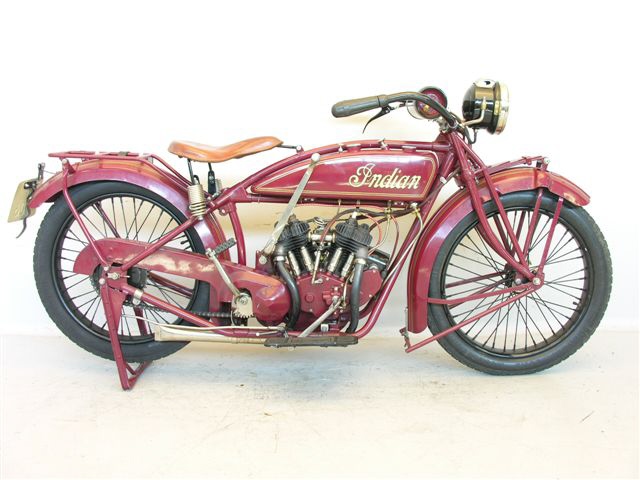
Finally, in the summer of 1919 the new motorcycle emerged. The winning strategy, the "better mousetrap" - the bike that stretched the state of the art, was no longer an idea; it was a reality in hard metal. By now, there was a name: "Indian Scout". Ahead were decades of glory to be won under the Scout banner. Motor number 50R000 was stamped to the left crankcase of the first Scout, which immediately went into a heavy schedule of test riding. The test results were even better than expected. A very rugged and, for its time, a very smooth-running V-twin engine produced more power than it should from its 37 ci (600 cc). The helical gear primary drive was a bit noisy but rendered a "solid" feel, particularly at slow engine speeds where there was no such thing as primary drive chain snap. Cautious decisions throughout development resulted in a little engine that was incapable of over-stressing the rugged primary drive and transmission. It wouldn't be long before the advertising guys would think up "You can't wear out an Indian Scout!" and they would be telling the truth. The compact double-loop frame was likewise very sturdy. Footboard vibration was far less than on the Powerplus twins with their old-style center-tube frames and tacked-on footboards.
[page 7]