
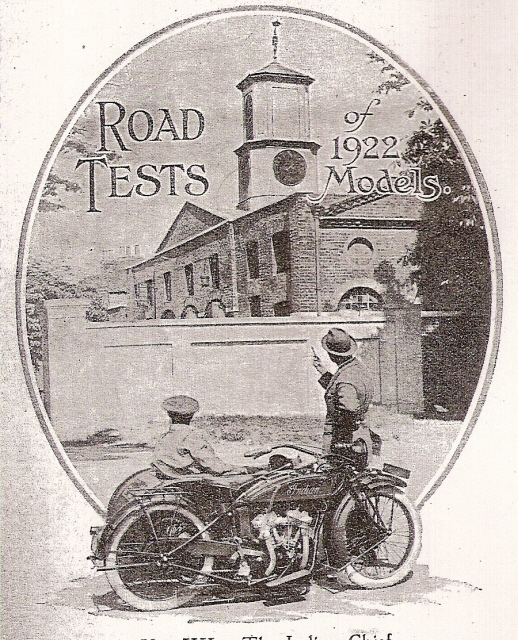
An Indian chief, according to the story books most of us used to devour when we were younger and, possibly, more impressionable than we are today, was a haughty-looking person, whose bearing and general appearance � as depicted by the artist from his �Far West� fastness (probably Hammersmith) - were more than a trifle reminiscent of the scion of nobility whose troubles had, no doubt, formed the subject of the aforesaid artist's previous commission.
Be that as it may, however, there is every probability that we have got it firmly fixed in our heads that an Indian chief is a superior being. That is why the Hendee Co. have done well to christen their latest production Indian Chief. For it is a machine of handsome and imposing appearance, and it goes about its work with a silent litheness.
Its general lines follow to a great extent its �nippy� little brother, the Scout. Its type of engine, its frame, and its transmission are all similar, but its crankshaft turns over with the full force of a thousand exploding c.c.s behind it, for the bore and stroke of each cylinder are 79.3 and 100.8 mm respectively. One-piece castings are the cylinders, with valves placed side by side, but each is removable for �de-coking� without need for detaching the engine from the frame.
Two points about the running of the Chief engine - apart from its power and acceleration, which were excellent - impressed us particularly during the time we drove the machine. The first of these was the total absence of vibration. Every engine has some critical speed at which it causes a vibratory period to be transmitted through the frame and handlebars of the machine. Try as we might, however, we could not discover this period on the Chief. We accelerated through the entire range of speed up to, probably, 50 m.p.h.; we dropped into second gear on the level, and raced the engine to its maximum speed (by request, be it noted), and still the handlebars refused to dither.
Where the vibratory period has been concealed, therefore, we are at a loss to say. Possibly, some of it has disap�peared through the heavier flywheels (which weigh 5 lb. more than those of the Powerplus engine), and no doubt the attention paid to the attachment of the engine to the frame has also helped. These attachments consist of forged anchor plates of extreme rigidity, and of steadies between cylinder heads and under tank tube, which are not only stiff, but allow for expansion. At any rate, for sheer vibrationless running, we are inclined to echo the phrase of the American grammarian and say that the Chief has got many another V twin motorcycle engine beaten completely to a frazzle.
[page 2]