
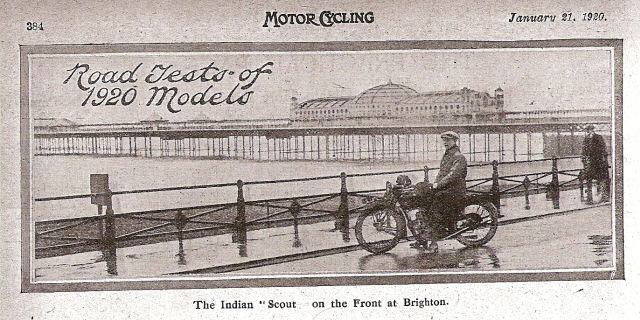
We had been impressed during the London-Exeter run by the roadworthiness of the new Indian Scout model, no less than by its taking appearance at the Show, and it was, therefore, with feelings of pleasurable anticipation that we took over recently a machine for the purpose of giving it a trial run.
Our feeling on bestriding the mount was an impression of compact solidity. The saddle position is extremely low, the combined result of 26 in. wheels and a carefully designed saddle, forming a part of the machine and not fitted as an afterthought. The handlebars, also, are wide and slightly dropped, and afford a comfortably natural attitude to the rider.

Ready for the road, we gave a gentle kick to the starter, and immediately the engine started to purr. Engaging first speed, we were soon threading our way through the traffic of Euston Road. The gears are operated by a long leyer on the right hand side of the tank: there is no quadrant visible, but the rider quickly locates the correct position for the lever in middle speed, neutral being marked on the tank, and first and top being back and right forward respectively.
We soon discovered that the �Scout� was capable of a tremendous acceleration and pick-up on the 5 to 1 top gear ratio, and, whilst we prefer a hand-controlled clutch for traffic work on a solo machine, yet the manipulation of' clutch and gears during the inevitable crawls behind slow traffic presented no great difficulty. Soon London was left behind, and the open road stretched itself ahead, but our longings for a �blind" were sternly repressed until Kingston, with its energetic police force, was but a speck on the horizon. The first opportunity presented itself on a long, straight and deserted stretch of road, and a twist of the wrist set the keen air rushing on to our face with redoubled force. Our accompanying sidecar outfit was passed in a flash, but, having no speedometer on the machine, it was impossible accurately to state the speed. Since, however, the indicator of the sidecar combination was registering 45 m.p.h. at the time we passed it, our speed could not have been less than 55 m.p.h.
Followed a short halt for the photographer's benefit, and Reigate Hill was descended with clutch �out�. On the steepest portion the machine was brought to a standstill on the footbrake, an internal expanding drum of great power, working inside a drum on which the rear-wheel chain sprocket is formed. The hand brake is an external band, contracting on to the same drum.
Through the ten-mile limit we pottered, with engine just ticking over and clutch slightly slipping. This latter is a departure from usual Indian practice, and consists of a series of ssteel discs running in oil. It is operated by a heel-and-toe pedal on the left footboard, as on the 7.9-h.p. model. The fact that it runs in oil makes it exceedingly sweet in action. Incidentally the engine and gearbox are built as one unit, the primary drive from the engine shaft being by spiral gears, the final transmission, which is on the offside of the machine, being by 5/8 in. by 3/8 in. roller chain.
[page 2]