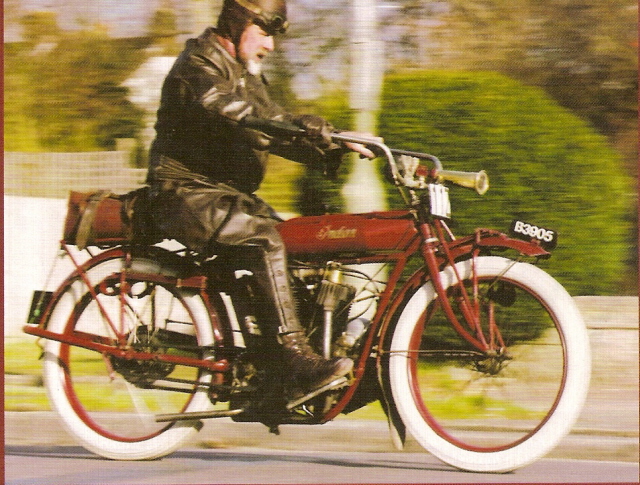
Chris wasn't too happy with some of the replacement spares available to buy now. 'There's more of them around now for these old bikes, but most of them aren't a lot of use. They're made to fit to show bikes so they look wonderful, but they're no use in practice.' For the same reason, Steve has fitted his Indian with ribbed tyres. 'It should have button tyres' he admitted. 'And they look great' interrupted Chris; 'but they're lethal in the wet!'
As the pair joked about their eccentric machines, the attraction of bikes like the Indian became obvious. These two riders revel in their knowledge of these machines and in their well-practised ability to ride them. What appears foreign and exotic at first sight has become familiar and comfortable to them. Steve roared up and down the lane for our entertainment, the Indian responding heartily to his enthusiasm. It IS a weird old bike, true, but it could still carry you halfway across a continent. And back.
'We shall not cease from exploration, and the end of all our exploring will be to arrive where we started and know the place for the first time'
Which brings me back to where we began, roughly a hundred years ago at the birth of an industry bursting with enthusiasm and innovation. When this Indian was built, it wasn't an oddball with unconventional components and idiosyncratic controls. It was at the cutting edge of technology: it was a ticket to ride for any young man with a yen for adventure and a fistful of dollars. Indian V-Twins were famed for their high power, low weight and mile-munching durability. This bike was built at Indian's peak and it exemplifies their aim to combine creative motorcycle engineering with the stripped-back elemental edge of frontier motorcycle riding.
During this bike's lifetime, the wheel of the world has spun several times and repeated the pattern of motorcycle boom / industry bust across the globe. What happened to the American motorcycle industry in the 1920s and 30s was echoed in the collapse of the British industry four decades later, and you have to wonder whether Japan is now headed the same way. The story doesn't seem to end here: the cycle goes on, echoes of the past endlessly repeating.
Yet in the midst of all this activity, the Indian is much as it ever was. Two wheels powered by an engine and by the desire of its rider to go faster than the other bloke. There's no escaping the fact that you need to be dedicated indeed to get to grips with a motorcycle of this kind today. But hey - you get back what you put in, don't you?
[Back to Contents]