
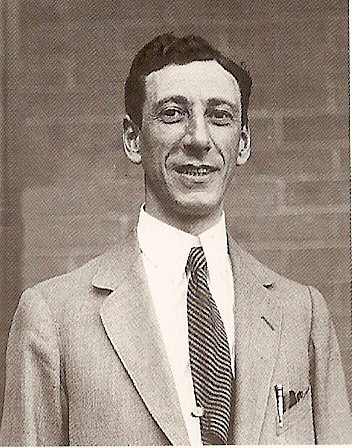
by Arthur M. Ritz
The greatest race in the motorcycle world, "The International Tourist Trophy Race", conducted by the Auto Cycle Union on the Isle of Man, off the coast of England, has been won by an Indian Motorcycle; and not only this, but two other Indian machines took the second and third places as well.
Such a performance has never been equalled, not even in the races of previous years, where the distance was not only much shorter but also over a far easier course than that traversed in the event of the present year.
To succeed in such an undertaking a motorcycle must possess not one good quality alone, but every quality that can be asked of a motorcycle, under every conceivable condition. The motor must develop wonderful power, and continue to do so under most adverse conditions. A stop to cool down is impossible, and the machine must go on continually with undiminished speed.
The endurance, not only of the motor, but of every part must be everlasting. The failure of a screw would be fatal. The control must be simple in the extreme, easy and certain in its operation, and instant in action. The doings of these Indians was a modern miracle, and a wonderful demonstration of cunning designing, clever combinations of materials, and precision of workmanship.
The object of the race, as officially stated, "is intended to assist the development of an ideal touring motorcycle of the power required by the ordinary user, regardless of the number of cylinders. It is not intended for racing motorcycles, and is not necessarily a race between existing standard types."
The Hendee Manufacturing Company entered five twin cylinder Indians for the race, exact duplicates of the regular twin machines except in the reduced size of the cylinders. As the course was a very hilly one, they were fitted with the regular Indian two speed gear and free engine clutch.
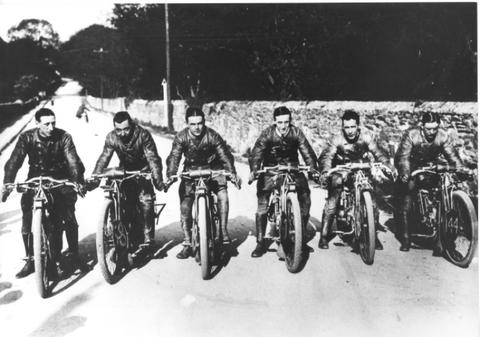
The course included Snaefell Mountain, a very sizable elevation, the length of which is in the neighbourhood of four miles. Besides the mountain, there were a number of lesser hills but with trying grades, and this circuit had to be made five times.
Such a course is evidently a most severe test, not only of power, but of endurance and reliability, and the winner must make the entire distance with absolutely no stop except the regular ones for gasoline.
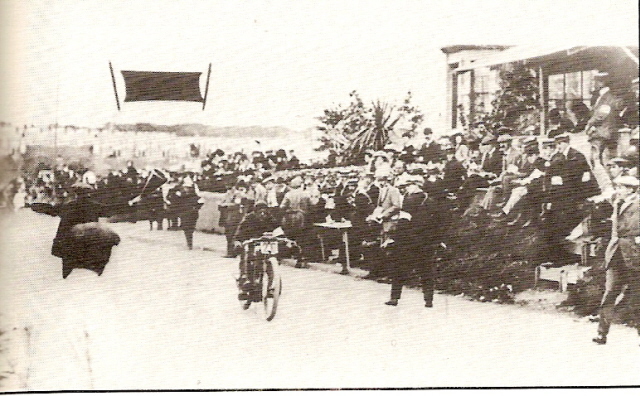
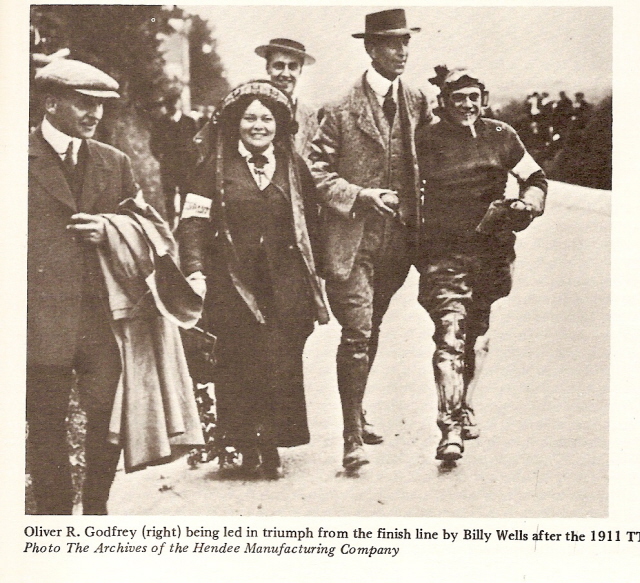
For this race 59 machines started, and only 28 survived. Such a wiping out of machines especially prepared to meet known conditions is the best evidence of the test. The result of the race was a wonderful victory for the Indian, for the first man in was O.C. Godfrey, one of the leading Indian riders.
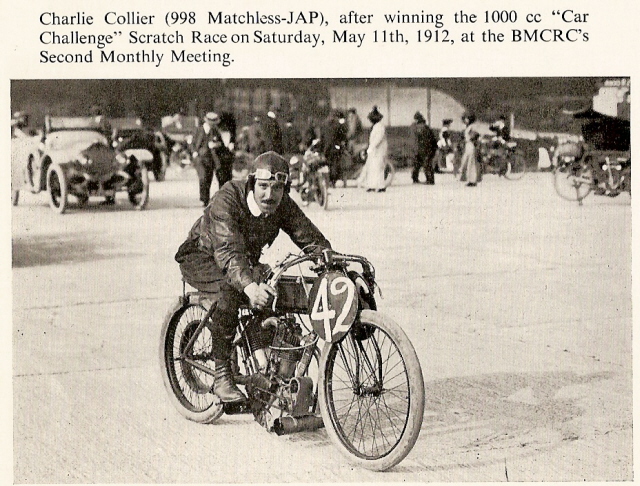
The second to finish was C.R. Collier, on a Matchless, a rider who has competed in these events since their inception, and who has been twice a winner and finished once in second place. Collier's long experience on the course and special study of conditions have always given him and his machine a great advantage, and to beat Collier on a Matchless gives a man an enviable standing in England.
[Page 2]