 Now all things considered, it is probably a good
thing that the PCI bus has remained essentially unchanged since its inception.
For one thing, it works.
Now all things considered, it is probably a good
thing that the PCI bus has remained essentially unchanged since its inception.
For one thing, it works.
It has provided a stable
and flexible platform for hardware and software developers to build on for
almost a decade. Anyone who remembers the days before Windows 95 and 'Plug and
Play' devices will understand why computers have become so much more common
since then.
Now there are three other
PCI specifications in existence, all designed to increase the amount of
available bandwidth. These are 66MHz PCI, PCI-X at 64bit/133MHz, and the soon
to be introduced PCI-X 2.0.
The trouble is, while
these technologies have, or soon will find a permanent home in the server
market, the complexities and extra costs they introduce to motherboard
manufacturing mean that they will be virtually unknown at the desktop level.
PCI-X, for example, requires a controller for every slot and that is just too
expensive. The solution to this is being backed by everyone's favorite
processor manufacturer, Intel.
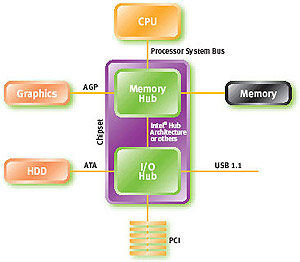
Intel, in partnership
with several other companies which include the likes of IBM, Dell, Compaq, HP
and Microsoft, recently introduced what will be the new standard for PC I/O in
the years to come; PCI
Express (formerly 3GIO or 3rd Generation I/O) is the name which it was
given by PCI-SIG, the committee responsible for overseeing the PCI interface
standard.
Approved as a standard on
April 17 2002, PCI Express is an evolutionary upgrade to the existing
PCI bus. It co-exists with the now 'legacy' PCI bus, but in terms of form, it is
something completely new.
What does PCI Express mean to your PC?
Like
AMD's Hypertransport technology, PCI Express is a 2-way, serial connection that
carries data in packets, similar to the way it is transferred over Ethernet
connections.
The
PCI Express bus is no longer a single parallel data bus through which all data
is routed at a set rate. Rather, an assembly of serial, point-to-point wired,
individually clocked �lanes� each consisting of two pairs of data lines carries
data upstream and downstream. As the technology goes to market, each of these
lanes is capable of a 2.5Gb/s data rate in each direction. The overall
sustained transfer rate roughly equals 250MB/s.
PCI
Express was designed with future upgrades in mind, and should see increased
results with later enhancements. Where the real performance benefit comes in is
when more than one lane is added to a given point-to-point route. Lanes can be
stacked together to increase the amount of bandwidth available to specific
areas of the I/O system, such as the video card slot, for example.
This
technology has a couple of immediate benefits. First of all, the amount of
trace routes on any given motherboard areconsiderably reduced by the adoption
of point-to-point circuitry.
Using
4 routes instead of 32 for a basic connection, you can see how motherboard
manufacturers might well be enthusiastic about this technology, as this would
significantly cut the costs of producing motherboards in the long term.
Secondly, since each lane is exclusively used for communication between two
points, there is no sharing of the available bandwidth.
 The objective then, was
to create an I/O bus technology that will have the staying power that 32-bit
PCI slots have enjoyed, a decade or more into the future. It seems like it has
been a success thus far.
The objective then, was
to create an I/O bus technology that will have the staying power that 32-bit
PCI slots have enjoyed, a decade or more into the future. It seems like it has
been a success thus far.
Upcoming
technologies such as Intel's multi-Gigabit Ethernet 'Dual Northway"
chipset, will inevitably require more bandwidth than PCI can currently offer,
so its phasing out in the server market seems inevitable.
The
biggest impact that PCI Express has made on the desktop market is with the PCIe
x16 graphics slot. Found in the latest Intel and AMD-based chipsets, This
implementation of the technology has virtually replaced AGP 8x as the platform
of choice for graphics card manufacturers. All new graphics cores from both
nVidia and ATI support PCI Express x16 by default, though some have been ported
to AGP 8x.
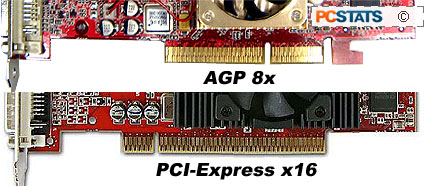
The
164-pin X16 slot provides a total usable bandwidth of around 4GB/s in each
direction, double the 2.1GB/s bandwidth that the 8x AGP spec boasts. The X16
specification is pretty similar to AGP in terms of connector card size, though
entirely non-compatible, which gives it a boost in terms of familiarity and
ease of installation.
nVidia
has succeeded in creating dual-SLI graphics technology using the PCIe x16 slot
and its new nForce 4 chipset . This technology allows two PCIe x16 slots
to split 16 lanes of PCI Express into two sets of eight and run two identical
video cards in tandem. This leads to often dramatic boosts in 3D gaming
performance.
Videocard Capabilities
Currently,
PCI Express X16 provides up to 75W of power for video cards, as opposed to the
current 25W/42W allowed by AGP8X. Most modern cards already consume more than
this amount, as evidenced by the extra power connectors that appear on today's
AGP high-end video cards. This explains why most modern midrange PCI-Express
videocards do not require extra power connectors, while their AGP counterparts
do.
Given
that both ATI and Nvidia have virtually switched over to PCI Express and that
major graphics companies from 3Dlabs to XGI have already announced support for
the architecture, it looks like AGP's days are inevitably drawing to a close.
To further depreciate the value of your very expensive AGP cards, PCI Express
X16 and 8x AGP slots cannot coexist properly on the same motherboard.
This fact has not stopped various motherboard manufacturers from releasing
ersatz PCIe/AGP solutions that use the PCI
bus or part of the PCI
Express bus. While this provides a better incentive to upgrade for AGP card
users, it should be noted that these solutions do not provide the full
bandwidth of a real AGP8x slot.
What makes up the PCI Express bus?
The
PCI Express bus is composed of multiple lanes of point-to-point wired copper
interconnects serving all the components that used to just drop data into the
older PCI bus. To make things even more flexible, a switch has been added to
the architecture.
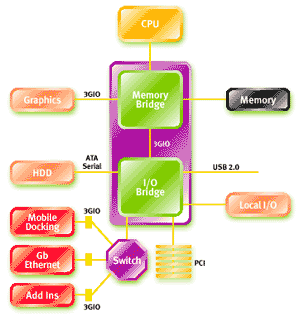
Working
in principle just like an Ethernet switch, this sits between the PCI Express
devices connected to the board and the rest of the I/O system. This will enable
newer devices, for example PCI Express connected on board Gigabit controllers
or 10/100 gigabit network cards, to communicate with each other directly if
necessary. By adding in this shortcut the data need not go through the chipset
to reach an adjacent device.
Compatibility between PCI 2.2 and PCI Express
As
mentioned previously, the PCI Express bus is software compatible with PCI 2.2
compliant devices. As Intel stated, all current operating systems will support
PCI 2.2 compatible interface cards in PCI Express systems using the existing
PCI drivers. This is because the legacy bus is still present, just in a reduced
form.
This
was an essential requirement if PCI Express technology was to gain widespread
acceptance. Forced obsolescence does not tend to go over well with computer
users.
PCI Express chipsets and connectors 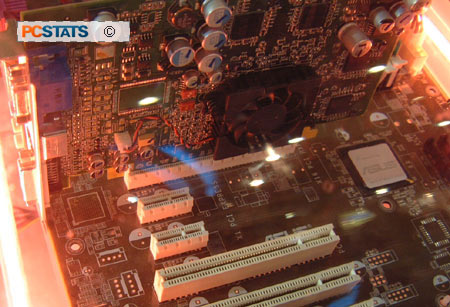
The
current standard PCI Express implementation, as seen in chipsets from Intel,
nVidia and VIA, allows for 20 lanes of PCI Express in total. 16 of these are
used for the PCIe x16 graphics slot and four more are distributed between any
combination of PCIe x1, x2 or x4 slots.
Current
PCI Express capable chipsets include Intel's 915, 925 and upcoming 955,
nVidia's Nforce 4 and nForce 4 SLI Intel Edition and VIA's K8T890, among
others. Both AMD and Intel processors are now well-supported with PCI Express,
though Intel chips had the technology well before AMD chips realized it with
the introduction of the nForce 4.
Other
than video cards, there are few PCI Express-based peripherals on the market,
but with nVidia and ATI's products spearheading a huge adoption of PCI Express
capable motherboards, it should not be long until peripherals based on the
technology are currently available.
 It was predicted that
Gigabit Ethernet adaptors would be the first technology to be commonly
available using PCI Express besides video cards, but since most PCI Express
capable motherboards now integrate Gigabit adaptors, there is little demand for
them in the desktop market.
It was predicted that
Gigabit Ethernet adaptors would be the first technology to be commonly
available using PCI Express besides video cards, but since most PCI Express
capable motherboards now integrate Gigabit adaptors, there is little demand for
them in the desktop market.
A
PCI Express 1X connector is ideal for gigabit Ethernet cards, which have enough
throughput to potentially cripple a standard PCI 2.2 bus. As found in most modern
PCI Express motherboards, the Gigabit Ethernet controller is soldered directly
to the motherboard and runs through the PCIe bus.
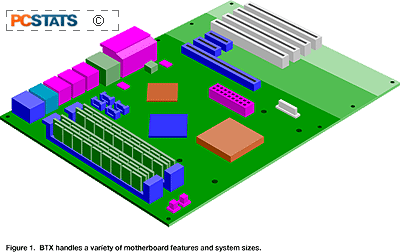
The
BTX
form factor (announced at IDF 2003) is intended as the replacement for the
current ATX motherboard standard, and included in its specifications are an X16
slot instead of an AGP connector for graphics, and two 1X PCI Express
connectors in place of several of the PCI slots.
In
the picture to the left, the PCI Express slots are coloured blue. The BTX
formfactor is beyond the scope of this article, so for more information about
it, look here.
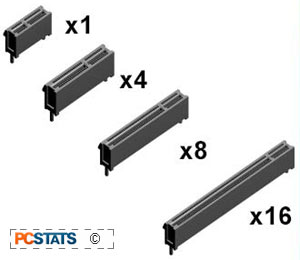
PCI Express X1, X2, X4, X8, X16
|
1X |
4X |
8X |
|
|
|
|
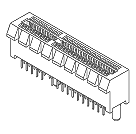
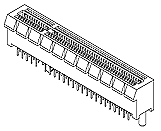
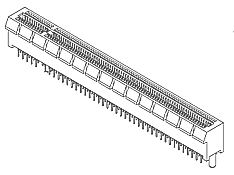
PCI
Express connectors are similar in appearance and connection method to 32-bit
PCI slots. PCI Express 1X slots are about the size of current modem riser slots
(about 1" long), while the X16 interface (164-pins) for graphics is very
similar in appearance to the standard AGP port. The flexibility to adapt to PCI
express devices of different bandwidths is built into the midrange X4 and X8
slots that we have seen.
For
the portable market, a new standard called the 'ExpressCard' has been created
by the PCMCIA group in cooperation with the development of PCI Express by the
PCI-SIG group. Many of the companies involved in the work on PCI Express are
members of both trade associations, so it can be considered a joint effort.
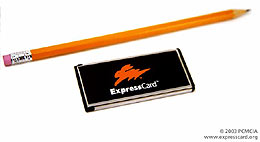 The ExpressCard is
clearly meant to be a technology that bridges the gap between current notebook
designs and future PCI Express enabled ones.
The ExpressCard is
clearly meant to be a technology that bridges the gap between current notebook
designs and future PCI Express enabled ones.
The
interface and form-factor (similar in appearance to the current PC Card form
factor for laptops) supports both USB2.0 and PCI-Express, allowing
manufacturers to implement one or both without worrying about being ahead of or
behind the times.
Intel
has used ExpressCard technology as an integral part of their 'Marble Falls'
small form factor PC technology demonstration. ExpressCard slots will not
be compatible with previous PC Card peripherals.
Adding
to the potential flexibility of the PCI Express system, is the capability of
external connections. The same 200MB/s point-to-point connections could be
extended over cable outside the box to a distance of approximately 5 meters.
Add this to the fact that designated PCI Express connectors will be
hot-pluggable, and you have the potential for some very interesting uses of the
technology.
External PCI Express devices road mapped
Among
other things, Intel has suggested a topology for the future that would separate
the computing unit from the monitor, interface devices and external drives
using PCI Express cable connections as a go-between.
A
concept PC like that would enable complete modularity in servers and even
desktop systems if manufacturers are willing to accept it. Of course, this is
significantly beyond the current plans for PCI Express, but if the technology
is capable of supporting more user friendly expressions of computer form, they
will probably be developed.
PCI
was developed in part to make computer configuration easier to handle, so there
is no reason why PCI Express should not take this to a new level. External
video cards, anyone? Speaking from past experiences, I don�t know how many
times external components have been mentioned as a �wave of the future� type of
thing; how about an entirely component based PC like a stereo system?
It
is unlikely that the makers of Firewire and USB 2.0 devices have much to worry
about in the short term, despite the apparent ability of the PCI Express
technology to carry out their roles without even requiring a bridge to connect
to the rest of the I/O system. USB and Firewire devices are already very
common, and by the time external devices supporting the PCI Express
specification become available in a year or two, they should have become so
prevalent in the market that manufacturers will have to continue support for
them for the same reasons that PCI Express was designed to coexist with PCI
2.2.
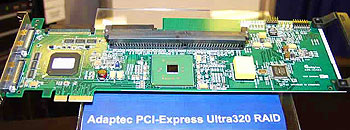 Also, the ExpressCard
format explicitly combines USB 2.0 and PCI Express in a single slot for
portable and small form factor devices. This is both an indication that PCI
Express is not necessarily intended to supplant USB anytime soon, and a
concession to the continued usefulness of USB technology in the brave new world
of sometime next year.
Also, the ExpressCard
format explicitly combines USB 2.0 and PCI Express in a single slot for
portable and small form factor devices. This is both an indication that PCI
Express is not necessarily intended to supplant USB anytime soon, and a
concession to the continued usefulness of USB technology in the brave new world
of sometime next year.
PCI
Express does not compete with AMD's Hypertransport technology, but rather
coexists with it in order to move data more efficiently in chipsets like the
nForce 4 and K8T890.
Likewise,
PCI Express is intended to serve as the underlying data-transport technology
for I/O methods like serial ATA and SCSI, not to replace them. PCI Express is
going to replace AGP as the conduit between the graphics chipset and the
processor and memory however.
 As you can see, the
modularity of the PCI Express system should enable it to carry out many
different roles in the computer industry. As manufacturers will have the
capability of deciding how much bandwidth to assign the needs of a specific
market. Commenting on server technology is slightly beyond the scope of this
article, but it is easy to see how PCI Express technology could work well in
this high-data area.
As you can see, the
modularity of the PCI Express system should enable it to carry out many
different roles in the computer industry. As manufacturers will have the
capability of deciding how much bandwidth to assign the needs of a specific
market. Commenting on server technology is slightly beyond the scope of this
article, but it is easy to see how PCI Express technology could work well in
this high-data area.
The
PCI Express architecture is not intended to replace current CPU/memory bus
technology, but rather to work with it by providing more available bandwidth
and flexibility for the rest of the I/O system.
While
it was originally believed that the PCI Express developers group might be
looking at ways to standardize the CPU and memory buses within the system as
well this is not part of the final approved specifications.
Industry
heavyweights ATI, Nvidia, and even AMD have already given PCI Express their
support for years to come. With endorsements like that it seems inevitable that
the PCI Express I/O system will be the basis for the forseeable future.

Copyright � 2003, All Rights Reserved. Mobile : +91(0) 9811328969, @mail :- [email protected]