| What is a Polygon? | ||||||||||||||||||||||||||
| Math definition: | ||||||||||||||||||||||||||
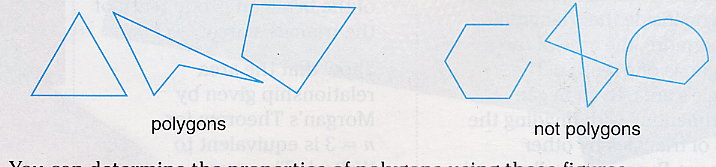
| A polygon is a closed figure formed by a finite number of coplanar segments such that: 1. The sides that have a common endpoint are noncollinear 2. each side intersects exactly two other sides, but only at their endpoints. |
||||||||||||||||||||||||||
| Simply Explained: | ||||||||||||||||||||||||||
| There are no openings in the figure No sides overlap The sides only meet at their endpoints each side meets with two other sides. |
||||||||||||||||||||||||||
![]() |
||||||||||||||||||||||||||
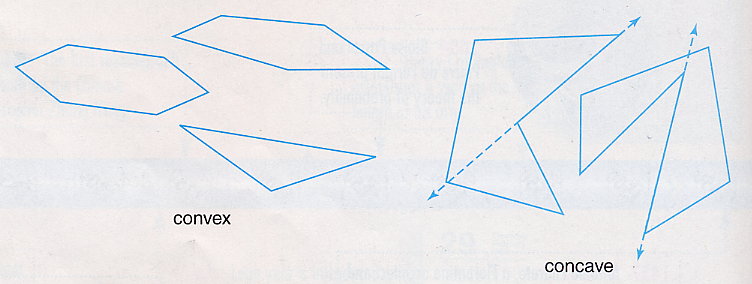
| In a convex polygon, all of the sides will point outward if they are extended. In a concave polygon, some of the sides will point inwards and have points inside of the figure. Think of concave like a "cave" because it moves into the figure. |
||||||||||||||||||||||||||
![]() |
||||||||||||||||||||||||||
| In a regular polygon, all of the sides are congruent and all of the angles are congruent. | ||||||||||||||||||||||||||
| Figure Name Triangle Quadrilateral Pentagon Hexagon Heptagon Octagon Nonagon decagon 11-gon Dodecagon |
Sides 3 4 5 6 7 8 9 10 11 12 |
|||||||||||||||||||||||||
| Sum of interior angles 180 360 540 720 900 1080 1160 1340 1520 1600 |
||||||||||||||||||||||||||
| If n is the number of sides, and S is the sum of the angles, the formula to find the sum of the interior angles is S=180(n-2) In a concave figure, the sum of the exterior angles (the angles formed by the extension of all of the segments in one direction) is 360. |
||||||||||||||||||||||||||
| Home | ||||||||||||||||||||||||||