CHANG NOI
|
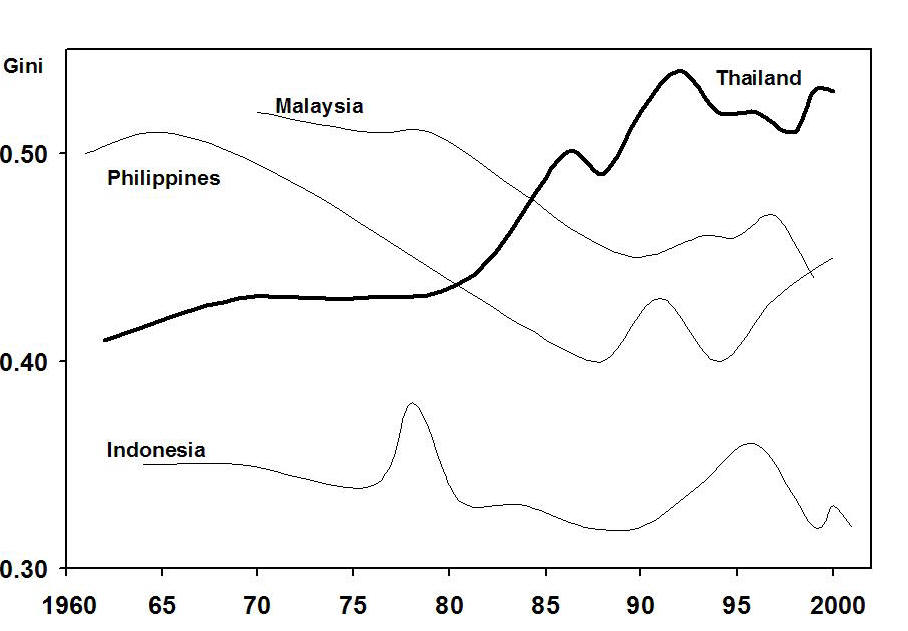
Thailand’s big divide 18 aug 2003 Take a look at this graph. It plots the trend in income inequality, the gap between rich and poor. A high figure means high inequality, a big gap between rich and poor. If the graph is going up, it means inequality is getting worse.
The graph is very striking because it contrasts Thailand with countries that are close at hand and moderately similar. Thailand, Malaysia, Indonesia and Philippines are all located in Southeast Asia; they still have sizeable rural sectors; they have been pursuing fairly similar development policies. But the contrast between these countries in the trend of inequality is huge. In all three other countries, the situation has been getting better over the long term. In Thailand, it has been getting worse. Much worse. This is not a short-term thing. The graph covers forty years. In all three other countries, the downward (improving) trend has been fairly consistent over this period. In Thailand, the trend in the opposite (worsening) direction has been equally consistent. In Malaysia and the Philippines (until the financial crisis), the scale of the long-term improvement was quite large. In Thailand, the deterioration between 1960 and 2000 has been spectacular. Over this whole forty-year period, there has only been one time (apart from a blip in 1988) when the gap between rich and poor narrowed in Thailand. That was in the six years of the early 1990s, before the financial crisis. Only when the economy was barrelling along out of control heading for a smash did the poor get a better share of the profits than the rich. Since the crisis hit, things have been getting worse again. The poor bore the brunt. The question is why. Why is the rich-poor gap getting worse in Thailand? Why is the trend so different from its neighbours? Why is the gap getting so much worse that Thailand is now one of the most unequal countries in the world? Nobody really knows. This graph was put together by researchers at the Australian National University who want to provoke someone to find out. There are several theories. Development economists used to argue that inequality was bound to get worse when an economy started to grow, but after a bit it would start to get better. Initially only a few people get the gains of growth, but eventually more benefit too. But that comforting theory doesn’t seem to fit. Thailand just goes on and on getting worse. So there seems to be something structural going on. Some economists used to blame it on education policy. In Thailand everyone got primary education but rather few got secondary. A decade ago, around 70 per cent of workers had only primary. Studies showed that people with secondary education have a much higher capacity to earn. The gap is wide because the poor don’t have the education which would let them earn more. If that is the cause, then things should get better soon. Over the last decade, the proportion of all teenagers at secondary school has gone up from a quarter to two-thirds. But probably education is only part of the explanation. Another theory is that government policies actually widen the rich-poor gap. Government gives investment-promotion subsidies which benefit only business owners and a few privileged workers. It is not very good at collecting taxes on business profits or rich people’s incomes, and instead relies on taxes like VAT which fall more heavily on the poor. It gives more subsidies to higher education, which is mostly enjoyed by the rich, than for primary education, which is for everyone. In the share-out of development spending, rich provinces often grab more than the poorer ones. In Bangkok, government spends billions on expressways and skytrains used by a rich few, and neglects the bus service used by the poor mass. Another theory argues that all the above about policy distortion may be true, but to understand why the government chooses those policies you have to look at politics. The rich control the government, and ultimately they look after themselves. Each time there is a crisis, or a major change of direction, the rich rulers are able to redraw the rules so they get a little bit more. In this respect, the shape of Thailand’s line on the graph is interesting. It takes a definite turn upwards in 1980, and then climbs very steeply until 1990. The 1980s was the decade when Thailand developed the “democratic” system best described as “money politics”. Maybe politics is the place to look for an explanation. Certainly there are signs that the recovery from the last crisis may result in the graph continuing on its upward journey. The luxury car market is booming. The luxury housing market is booming. This government may talk a lot about helping the poor, and indeed has a lot of genuine pro-poor schemes. But the effect of these may be less than their actions in favour of themselves and their peers. After all, last week we had a revealing glimpse of the mentality of someone right at the core of policy-making. Suriya Jungrungreangkit, the transport minister, paid four million baht for a car licence plate with the number 9999. This shows two things. First, the minister believes in magic. Second, in pursuit of this belief, he’s ready, able and proud to spend a sum equivalent to 50 years income for the average Thai citizen. Acknowledgements to Hal Hill and Matt Wai-Poi.
|