CHANG NOI
|
The Chang Noi corruption curve
3 December 1996
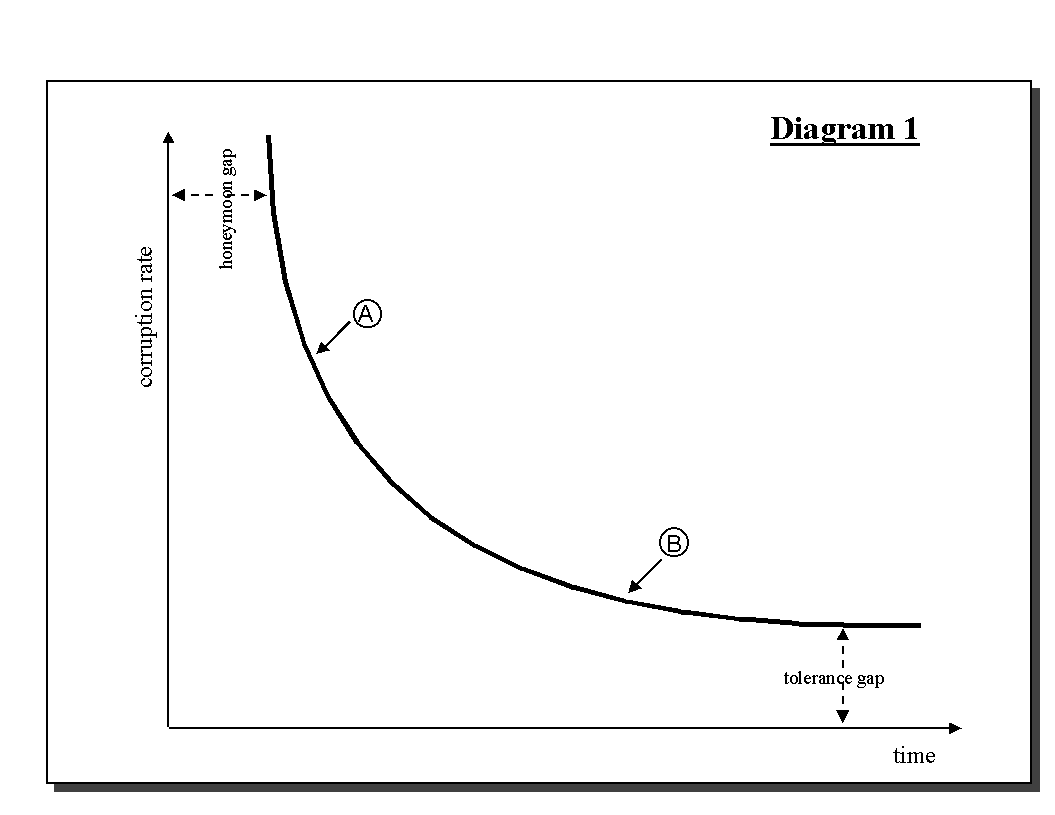
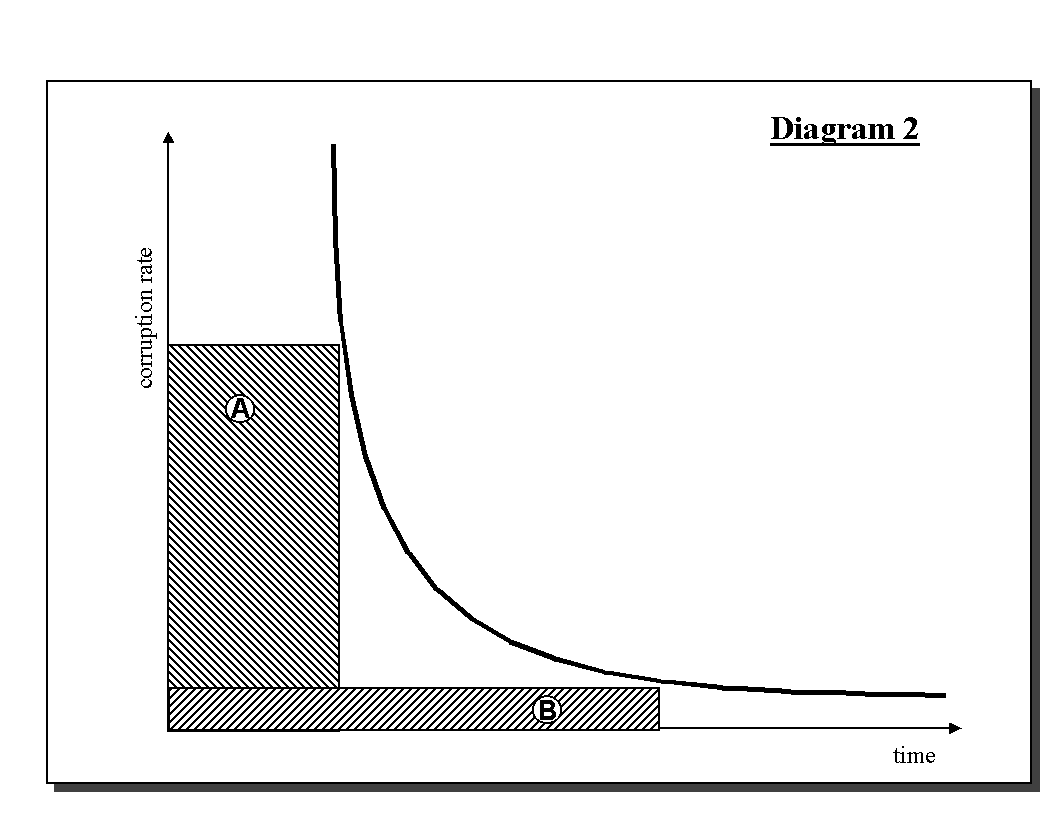
The Chang Noi "corruption curve" plots the relationship between a government’s rate of graft and the length of time it stays in office. The horizontal axis plots time. The vertical axis plots the corruption rate. This rate is not an exact measure in terms of millions of baht or percentages of GDP. Rather it plots perception: how corrupt people believe the government to be. The curve illustrates a simple contemporary truth: the more corrupt a government is, the shorter it lasts. The curve has a special shape with some other points of interest. At the top left, there is the honeymoon gap. Even if a government is amazingly corrupt, it will still have a short minimum stay in office. The public grants any new cabinet a honeymoon period. And technically it takes some time to get rid of a bad government. At the bottom right, there is the tolerance gap. Society is prepared to tolerate a certain level of political corruption. Khun Anand Panyarachun spoke last week about the need for the new cabinet to reduce corruption to a "manageable level". If a government can keep corruption below this level, then it can stay around for a long, long time. Towards the upper left (point A), the curve rises very steeply. This shows that when a government’s corruption rate rises above a certain level, public tolerance drops away rapidly, and the predicted life of the government shortens abruptly. this is the zone of public disgust. Towards the lower right (point B), the curve drops away gently. Beyond a certain point, quite modest reductions in the rate of corruption can greatly extend a government’s expected life. This is the zone of public comfort. The size of the total potential corruption revenue can be calculated as the corruption rate times the length of time in office. The shaded rectangles in Diagram 2 illustrate two different scenarios. In scenario A, the government is very corrupt but lasts only a short time. The total corruption revenue is illustrated by the size of the rectangle A. In scenario B, the government is less corrupt and manages to last longer.
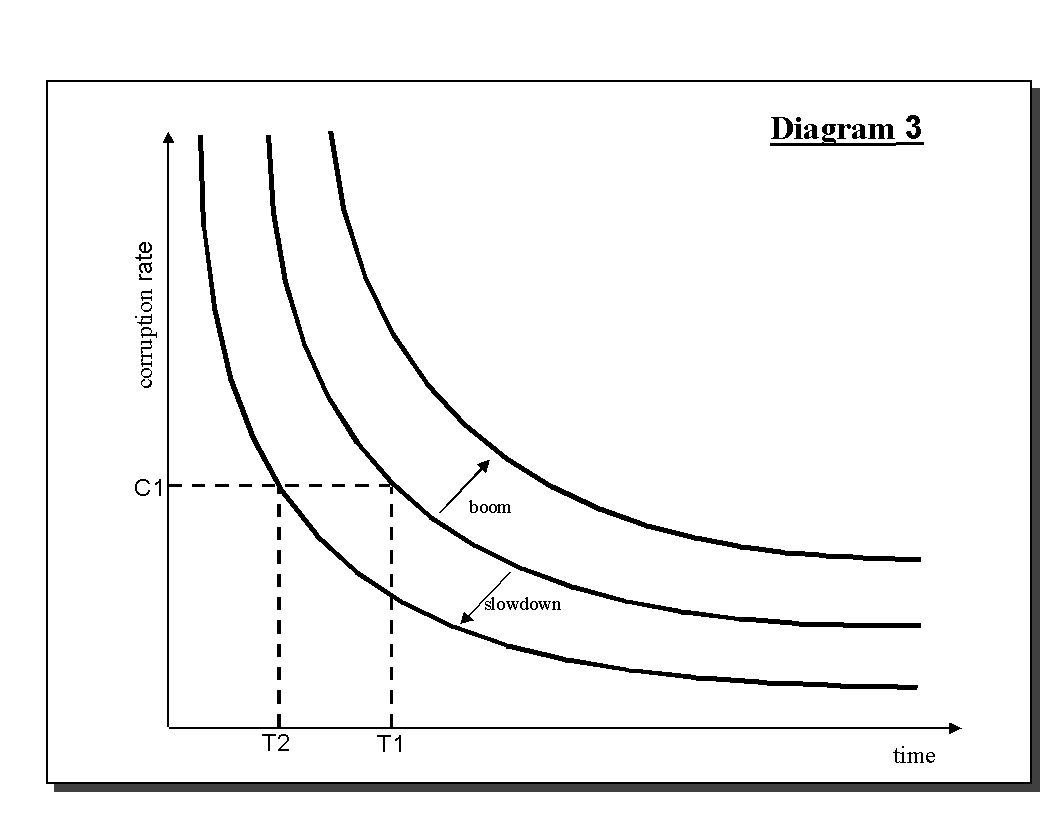
Diagram 2 shows that the optimal corruption strategy depends on the relative sizes of the honeymoon gap and the tolerance gap. If a government thinks the tolerance gap is small (the people won’t put up with much corruption at all) but the honeymoon gap is large (the people will always give a new government some chance), then the best strategy is to go for a high corruption rate even though it may mean only a short time in office. This is the situation illustrated in Diagram 2. Rectangle A is bigger than Rectangle B. This seems to have been the strategy of the Banharn cabinet. Many ministers launched very ambitious money-making schemes in the first month in office. And the cabinet appeared to make very productive use of its final caretaker period. For reference: both the Chatichai government (1988-91) and the Chuan government (1992-5) lasted 34 months, while the Banharn government (1995-6) lasted just 16 months. This does not mean that the Chatichai and Chuan governments had the same corruption rates. As Diagram 3 shows, the curve shifts depending on the economic growth rate. If the economy is growing very fast (as during the Chatichai premiership), the curve shifts outwards. The politicians can get away with more. At a given corruption rate, they can stay in office longer. More interesting right now is the opposite effect. When the growth rate drops, the curve shifts inwards. The tolerance gap shrinks: when people themselves are less well off, they are less tolerant towards political corruption. The honeymoon gap shrinks too: people look to the government for help, and will be less patient. The cabinet must reduce its corruption rate, or face being kicked out of office more quickly. But the demand for corruption revenue tends to be rather inelastic. In other words, politicians get used to the corruption income and don’t want to give it up. They also face steep inflation in the cost of running elections. Hence if a government wants to last a long time in a time of economic slowdown, it must do something positive to reduce the corruption rate. At his press conference last week, General Chavalit was asked about the corruption issue. He replied with a saying: if the boss doesn’t do it, the subordinates won’t do it either. This was a clever way to draw a contrast between himself and Banharn. But Chavalit refused to commit himself to any specific anti-corruption strategy. The existing machinery for combating political corruption is notoriously defective. Chavalit appeared to say he had no plans to do anything about it. He will trust to his own good example. Viewing the rest of his cabinet, this seems rather optimistic. It contains more refugees from Banharn’s Chat Thai than Chavalit’s own direct supporters. Six of its members were among those investigated in 1991 for being "unusually rich". Two non-MPs who helped finance the election campaigns have been given posts; either these posts are rewards, or they are to be used to replenish funds for the next election. And in an unprecedented move, the cabinet posts appear to have been distributed across ministries according not to workload but to potential income. According to Chulalongkorn University’s study of political corruption, the public perceives that the Interior Ministry ranks top in terms of corruption. It now has six ministers. The Communications Ministry ranked third. It now has five ministers. The Agriculture Ministry ranked fourth. It now has four ministers. Four ministries (Interior, Communications, Agriculture and Education) account for around 60 percent of all the government budget funds for capital items and purchases of materials and equipment (the portion of the budget most heavily looted in the past). Between them these four now have 19 Cabinet posts. In each of these ministries, the posts have been distributed around the various parties like candy to children. This has added a new aspect to the quota method of forming Cabinets. It suggest the corruption rate could be high.
|