My piece on music in
Scientific American.
New paper in the journal Complexity on the brain-like organization of cities.
LiveScience
(Yahoo News),
Reason,
The Atlantic,
Open Mag,
io9,
Technovelgy,
Digital City,
ScientificBlogging,
RPI press release,
Reprint
The research was also featured on Discovery Channel's (Sept 16, 2009)
Daily Planet TV show (7 min, 30 sec in).
My Lab,
My Blog,
LinkedIn,
Twitter,
Contact
MARK CHANGIZI
is a scientist with expertise in theoretical neurobiology, vision, cognitive science,
and language. Born in 1969 and raised in Fairfax, Virginia, he attended the Thomas
Jefferson High School for Science and Technology, and then went on to the University
of Virginia for a degree in physics and mathematics, and to the University of Maryland
for a PhD in math. In 2002 he won a prestigious Sloan-Swartz Fellowship at Caltech, and
since 2007 he has been an assistant professor in the Department of Cognitive Science at
Rensselaer Polytechnic Institute.
His research aims to grasp the ultimate foundations underlying why we think, feel and
see as we do. Focusing on "why" questions, he has made important discoveries on why
we see in color, why we see illusions, why we have forward-facing eyes, why letters are
shaped as they are, why the brain is organized as it is, why animals have as many limbs
and fingers as they do, and why the dictionary is organized as it is.
He has more than thirty scientific journal articles, some of which have been covered in
news venues such as the New York Times, Wall Street Journal, Newsweek, USA Today,
Time Magazine, Reuters, ABC News, Financial Times, Daily Telegraph, Scientific American,
Wired, Discover Magazine and Live Science. He has written two books,
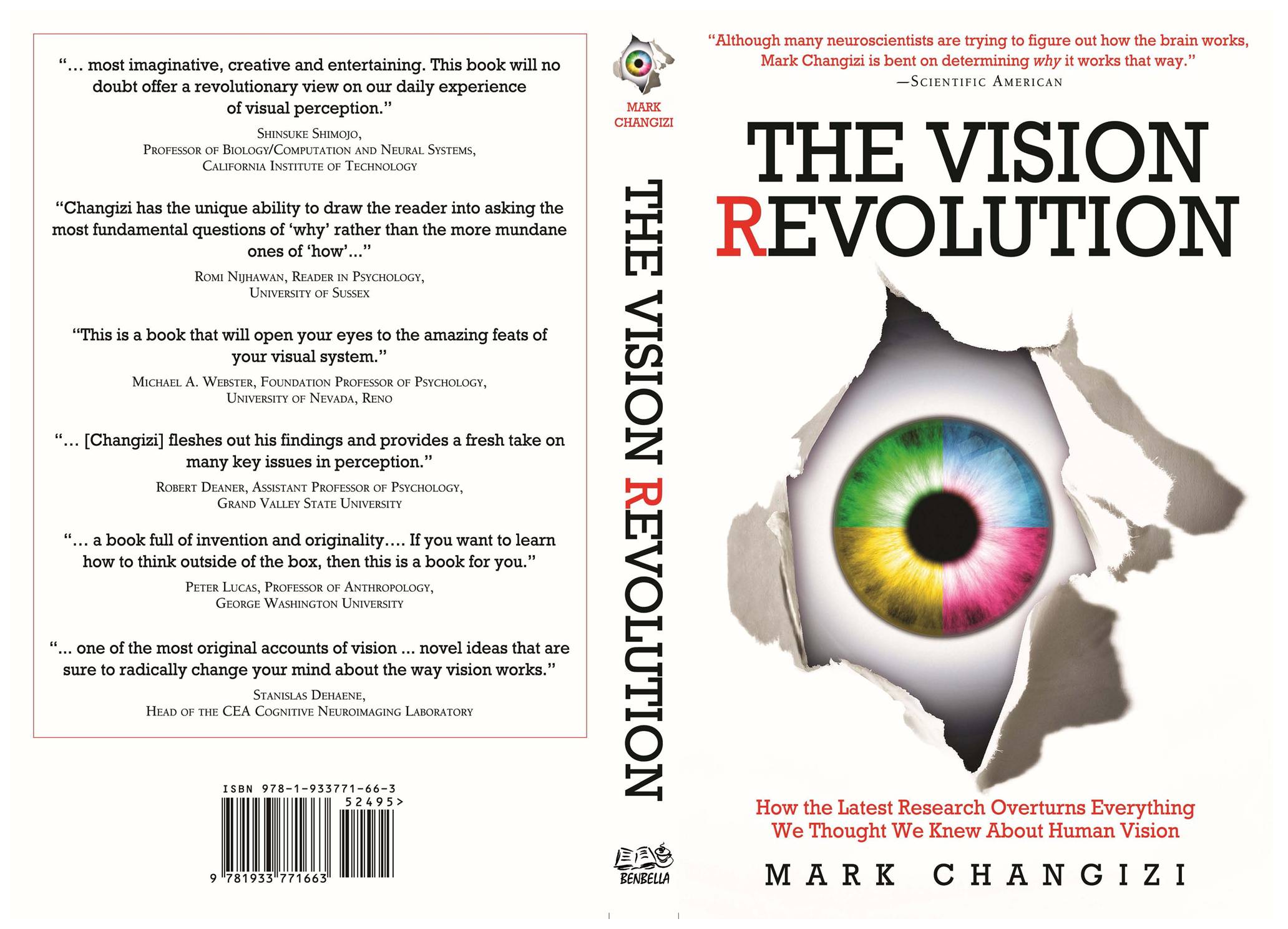
THE VISION REVOLUTION
(Benbella, 2009) and THE BRAIN FROM 25,000 FEET (Kluwer, 2003).
He is currently wrapping up his third book, HARNESSED: How Language and Music
Mimicked Nature and Turned Ape to Man.
Praise for THE VISION REVOLUTION:
"...the novel ideas...may have a big effect on our understanding of the human brain."
-- Wall Street Journal, June 19, 2009.
Book excerpt in WSJ.
"Changizi's theories are appealing and logical... ...will make you wonder the next time you notice someone blush"
-- Scientific American MIND, July 2009
"...surprising, overturning theories that have dominated primatology since the 1970s"
-- Barnes & Noble Spotlight Review, July 13, 2009
"Changizi challenges common notions regarding sight. ...keep[s] them... dazzled."
-- Publishers Weekly (starred review), May 11, 2009
The book has also been mentioned in interviews in the
New York Times and
Scientific American,