 This page published from my experiences and experiments.
 Modified on 06-10-05
This page published from my experiences and experiments. 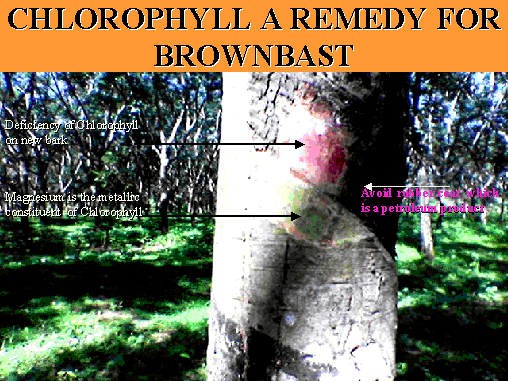
 |
I am thankful to Dr.Thomas Varghees (Retired Professor of Kerala Agricultural University) for
THE ROLE OF SECONDARY NUTRIENTS AND TRACE ELEMENTS IN PLANT NUTRITION
INTRODUCTION
Plants require 16 essential elements for their normal growth. They are Carbon (C), Hydrogen (H), Oxygen (O), Nitrogen (N), Potassium (K), Sulphur (S), Phosphrous (P), Calcium (Ca), Magnesium (Mg), Iron (Fe), Manganese (Mn), Molybdenum (MO), Berons (B), Zinc (Zn), Copper (Cu) and Chlorine (Cl)
Carbon is absorbed by the plants in the form of Co2 from air, Hydrogen and Oxygen are present in the water which is absorbed by the plant from the soil. The remaining 13 essential elements must be supplied through the soil. The importance of major nutrients N, P and K is generally accepted today. But the importance of Secondary nutrients Mg, S, Ca and trace elements B, Zn, Mn, Fe, Cl, Cu and Mo are unknown by the farmers.
MAGNESIUM
ROLE OF MAGNESIUM IN PLANTS
Mg plays a vital role in the plant nutrition. Mg found in all parts of the plants especially in the young leaves and the reproductive organs (eg. Seed) Mg. is a structural constituent of chlorophyll molecule. Chlorophyll is essential for Photosynthesis. Thus Mg plays a leading role in photosynthesis and in the formation of plant tissue. It also promotes a formation of sugar, proteins, fats and vitamins in the plant. As an enzyme activator it is involved in respiration, cell division, synthesis of ATP (Phosphorglation) from ADP (Adnine - di - Phosphate) and inorganic phosphate and protein synthesis. Mg. increases resistance to harmful environmental conditions such as drought, diseases and infections.
The interaction of Mg with other nutrients are very important in plant nutrition. For eg. Mg and the major nutrient P act synergistically (Co-operative and beneficial action). Mg. increases the P intake and aids the transport of P in Plants.
The various crops differ in their Mg requirements. Citrus fruits require a particularly large amount. Tobacco, potatoes, cotton and maize are sensitive to a shortage of Mg. Mg is withdrawn from soil at harvest.
Mg is normally found in varying quantities in all types of soil. Alkaline soil usually have an adequate Mg content. Mg. is often lacking in all light, acid and organic (Peat) soil. It is easily leached from the soil especially when it is present as a sulphate or a carbonate.
DEFICIENCY OF MAGNESIUM
A shortage of Mg in the soil causes Mg deficiency in the plant as a rule. Mg deficiency first appears in the lower, older leaves often towards the end of the vegetative period.
Besides affecting crop growth and reducing yield, a shortage of Mg can also cause direct damage. Eg. if grass with low Mg content is used as a fodder grass tetany (hypomagnesemia) is well known in the intensive cattle - rearing areas of Europe. This deficiency disease is caused by a shortage of Mg in the blood serum, and is particularly common in early spring, when the animals are given the first young fodder which is often low in Mg. The addition of Mg salts soon overcomes the problem. The risk of this fatal disease can be reduced prophylactically by applying a Mg fertilizer to the pasture.
Major deficiency symptoms are the following
1. Poor Carbohydrate production because of reduced photosynthesis.
2. Chlorosis (appearance of yellow colour instead of green colour in leaves) between the veins of older leaves.
3. Necrosis (localised death of plant tissue)
Many progressive farmers throughout the World have already recognised the importance of the secondary nutrient Mg. Mg can thus increase the yield and improve the quality of the crops.
SULPHUR
Sulphur is essential for the formation of vegetable protein. The plant therefore needs sulphur which is normally absorbed by the roots in mineral form (So4) and carried to the leaves where it is in corporated, principally in the form of amino acids. Some atmospheric sulphur is also absorbed by the green parts of the plant. Once converted to an organic substance the sulphur usually ceases to move within the plant, except for considerable amounts transported to the fruit during ripening. As ca. 70% of the sulphur is found in the green parts, which contain the chloroplasts, sulphur plays an important role in the assimilation of other nutrients.
Sulphur stimulates plant development. Like nitrogen it plays a role in the production of the dark green leaf colouring, which guaranties optimal chlorophyll activity. During periods of sulphur deficiency the young leaves turn light green and then yellow, and growth stunted. Affected plants have small, narrow leaves and the yield is reduced. the veins nevertheless remain dark, in contradistinction to nitrogen deficiency, although the contrast is not as clear as in the case of iron chlorosis.
Sulphur in the soil is usually found in organic form and is therefore protected against leaching, to which mineral sulphur (plant-available), like nitrate nitrogen, is subject. Before absorption by the plant the sulphur must be converted to a mineral form. This is the work of the soil flora, provided that optimal conditions (temperature, water and pH-value) are available. In this case the soluble sulphur content is ca. 2 mg/100 g dry soil. If such favourable conditions are not present, a sulphur deficiency is likel, unless sulphur is added in the fertiliser.
Sulphur deficiency is rarew in the area surrounding large cities and industrial centres as part of high atmospheric sulphur content is either absorbed directly by the plant or washed into the soil by rain and absorbed by the roots.
SULPHUR UPTAKE BY IMPORTANT CROPS
Part of the sulphur content is transferred to the fruit during ripening, and therefore removed from the soil at harvest. The amount of sulphur carried away will be particularly high if all the vegetation growing above the ground is removed.
Sulphur withdrawal in important crops
|
Crop |
Yield dt/ha |
S-loss kg/ha |
| Cereal (grain)
potatoes (tubers) Sugar beet (beet and leaf) Lucerne Cotton seed Coffee (berries) Bananas (bunches) Hevea (latex) |
40
225 350 120 20 20 350 45 |
6
11 32 33 5* 4* 5* 0.2* |
* These figures refer to the harvested crop only, and not to the total amount of sulphur required for plant growth. This figure is higher, a fact which should be borne in mind during fertilisation.
SULPHUR FERTILISATION
A fertiliser containing sulphur should be used wherever the amount present in the atmosphere and the soil fails to give adequate results. Ammonium sulphate, the oldest synthetic N-fertiliser, supplies the plant with more sulphur than nitrogen. These secondary components in fertilisers were formerly regarded as "inert matter" and left out of the list of contents. For reasons of economy, highly concentrated fertilisers are taking over, especially in overseas areas, and the quantity of inert matter is the first to suffer. The increase in sulphur deficiency makes clear the importance of these secondary components as nutrients.
"COMMENTS AND SUGGESTIONS"
Major recommendations in the book ' The role of secondary and trace elements in plant Nutrition' written by Dr. D.U. Belger, A. Fritz, H. Irschick printed and published by BASF Aktiengesellschaft, 6700 Ludwigshafen, Federal Republic of Germany is compatible to my experiences and experiments.
Let me add further recommendations from experiments. Mg must b applied only alkaline soil (Do not apply other fertilizers which are acidic along with it). Calcium carbonate can be applied to maintain alkaline soil in the summer rain with Mg. Calcium is always present in the plant ashes. Thus after seasonal leaf fall controlled burning is helpful to apply Mg in summer rain as alkaline soil.
I hereby recommend application of Mg in the soil to maintain new bark of rubber trees alive with chlorophyll to avoid Brown bast and to prevent Necrosis as well. After the vegetative period (up to the flowering and seeding) deficiency of Mg is a reason of leaf fall from the lowest branches and the branches becomes dry.
Functions of other elements will be published as soon as possible.
13/05/05 Kerala, Thiruvananthapuram
"Suggestions and complaints are valuable to me" because I am presenting it with out any academic knowledge and only from experiments & experiences.
Important facts from plant anatomy written by P.C.Vasishta
Reserve Food Materials: The protoplasm manufactures its food from the simple inorganic substances like CO2 and H2O. The foods thus manufactured are partly used up to make new protoplasm and partly it is broken down to provide necessary energy, and the remaining food is stored as reserve food material in protoplasm of cells, specially meant for this purpose. These reserve materials are used by the protoplasm as and when required. The reserve food may be stored in the form of solid and insoluble particles in the cytoplasm, or it may be stored in solution in the vacuoles. These reserve foods are of three principal types: (1) Carbohydrates, (2) Nitrogenous materials, and (3) Fats.
1. Carbohydrates. These are compounds of carbon, hydrogen, and oxygen derived more or less directly from carbon dioxide and water during the process of photosynthesis. Sugars, starches, celluloses, dextrin, glycogen and inulin are examples of some carbohydrates that are found in the plants. Carbohydrates are the cheapest food and are chief sources of energy, and also supply carbon skeletons that are necessary for the manufacture of basic components of protoplasm. most of the carbohydrates are employed in the various industries (paper industry, fibres of various types), and some are employed in the production of alcohol. They are a chemical formula Cn(H2O)n. On heating, the carbohydrates form a black mass, which is carbon left behind as a result of escape of water.
2. Nitrogenous materials. Proteins, amino-acids and amines are the principal reserve food materials that belong to this group. They are very important and indispensable foods that enter in to the composition of protoplasm.
3. Fats and Oils. They are compounds of carbon, hydrogen, and oxygen. The last do not occur in the same proportion as in the carbohydrates. Only a little percentage of oxygen enters in to the composition of fats and oils. Nitrogen is altogether absent. They are concentrated sources of food and provide more calories as compared to proteins and carbohydrates. They are insoluble in water. Ether and ethanol are used to extract them from the cells. They are generally found in smaller or greater amounts in all plants and usually occur as minute globules in the protoplasm and are unable to be transported as such from cell to cell. They are abundant in fatty seeds and fruits e.g., Arachis hypogea, Linum, etc. Fats are solid at ordinary temperatures where as oils are liquids. Fats are synthesized from glycerin and fatty acids in the presence of an enzyme called lipase. The fatty acids (butyric acid, octanoic acid, palmitic acid, stearic acid) and the glycerin are formed in the protoplasm from the carbohydrates during the process of respiration.
An Email letter send to the concerned in India and to IRRDB on 31-03-05 and 01-04-05
Read report received from IRRDB.

