Kulkulkan Pyramid (El Castillo)
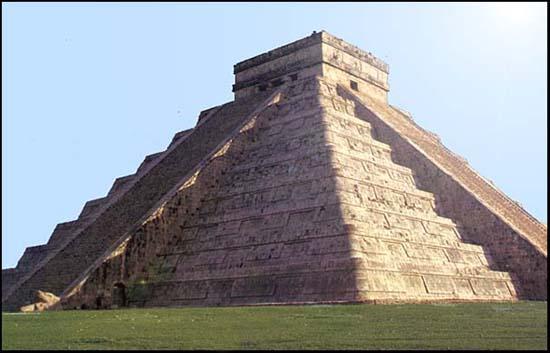
The Kulkulkan pyramid is one of the grooviest pyramids in our city. It's is not only a beautiful building, but it is also a calendar with loads of distinctive mathematics and as if this wasn't enough to amaze people for ages, every year it performs magical a trick on both the spring and autumn equinoxes.
Magic show
At the spring and autumn equinoxes on the stairway, that is oriented towards the north, a shadow falls over the north east angle of the pyramid. This shadow forms a pattern of 7 triangles that are connected to the serpent head (the head of Kulkulkan) at the bottom of the staircase, thus creating the illusion of a serpent crawling down from the pyramid.
Calendar*
On each side there's a staircase with each 91 stairs, so that makes 91x 4 = 364 add the platform on which the temple is build and you'll get 365 days: the total amount of days within the Haab calendar. This is the feature that is mentioned in every text about his pyramid, but there's more...
Mathematical information
The 9 layers of the pyramid are said to represent the 9 layers
of the Underworld.
The 91 stairs divided over the 7 triangles (the 7 layers on earth
or the middle world) of shadow results in 13; the sacred number
of the Tzolkin and at the same time the amount of layers that
are beleived to exist in heaven. On the top of the pyramid there
are 5 symbols on each side: 5x4=20 the seals of the Tzolkin.
On either side of the staircases you can count a total of
2 times 9 is 18 layers, add the platform and you'll get the number
of 19, this being the number of months in the Haab calendar.
18 times the four sides is 72 added with the platform makes 73
and guess what ... if the Tzolkin calendar has made 73 rounds,
the Haab would have made 52 rounds. This makes 18980 days. After
18980 days there were 13 "leapdays", so 18980 + 13
= 18993 divided by 52 = 365,25, the days in a year.
I'm sure there is even more information concealed in this pyramid... please let us know when you've figured out something new.
* For more information on the Mayan calendars,
take a look at the Observatory board.