Speaker impedance
The following
things have effect on speaker impedance :
- Voice coil's electrical impedance (resistance,
inductance, stray capacitance)
- Driver's mechanical impedance (stiffness, mass,
damping)
- Driver's acoustic radiation impedance
(resistance, reactance)
Speaker
Nominal impedance.
There is a
convention to the use of the term "nominal impedance", and if the
impedance over the majority of the bandwidth, specifically covering the range
in spectrum where majority of the musical spectral power occurs, it's 8 ohms. A single number cannot tell all there
is to tell about an impedance that varies with frequency. You must keep in mind that
'nominal impedance' is not defined in IEC.
Indeed, the electronics industry was advised when the Trade Descriptions Act
was introduced, that the word 'nominal' should no longer be used in
specifications. That is why the IEC
concept of 'rated value' is so useful.
There is a very detailed definition and explanation of this term in IEC60268-2. The IEC standard (IEC60268-3) allows any
"increase" above the rated value, but limits the "decrease". The standard does not allow the
impedance to fall below the 80 % of the nominal value at any frequency,
including DC.
Practical case.
In practice all
loudspeakers are a compromise, the designer is therefore free to allow the
speaker to suck more power from the amp in order to optimise other parameters. Most high-quality loudspeakers do dip
well below 80% of their nominal impedance at one or more points in the audio
band. Speakers which attempt to
present a flat impedance load using conjugate techniques have sometimes been
described as 'flat and boring', which may or may not be connected to their
excessively complex crossovers.
Speaker design is non-trivial ! Remember
that a specification is only of relevance when a product is claimed to meet it. A specification is only of value when
it lays down a minimum standard which is of relevance to the intended purpose
of the product. A high-quality
speaker may reasonably be assumed to be intended to be driven by a high quality
amplifier, hence minimum impedance is not an important criterion in
establishing sonic performance.
Measuring speaker
nominal impedance.
If you just want
to find out the nominal impedance of the speaker e.g. it is 4, 8 or 15
ohms then there is a rough & ready way.
Just use your multimeter to measure the DC resistance of the voice coil i.e.
across the speaker terminals (with nothing else connected) and multiply the
answer by 1.3. So if the DC resistance is say 6 ohms then the speaker is
nominally 8 ohm impedance. More complete analysis with minimal equipments
:
- A ) Measure the DC resistance across the voice coil
with the driver disconnected.
The ohm value you get, is the lower impedance bound of the driver. Add an ohm or two to this value,
and you should be at the nominal (rated) impedance of the driver.
- B ) Connect a pot in series with the driver voice
coil and then to the amp.
- C ) Connect frequency generator or CD player with
suitable test CD in it to the amp input, and start walking up the
frequency scale in steps. For
each step, measure the voltage across the voice coil terminals and then
across the pot. Adjust the pot
until both voltages match. Now
shut down the amp. and measure
the resistance across the pot.
This is the driver impedance for the current drive frequency.
This
approach is not the most accurate, but it needs minimal set of measuring
equipments: multimeter, signal generator and a potentiometer of 50 ohms 5-10
watt. The clear advantage of this
approach is that the accuracy of the measurement is not affected by the
multimeter frequency response (their AC range is designed to show right values
at around 50 Hz range and at higher frequencies the accuracy can drop noticeably
depending on the meter construction, but this does not affect in this measurement
because the absolutely correct AC voltage values are not needed). Warning,
Speaker Model.
The single most
dominant branch of the model is the voice coil DC resistance, Re. It's going to be in series with
everything else we will look at (you mentioned "stray capacitance". Yes, there is some, but it's
magnitude is absolutely miniscule compared to all other components so it can be
ignored).
Next we have the
voice coil inductance (we'll call it Lvc).
Now, it, too, is in series with everything else, but it's no simple inductance.
So far, we have
the two real electrical components, and they look like:
o-----Re------Lvc----o
Now,
the next major set of components are the electrical equivalents of the major
mechanical components of suspension compliance, cone mass and suspension losses. The suspension compliance is modelled
as an inductor, Lces. The cone mass
is modelled as a capacitance, Cmes, and the suspension losses are modeled as a
resistor, Res. These three are in
parallel and form a damped, parallel resonant branch called the driver
mechanical branch.
Finally, in
series with that, is the radiation impedance. No single lumped-parameter synthesis comes close to approximating
this. Also the magnitude of the
impedance of this branch is small compared to the others, so for simulating the
ELECTRICAL characteristics, it can be safely eliminated.
The driver
electrical model, then, looks like this :
o------Re------Lvc------+ | +------+------+ | | | Lces Cmes Res | | | +------+------+ | Xrs | o-----------------------+
Now,
the relative values of these components depends upon the magnitudes of the
physical values times a transformation factor. That transformation factor is the electromagnetic transduction
factor, proportional to the Bl product (the product of the length of the wire l
immersed in the magnetic field B), measured in N/A (or T/M, if you will). So, IF we know the magnitudes of the
physical components, we can easily calculate their electrical equivalents :
Re - don't calculate it, just measure it with a good ohmmeter! Lvc - measure it, but see below! Lces - depends upon the suspension compliance : 2 Lces = Cms (Bl) Where Cms is the mechanical compliance in m/N, and the resulting inductance is in henries.Cmes - depends upon the cone mass : 2 Cmes = Mms/(Bl) Where Mms is the mechanical compliance in kg, and the resulting capacitance is in faradsRes - depends upon the suspension losses: 2 Res = (Bl) /Rms Where Rms is the mechanical losses in 1/s, and the resulting resistance is in ohms. Xrs - depends upon the air, the driver diameter, the baffle dimensions, position of the driver on the baffle, etc., but has little effect on the electrical impedance.
Typical characteristics.
For example, a
typical 8" woofer with an Fs=30 Hz, Vas=60L, Qms=2.40, Qes=0.42, Qts=0.36, Re=6.25 ohms, might have the following mechanical parameters:
- 3 Cms = 1.01 x 10 m/N, - 3 Mms = 27.9 x 10 kg, Rms = 2.19 kg/s Bl = 8.84 N/A
Then, the electrical
equivalents would be:
Lces = 78.9 mH Cmes = 356 uF Res = 35.7 ohms Re = 6.25 ohms
Effect of enclosure
One can construct
a similar branch for the enclosure, using the lumped parameters of a capacitive
equivalent Cmep for the port mass Mmp, amd inductive equivalent Lceb for the
enclosure compliance Cmb a resistive equivalent Reb for the system losses Rmb
and the port radiation impedance Xrp (which is, again, small). That branch looks like:
o------+ | Lceb | Cmep | Rmb | Xrp | o------+
The
complete driver + enclosure + electrical model looks like :
o------Re------Lvc------+------------+ | | +------+------+ Lceb | | | | Lces Cmes Res Cmep | | | | +------+------+ Reb | | Xrs Xrp | | o-----------------------+------------+
Now
there are some other complicating elements that would make for a complete
mechanical and acoustical model, such as the mutual coupling of the driver and
port, etc., but for the electrical
model the above suffices quite well for predicting reality.
Typical impedance
characteristics of speaker element at different frequencies.
Let's look at the
impedance of a very typical driver.
It has the following characteristics :
- At DC, the impedance is completely dominated by
the DC resistance of the voice coil
- As you increase in frequency towards the fundamental
mechanical resonance, the reflected motional impedance begins to dominate
and is inductive in nature.
However, the total phase angle of the impedance RARELY exceeds 45 degrees
and thus the resistive and reactive (inductive) parts of the impedance are
just about equal.
- At fundamental resonance, the impedance is
purely resistive, its phase angle is 0, and is determined by the effective
series combination of the voice coil DC resistance and the reflected
mechanical losses of (primarily) the suspension (Re + Res in standard
Thiele/Small notation).
- Above fundamental resonance, the impedances
drops, has a negative phase angle (rarely exceeding 45 degrees) and is,
surprise, capacitive in nature.
The impedance drops until...
- In the midrange, it approaches the DC resistance
of the voice coil it is SLIGHTLY higher than that DC resistance for a
variety of reasons, typically about 10-20% (and THIS is the region that is
used by MOST reasonably responsible manufacturers for specifying the
nominal impedance). The
impedance at these frequencies is predominantly resistive in nature and is
dominated by the DC resistance of the voice coil.
- Above this region, the inductance of the voice
coil begins to influence the impedance.
However, it NEVER becomes purely inductive, or even remotely close. First, over the majority of the
range of operation, the voice coil resistance still dominates. Second, eddy current losses in
the pole piece dominate quickly, such that the phase angle of the
impedance approaches about 45 degrees, and NEVER 90 degrees, which would
be necessary if your assertion that the impedance was almost a pure
inductance were true.
Impedance
of a speaker IS NOT ALMOST A PURE INDUCTANCE. It is NOWHERE NEAR a pure inductance. The impedance of a speaker is only a rough average of the
impedance and that the the voice coil dc resistance of most normal cone type
dynamic speaker is roughly 75% of its "rated" impedance as the
industry rates impedance. Most 8 ohm
speakers will measure somewhere around 6+ ohms dc give or take a bit. (When horn loaded, the impedance
increases).
Impedance and Effiency.
Let's look at the
following situation : Take an 8 ohm
speaker and wind twice the length of wire onto the voice coil. The resistance will go up, for sure,
but because there is no more wire in the gap, the electromagnetic couping
coefficient, the Bl product, would also go up. And you would have, as a result, a 16 ohm speaker with
essentially the same efficiency as the 8 ohm speaker, all other things being
equal. Or you could design a speaker
with both a higher impedance (longer wire in the voice coil) AND a larger
magnet assembly with higher flux density in the gap and get a higher impedance
driver with higher electro-acoustic efficiency. Or you could design a
higher impedance driver with a stronger magnet and a lighter cone and get even more
efficiency.
The point is, the
rated impedance IS NOT the same as the efficiency, nor is there any direct
correlation between the two.
Efficiency of a given direct readiator driver is determined by the following
relationship :
2 2 B l n0 = k * ------------ 2 2 Re Sd Mas
where
- k is a
constant determined by the properties of air
- B is
the magnetic flux density in the gap
- l is
the length of wire in the magnetic field
- Re is
the DC resistance
- Sd is
the radiating area of the cone
- Mas is
the effective total moving acoustical mass of the driver.
So, we can see
that by doubling the length of the wire that's in the gap (doubling l) will, by
itself, increase the efficiency by a factor of 4, but since Re also doubles, it
drops it by half, meaning that, all other things being equal, lengthening the
voice coil winding in the gap increases BOTH impedance AND efficiency. Now, there ARE tradeoffs, and
everything CAN'T be equal.
Lengthening the wire ALSO increases the mass, though the voice coil is only
part of a larger mass (it includes the voice coil former, the cone, and so on)
so there is not a direct relation.
Also, the gap may need to be widened to accommodate the greater winding diameter
of the voice coil, and that may reduce B.
Add resistance certainly reduces
efficiency all by itself. You could,
for example, just simply solder a resistor in series and, lo and behold, the
impedance goes up and the efficiency goes down. But we already have a case where the efficiency goes up as the
impedance goes up. You could wind the voice coil with the same
length of finer gauge wire. The
result would be the impedance goes up, and so does the resistance, but since l
remains about the same, l^2, remains the same and the efficiency goes down. But wait!, finer wire means less
mass, so we can gain some efficiency back from that and the finer wire means a
smaller thickness to the voice coil, and the designer may be able to close up
the gap and increase B. Or, the designer may just design a
TOTALLY difference driver with a different B, a different l, a different cone
diameter (changes Sd), a different moving mass and a different resistance and
get something totally different efficiency wise. The point being is that a
statement like "The higher the impedance, the lower then efficiency,"
as a generalization has NO basis in physical fact.
IMPEDANCE IN AUDIO TECHNOLOGY.
Several
years ago I wrote four separate articles on Loudspeaker Impedance that were published
in various Peavey Monitor Magazines.
Realizing that many people may not have read each of the articles, I have
decided to address the subject of Impedance in audio once again. This will be a detailed technical
paper that will start out with the basics so that sound system operators and
technicians may have an opportunity to establish a thorough understanding of
the fundamental concepts of loudspeaker impedance and their applications. I will also continue to address the
subject of impedance as it applies to the interfacing of those electronic
components ahead of the power amplifier.
In order to completely understand the workings of impedance, one must grasp the
mathematical aspects of impedance and Ohm's Law. Ohm's Law is actually quite simple. However, some people get glassy eyed when it comes to any kind of
mathematics. If you want be just a
roadie in the music industry, you may not need to understand Ohm's Law. However, if you want to be the best
sound system engineer, you must fully appreciate the principles set forth in
this paper. You don't have to
understand this to operate a system, but if you are connecting sound system
components together and you ignore Ohm's Law, you are destined to literally pay
for your ignorance with your pocketbook.
So don't let impedance be an impediment to your success.
LOUDSPEAKER IMPEDANCE.
A
simple definition of impedance is "the opposition of one thing to another." For an analogy : you are in a room and you would like
to leave that room, but if there were a 365-pound wrestler standing in the
doorway and he didn't want you to go through the door, he would represent a
significantly high impedance. He
could easily impede or prevent you from going out of the room. If, one the other hand, some person
much smaller and lighter than you were standing in the doorway, he would not
offer much opposition to you if you truly desired to go through that doorway.
A loudspeaker's impedance is its
opposition to current flow from the power amplifier. It is the current flow from the power amplifier that actually
performs the work, or causes the voice coil attached to the paper cone to move
back and forth in the magnetic field, which causes the loudspeaker cone to
start the air molecules bumping in to each other to produce what we hear as
sound. The more current that flows
in the voice coil, the greater the cone's motion and the higher the sound
pressure level, i.e., the louder the sound that is
produced. The loudspeaker is a
transducer, or a device that changes energy from one form into another. The loudspeaker takes the electrical
current produced by the amplifier and transforms it into acoustical energy,
thus creating a phenomenon we recognize as sound. However, the loudspeaker is far from being 100% efficient. The electrical current that is not
converted into acoustical energy is converted into another form of energy we
know as heat. Since impedance is the
opposition to current flow, the higher the loudspeaker's impedance, the less
current flow from the power amplifier.
The lower the loudspeaker's impedance, the more current will flow from the
amplifier. The power amplifier
produces energy in the form of both voltage and current. Voltage is analogous to pressure or the potential to do some work. Power in watts represents the amount
of work that can be accomplished.
The voltage potential itself does not produce the power. Power is only produced when there is current flow. The more power, the more work that
can be done. Voltage represents the
potential to create power or do work, but the power necessary to do the work is
not produced until there is significant current flow. I think it is important to understand the consequences as far as
power demand from the amplifier is concerned when you connect different
loudspeaker loads to the output. It
is for this reason that I am going to discuss the relationship between the
loudspeaker's load and power before I illustrate actual loudspeakers in series
and parallel. Don't panic; it's
fairly simple math (multiplication and division).
Electrical power represents the amount of work accomplished by the electrical
pressure (voltage) acting on the load or the loudspeaker. Another term used to describe this pressure or voltage in the
past was electrical-motive-force (EMF), which has been shortened to E when
representing voltage mathematically.
Electric current (I) represents the rate or number of electrons flowing in an
electrical circuit. Electrical
pressure of the unit of electro-motive-force is a form of potential energy that
is measured in volts (voltage), named after Count Alessandro Volta (1745-1827),
an Italian physicist and pioneer in electricity. Electrical current is
measured in units of amperes, named after French scientist Andre Ampere,
(1775-1836). One Ampere of current
(one amp) represent 6.24196 X 10 (to
the 18th) electrons flowing past a given point in a electrical
circuit in one second. The
opposition to current flow from a power amplifier is determined by the rated
impedance (measured in ohms) of the loudspeaker system. One ohm is the unit of resistance that will limit the current
flow to one ampere when an electrical pressure of one volt is applied. The unit of measurement for Power is the Watt,
so named to honor James Watt (1736-1819), a Scottish inventor and engineer. James Watt is credited for inventing
the Steam Engine, which was the first self-powered machine.
OHM IS NOT A CHANT !
George Simon Ohm (1787-1854) was a
German physicist who quantified the relationship between voltage, current, and
resistance. The unit of resistance was
named in honor of George Ohm. One
ohm is the opposition offered to the flow of current by a uniform column of
mercury 106.3 centimeters in length
and one square millimeter in cross-sectional area (mass = 14.4521 grams), at 32 degrees Fahrenheit
or 0 degrees Centigrade.
OHM's LAW.
The
fundamental formula of Ohm's Law is quite simple: The amount of current flow
when one Volt encounters 1 Ohm of resistance is equal to 1 Ampere of current. Another simple corollary regarding
power is: 1 Volt of electrical pressure (E) times 1 Ampere of current flow (I)
equals 1 Watt of power (W) or P = IE.
The amount of current flow measured in
amperes (amps) is a function of how much total opposition in both DC resistance
and AC impedance that the loudspeaker offers to the amplifier. Power (P), in watts, equals the
voltage (E) available from the power amplifier times the amount of current
flow, in amps (I), or P = I x E.
Power in watts (W) is also equal to the voltage available from the power
amplifier squared (E x E) divided by the resistance (R) of the loudspeaker (W =
E x E / R). Resistance is measured
in units of ohms. When it comes to
electrical measurements, it is much easier to measure the voltage potential
across a resistive load than it is to measure current flow through the circuit
itself. Therefore, if we know the
value of the load resistance, we can derive the current flow by measuring the
voltage and using two related formulas for power. The power amplifier in sound reinforcement technology acts for
the most part as a constant voltage source.
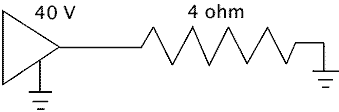
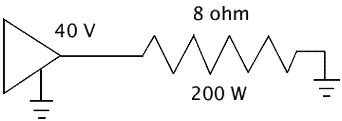
If there is a source voltage of 40 volts of potential from the amplifier and if
the loudspeaker has 8 ohms of resistance, then (W = E x E / R) 40 volts times
40 volts divided by 8 equals 1600 divided by 8, or 200 watts of power. If the same 40 volts were delivered
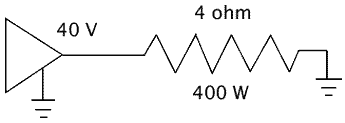
by the amplifier to a 4 ohm loudspeaker load, then we would have 40 times 40,
or 1600 divided by 4, or 400 watts of power.
W = 402 ÷ 8 =
1600 ÷ 8 = 200 watts
W = 402 ÷ 4 =
1600 ÷ 4 = 400 watts
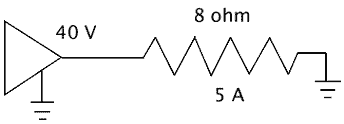
Let's find out what the current would be: P = I x E, so I = P / E ; 400 watts
divided by 40 volts would equal 10 amperes of current. Forty volts of electrical potential delivered to an 8 ohm
loudspeaker would result in 5 amps of current or I = 200 watts (P) divided by
40 volts (E) equals 5 amperes of current.
I = 400 watts ÷ 40 volts =
10 amps
I = 200 watts ÷ 40 volts =
5 amps
There is a device used by electricians to measure current directly, it's a type
of Amp-meter that employs a clamp that is placed around a single conductor in
an electrical circuit. This device
displays the current flow in amperes by measuring the magnetic flux field
generated around the conductor. This
magnetic field is directly proportional to the rate of current flow. It is designed primarily to read AC
current in power distribution systems so it is not very accurate at audio
frequencies above about 400 Hz. It
is much easier to treat the loudspeaker as if it were pure resistance to
calculate simple power produced. A
more complicated aspect of impedance is that when dealing with audio
frequencies (which are essentially alternating as positive and negative voltage
swings that cause the current to alternate in its direction of flow within the
voice coil of the loudspeaker), the actual opposition impedance to current flow
offered by the speaker is frequency-dependent. Loudspeakers are not purely passive resistors that generate heat. Loudspeaker systems offer a reactive
component in the form of inductance and capacitance, which are more complicated
forms of impedance. Inductors are
coils of wire that offer less opposition to low frequency current flow and more
opposition to high frequency current flow.
Capacitors are devices that can sustain an electrical charge and offer more
opposition to low frequencies and less opposition to current flow at high
frequencies. There is a certain
amount of capacitance between the actual windings of the voice coil wire itself. It is for this reason that
loudspeaker manufacturers publish what is said to be nominal impedance. The nominal impedance can be used to
calculate the power developed in the voice coil of the loudspeaker, and thus
simplify basic loudspeaker power handling calculations. In this next section we will show simple circuits to represent
simple combinations of loudspeaker opposition to current flow.
SERIES
CIRCUITS.
When loudspeakers are wired in
series, the impedance or opposition to current flow increases and less power is
developed. An 8 ohm speaker and an 8
ohm speaker wired in series would result in 16 ohms of resistance to current
flow. Forty volts times 40 volts
equals 1600. Sixteen hundred divided
by 16 ohms equals 100 watts. One
hundred watts divided by 40 volts equals 2.5
amps of
current flow.
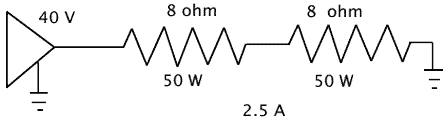
W = 402 ÷ 16 =
1600 ÷ 16 = 100 watts
I = 100 watts ÷ 40 volts = 2.5 amps
PARALLEL CIRCUITS.
When
loudspeakers are wired in parallel, the opposition to current flow from the
amplifier is decreased and more power is produced. Two 8 ohm loudspeakers wired in parallel would result in 4 ohms
of resistance to current flow. Forty
volts times 40 volts equals 1600.
Sixteen hundred divided by 4 equals 400 watts. Four hundred watts divided by 40 bolts equals 10 amps of current.
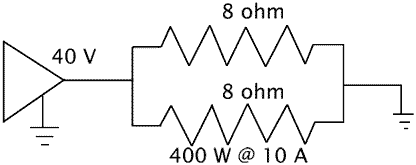
W = 402 ÷ 4 =
1600 ÷ 4 = 400 watts
I = 400 watts ÷ 40 volts = 10 amps
Actually, each loudspeaker or branch
circuit develops 5 amps of current flow.
Since there are two parallel branches, each develops 5 amperes of current
because 40 volts times 40 volts divided by 8 ohms equals 200 watts in each
parallel circuit branch, and 200 watts divided by 40 volts equals 5 amps of
current flow for each speaker. Five
amps of current in each branch equals 10 amps of total current flow from the
power amplifier. W = 402/
8 = 1600 / 8 = 200 watts. I = 200
watts / 40 volts = 5 amps x 2 circuit branches = 10 amps.
When
working with loudspeakers, don't mix speakers with different impedances in the
same enclosures. They would not be
able to perform at the same power levels and therefore would not combine their
acoustical outputs so as to mutually reinforce one another. Some people who only
understand the direct current aspects of loudspeaker impedance have tried to
fool a speaker system by using resistors to balance out the equivalent
resistive circuit. This also limits
the loudspeaker's abilities to combine acoustically in a constructive manner,
since resistors do not produce sound.
Therefore, if you only deal with
loudspeakers of like impedances, then the rules of thumb to calculate
equivalent load impedance are simplified.
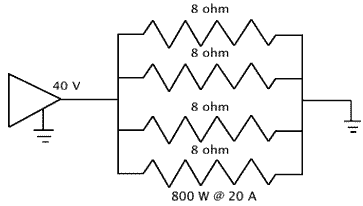
In series circuits, take the number of like impedance loudspeakers placed in
series and multiply them by their mutual impedance. Four 8 ohm speakers in
series is 8 x 4 = 32 ohms.

402 ÷ 32 = 1600
÷ 32 = 50 watts
In parallel circuits, take the like impedance of the speakers wired in parallel
and divide this impedance by the number of speakers placed in parallel to get
the resultant impedance that the amplifier will see.
SERIES/PARALLEL CIRCUIT.
.
When
the loudspeakers are wired in combination of series/parallel, the opposition to
current flow is determined by the resultant impedance that the amplifier sees. Two parallel circuit branches, each
consisting of two 8 ohm speakers in series, become two 16 ohm circuit branches
if parallel and the amplifier will see a load of 8 ohms.
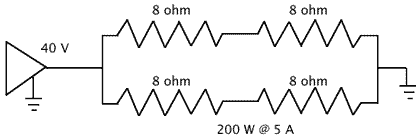
W = 402 ÷ 8 =
1600 ÷ 8 = 200 watts
I = 200 watts ÷ 40 volts = 5 amps = 2.5 amps per parallel
branch
I have tried to keep this
explanation of impedance informative while covering basic rules governing the
power generated by the amplifier.
When discussing a technical subject such as impedance, it is necessary to
employ mathematics to illustrate the relationship between voltage, current,
impedance, and the resultant power produced in the circuit. I realize that a lot of people don't' like math. You don't need the math if you are
going to just be a roadie or stage technician, but if you desire to truly
understand how sound equipment functions, you must accept the fact that the
math works. If you want to design
systems and specify equipment, then you will need to understand the math
involved.
If you now understand the relationship
of the speaker load to the power produced, you may think that the lower the
impedance of the speaker load, the more current will flow and maximum power
will be produced by the amplifier.
However, in reality the amplifier can develop only so much current flow from
its output stage until the point that the maximum sage output current is
reached.
This is why amplifiers have a rated
minimum load impedance limit, i.e. they can only develop their maximum
safe power at the rated minimum load impedance. If the amplifier were allowed to produce more current than the
rated power required, it would destroy itself. The output devices would fail, due to the excess heat generated
in the transistors. The more current
that flows in a circuit, the hotter the conductor becomes; this is also the
case for transistors that are amplifying the signal. This is why most power amplifiers today will begin to current
limit in order to protect themselves when the loudspeaker load goes below the
minimum rated load impedance.
Loudspeakers also have a minimum
impedance that is even lower than the nominal impedance published by the
manufacturer. The actual impedance
varies with frequency, and it is for this reason that many manufacturers
publish impedance charts that will indicate at what frequency the impedance is
at its minimum.
IMPEDANCE
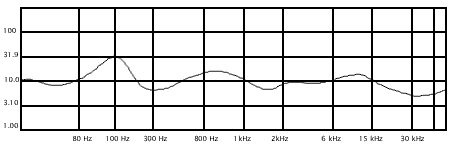
Example Impedance Curves Note that the minimum impedance is lower than the
nominal impedance.
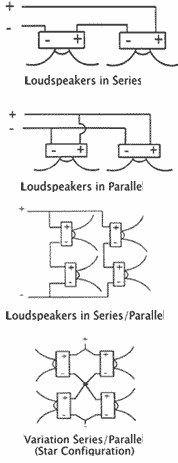
Some people who check out a loudspeaker's resistance to direct current with a
volt-ohm meter (VOM) become confused, because the DC resistance of a speaker is
much lower than the stated nominal impedance. Remember, audio signals are alternating in their direction of
current flow (AC). A typical DC
resistance measurement can be 20% lower than the nominal impedance rating.
POLARITY OF LOUDSPEAKERS.
I haven't discussed the electrical
polarity of the loudspeaker yet.
Most loudspeaker manufacturers produce speakers that move OUT when a positive
referenced voltage is present at the red terminal. All of our Scorpion and Black Widow loudspeakers respond to a positive
voltage at the red terminal by moving forward. The correct wiring of loudspeakers with regards to proper
polarity is shown below : For your
information, in case you aren't aware of this, at least one manufacturer's
loudspeakers move IN when a positive referenced voltage is present at their red
terminal. In that manufacturers'
loudspeaker systems, the loudspeaker leads are reversed to place the woofers or
cone loudspeakers "In-phase" with their compression drivers mounted
on their high frequency horns. Their
compression drivers have what is considered normal polarity—they move out when
the positive voltage appears at their red terminal.
This fact about polarity is very important when putting one manufacturer's
loudspeaker in a system in conjunction with another manufacturer's components,
as in adding a subwoofer. You must
verify that a positive voltage, placed on what is supposed to be the positive
speaker lead wire, will indeed cause that speaker to move out. This can be accomplished with a
simple nine-volt transistor radio battery.
With the positive terminal of the battery placed on the positive speaker lead
and the negative terminal on the negative speaker lead, the speaker should move
OUT. If the speaker moves IN, the
leads need to be reversed either at the loudspeaker itself, at the input jack,
or at the power amplifier's output terminals. The reason for the difference in the direction of the loudspeaker
cone's movement is that some loudspeakers have opposite magnetic polarity. If you try putting two identical
types of loudspeakers together where the magnets are back to back, they will
repel one another. If , on the other
hand, you take a Black Widow and JBL and place them back plate to back plate,
they will attract one another and may be difficult to pull apart. If you reverse an electro-magnetic
system's magnetic polarity, you are also reversing its electrical polarity. They are opposite sides of the same
coin.
Since I have brought up the subject of
magnetic/electrical polarity, let me tell you one situation that I have
experienced on a couple of occasions in my twenty-seven years of active
involvement in audio. If the magnet
or motor structure has been accidentally placed upside down in the magnetizer,
it will be charged to the opposite magnetic polarity. This speaker may then be placed in a system with other similar
loudspeakers, but it will move opposite to them, causing the speaker system to
sound thin. The wiring color coding
may appear to be correct, but it is the mis-magnetized motor structure that is
the culprit. When wiring
loudspeakers, you must orient the leads correctly. In a series circuit, the connection between loudspeakers always
is made between opposite terminals, i.e., from + red to – black or vice versa
(- black to + red). In paralleled
circuits we always connect black to black (- to -) and red to red (+ to +). We have a couple of low frequency enclosures
in the Peavey line that employ what we call a trans-axial loudspeaker loading
technique. One loudspeaker faces
inward while the other faces normal.
These two loudspeakers are not on
opposite sides of the same baffle board.
There are two separate baffle boards that are offset to allow the acoustic
centers of the two opposite facing loudspeakers to be in the same plane. In this application the polarity of
the rearward facing loudspeaker is reversed.
Since the speaker is facing backwards, the reversed polarity causes the two
loudspeakers to be acoustically in phase, i.e., they are both moving in the same
direction at the same time.
There
is a difference between loudspeakers that PRODUCE music (guitar amplifier
loudspeakers) and loudspeakers that REPRODUCE music (sound reinforcement
loudspeakers). Guitar amplifier
loudspeakers are actually voiced or designed to have somewhat "soft" cone
breakup, called cone cry by some transducer engineers. Cone breakup occurs at certain resonant frequencies where the
cone ceases to move as a single linear piston, but moves in segments. A sound reinforcement loudspeaker
should be designed to minimize all cone breakup modes, and thus perform as
linear as possible. It is acceptable
to wire guitar amplifier speakers in series and parallel configurations. In guitar amplifiers, the damping
factor of the power amplifier is purposely kept low. The speaker is not controlled or damped well and essentially
flops around, but this is part of the sound.
However, sound reinforcement loudspeakers should NOT be wired in series. They can be wired in parallel, but
they should be wired in such a manner that each speaker has its own two leads
wired in parallel at the output of the power amplifier. Some people neglect to do this because it's inconvenient to run
separate speaker lines for each transducer. Tighter, punchier, more transparent kick
drum and bass lines will result when the loudspeakers are individually wired in
parallel at the power amplifier's output terminals. Tight bass means control of the loudspeaker or high Damping
Factor. More on this later. Sound reinforcement loudspeakers can be wired
in parallel, but not internally in the loudspeaker enclosure. Each loudspeaker should have its own
set of speaker wires that may be wired in parallel at the output of the power
amplifier. Most loudspeaker systems
have parallel input jacks on the enclosure.
If we didn't include them and other manufacturers did, some salesman that
didn't know any better would use this against us to sell another product. More on this later also. Moving right along, I have even more
information to help you understand impedance. We should learn by other's mistakes so we don't have to repeat
them. Several years ago while
working on some projects in
DC
resistance is equal to the voltage drop (pressure) across the device under
measurement, divided by the current flow (number of electrons) passing through
the device. DC resistance is rather
straightforward. In dealing with the
opposition to current flow offered by components in an electrical circuit that
contains varying electrical cycles of audio frequencies, the opposition to
current flow is know as the more complex impedance. There are a couple of
different types of impedance. The
following are some definitions of impedance from the Dictionary of Scientific
and Technical Terms by McGraw-Hill.
IMPEDANCE: (PHYS).
1. The ratio of a sinosuidally varying quantity to a
second quantity, which measures the response of a physical system to the first,
both being considered in complex notation; examples are electrical impedance,
acoustical impedance, and mechanical impedance. Also known as complex impedance.
2. The ratio of the greatest magnitude of a second
quantity which measures the response of a physical system to the first; equal
to the magnitude of the quantity in the first definition.
ELECTRONIC IMPEDANCE.
Also
known as Impedance. (ELEC) 1. The total opposition that a circuit
presents to an alternating current, equal to the complex ratio of the voltage
to the current in complex notation.
Also known as the complex impedance.
2. The ratio of the maximum voltage
in an alternating current circuit to the maximum current; equal to the
magnitude of the quantity in the first definition.
ACOUSTIC IMPEDANCE.
(ACOUS)
The complex ratio of the sound pressure on a given surface to the sound flux
through that surface, expressed in acoustic ohms.
MECHANICAL IMPEDANCE.
The
opposition to electrical current flow takes two forms, passive resistance
(which produces heat), and an active reaction when there is capacitance or
inductance in the circuit. The
opposition created by capacitance or inductance is referred to as reactance. A capacitor consists of two electrical
conductors separated by a dielectric or something that will support or store an
electrical charge. Air itself can
support an electrical charge and is said to have a dielectric of one. A capacitor is said to have a
capacitive reactance or opposition (impedance) to current flow. A capacitor blocks direct current
(DC), and stores a charge, but for alternating current (AC) a capacitor has
high opposition to current flow at low frequencies, and low opposition at high
frequencies. When alternating
current encounters a capacitor, the voltage lags behind the current. An inductor is a coil of wire that offers high
opposition to current flow at high frequencies and low opposition at low
frequencies. When alternating
current encounters an inductor, the current lags behind the voltage because
inductance is a circuit element that opposes changes in current.
Here
is an analogy for impedance in the physical world. You have loaded a wheel barrow with dirt, and now you must move
the payload. When you pick up on the
handles of the wheel barrow, the weight offers a resistance. However, because the handles operate with the wheel and the axle
to form a kind of inclined plane (lever), the resistance is less than the
actual weight. In order to get the
wheel barrow moving, you must apply even more force, but the mass (real weight
of the dirt) offers inertia or opposition to the force applied (Inductive
reactance). Now imagine you have
moved the payload to its intended location, and must now stop the wheel
barrow's forward motion. But now the
opposition to the deceleration is in the form of momentum or stored energy in
the actual motion of the wheel barrow (Capacitive reactance). In the case of our loudspeakers, their
opposition to current flow from the power amplifier is their impedance. Audio electrical signals are
electrical analogues or representations of the positive and negative
fluctuations of air pressure that have been converted to positive and negative
fluctuations of voltage. This
fluctuating electrical signal that represents the vibrations of air or sound is
by its very nature Alternating Current or AC (i.e., the direction of
current flow changes directly with the number of audio cycles per second being
reproduced).
Loudspeakers actually involve three
forms of impedance. The first is the
electrical impedance offered to the power amplifier discussed above. The second is the mechanical
impedance of the loudspeaker, which is taken into account in the design of the
loudspeaker enclosure. Third is the
impedance of the air or the acoustic impedance that the combination
loudspeaker/enclosure encounters.
The air itself, which is the medium through which we transmit sound in the form
of pressure variations, has an impedance (the medium of transmission offers
opposition to the vibrations of its air molecules). A loudspeaker is a transducer that changes energy from one form
to another. The loudspeaker changes
electrical energy into acoustical energy or sound as we know it. A
basic loudspeaker is quite a bit inefficient in that most of the energy
produced is in the form of heat generated in the voice coil of the speaker. Loudspeakers intended for use as
direct radiators are anywhere from 0.25%
to 4% efficient, meaning that more than 96% of the energy is lost as heat and
not converted into sound or acoustical energy. Loudspeakers actually make better space-heaters than they do
electrical to acoustical transducers.
There
are ways to somewhat improve upon the efficiency of a basic loudspeaker, and
that is to use a kind of transformer to couple it with its acoustic environment. Many of you already know about
electrical transformers that can isolate (1:1 ratio), step up (1: 10), or step
down (10:1) electrical signals. The
ratio represents the proportion of the number of turns in the primary to the
number of turns in the secondary. In
addition to isolating and stepping voltages up or down, a transformer can match
impedances: i.e., a very high impedance source can be coupled to a low impedance
load via a step down (high to low turns ratio) transformer. The source that is coupled to the primary of the transformer now
sees the high turns ratio as its load impedance, while the secondaries lower
turns ratio sees the device coupled to the secondary of the transformer as the
actual load impedance.
In loudspeaker transducer technology, we
use a horn as a transformer. The
horn couples or matches the loudspeaker to the air in a manner in which the
efficiency of the loudspeaker as a system is increased (i.e., with one watt of
power going to the loudspeaker, the sound pressure on-axis with the horn will
be greater, because all of the acoustic energy radiated from the loudspeaker is
focused by the horn). Since the
acoustic signal produced by the loudspeaker is now restricted within the walls
of the horn, the speaker is said to be loaded by the horn. The horn offers an acoustical impedance to the loudspeaker and,
like a transformer, the horn changes the impedance that the source amplifier
sees. In this case our amplifier
actually sees a somewhat higher impedance or opposition to current flow than
the speaker would offer if it were directly coupled to the air itself.
WHEN FOUR OHMS IS NOT FOUR OHMS.
There is an enclosure in our product line that we
have been making for twenty years called, the FH-1 low frequency enclosure. We use a four ohm loudspeaker in this
enclosure; however, as long as the enclosure is operated above its cut-off
frequency of 60 Hz, the actual load impedance that the power amplifier sees is
nominally eight ohms. Likewise, we
use a four ohm loudspeaker in the Mid bass horn of HDH-4 and HDH-1 speaker
enclosures. As long as these horns
are operated above their cut-off frequency of 300 Hz, the mid bass of the
enclosure will exhibit an eight ohm load to the amplifier.
The mechanical loading of the loudspeaker by the horn
makes an impedance transformation so the amplifier sees a load impedance of 8
ohms within the horns operating band pass.
I mention the horn's operating band pass
because if you operate any horn below its cut-off (-3 dB down point on the low
frequency portion of its response curve), the driver reverts back to its
original lower impedance. As long as
you send horn loaded enclosure frequencies that are above the cut-off, the
system will offer a higher load impedance to the power amplifier.
The DC resistance of the loudspeakers discussed above
is 3.2 to 3.8 ohms. Mounting the
loudspeaker on a horn doesn't change the DC resistance, but a power amplifier
driving that horn will see a load impedance that is more than twice that of the
nominal four ohm impedance of the individual speaker. Hopefully some of us now understand how a four ohm loudspeaker
can become an 8 ohm loudspeaker system when mounted on a properly designed horn. I had mentioned earlier a situation I
discovered in
Sir Issac Newton said that for every
action there is an equal and opposite reaction. If you would take a fifteen inch Black Widow loudspeaker and hook
its terminal up to the input of an oscilloscope and slap the cone abruptly with
the palm of your hand, you could cause a voltage to be displayed on the scope
greater that 80 volts peak to peak, 40 volts peak, or about 28 volts RMS.
If two loudspeakers are wired in
parallel within an enclosure at a distance from the power amplifier, each
speaker creates a back-EMF that causes low frequency cancellation as these
voltages are out of phase with the incoming signal. When the two loudspeakers are wired in parallel at the output
terminals of the power amplifier, the very low internal output impedance
(source impedance) of the amplifier (typically 0.02 ohms) acts as a shunt or near short circuit to the back-EMF
voltages.
ARE YOU READY FOR MORE ?
I mentioned Damping Factor earlier and I wanted to
wait until I discussed Source Impedance before I covered it more thoroughly.
SOURCE
IMPEDANCE.
Up until now I have been talking about the impedances
offered by the loudspeaker load on the amplifier. The loudspeaker load impedance is often referred to as the output
impedance of the amplifier; however, it is more correct to call this the
amplifier load impedance. This is
because amplifiers have an internal output or "source impedance." The ratio of the source impedance to the load
impedance is the amplifier's Damping Factor rating number. The damping Factor number can be obtained by dividing the
loudspeaker load impedance by the internal output or source impedance of the
power amp. A typical power amplifier
source impedance is 0.02 ohms. If I were to divide an 8 ohm speaker
load by 0.02 ohms, I would have a
Damping Factor number of 400. As you can see the impedance of the load
affects the damping factor of the amplifier.
The same amplifier would have a damping factor of 200 into a four ohm load (4 /
0.02 = 200). The damping factor is the
ability of the amplifier to control the loudspeaker load. Another word for control is regulation. The control of the load is a function of the ability of the power
amplifier's regulation of the load.
If you have a precise millivolt scale on a digital voltmeter, you can calculate
the percentage of regulation by measuring the output voltage of the amplifier
without a load (open circuit), then place the load resistance value on the
amplifiers output and measure the voltage.
It will have dropped a very small amount.
If you then take the No Load Voltage and subtract the Full Load Voltage from
it, and then divide that number by the Full Load Voltage, you will have
calculated that amplifier's percentage of regulation. If you now take the reciprocal of that percentage of regulation,
you will have the Damping Factor rating number of that amplifier into that load
value.
NLv - FLv / FLv = % Regulation
1 / % Regulation = Damping Factor
or DF = 1 / (NLv - FLv / Flv)
Note
: You can't really measure Damping
Factor at full power because that amplifier will not be able to maintain its
regulation, but as an example let's say you are measuring a CS-800X into an
eight ohm load with 6 dB of head room.
Your open circuit (NL) voltage is measured at 20 volts, you place an eight ohm
load in the circuit (you better use a dummy load or a speaker will be awfully
loud), then you measure a (FL) voltage of 19.95 volts, your math would now be
:
20 - 19.95 = 0.05 / 19.95
= 0.0025
% of Regulation would be .25%
The reciprocal of 0.0025 = 1 / 0.0025 = 400
DF = 400
Source Impedance (Z source) would then be calculated from an inversion of the
previous formula for damping factor (DF = Z Load / Z Source) would now become :
Z Load / DF =
Z Source or
8 / 400 = 0.02 ohm Source Impedance
This, ladies and gentlemen is what damping factor is all about. Remember the resistance of the load
affects the amplifier's ability to control its load. We have all heard that the professional method of loudspeaker
cable connections in audio is use to a heavy gauge cable and the shortest
possible cable run. Losses in
loudspeaker cable runs are due to the friction, or heat, caused by the high
level of electron current flow. Most
manufacturers provide an American Wire Gauge (AWG) # 18 in a 25 foot length as
a standard loudspeaker cord. But the
electrons flow back and forth in a 50 foot circuit. The speaker wire itself opposes current flow because it has a
resistance value.
Let's use an example of an 8 ohm
loudspeaker connected directly to the output terminals of a power amplifier :
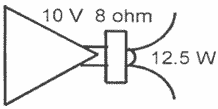
102 ÷ 8 = 100 ÷
8 = 12.5 watts
Now let us suppose we are practicing
very poor audio and have a loudspeaker connected at the end of 153.6 ft of # 18 gauge copper wire. AWG # 18 wire has a resistance of 6.51 ohms per 1000 ft (1000 / 6.51 = 153.60), which means that 153.6
ft of # 18 copper wire will have a resistance of 1 ohm. Since a loudspeaker wire has two conductors, there would actually
be 2 ohms of resistance in series with an 8 ohm speaker connected via 153.6 ft of two conductor AWG # 18 copper
wire. Now our power amplifier looks
out at the load and sees the 2 ohms of wire resistance, in series with 8 ohm
loudspeaker impedances. So the load
is now actually 10 ohms instead of 8 ohms.
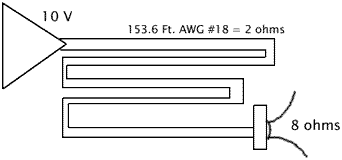
102 ÷ 10 = 100
÷ 10 = 10 watts
At first glance you may say that you
are only losing 2.5 watts (which is
a 20 percent power loss). However,
you are actually losing 36% power.
Of the 10 watts now produced by the amplifier, 2 watts is dissipated in the
wire, while only 8 watts gets to the loudspeaker.
If you think this is not cool, let's
examine what this would do to the amplifier's ability to control or dampen the
loudspeaker load. The loudspeaker
actually sees the 2 ohms of wire resistance in series with the amplifier's
internal output or source impedance.
So instead of a Damping Factor of 400, you would have :
DF = Load Z /
Source Z
DF = 8 ohm / (.02 + 2 ohm) = 8 / 2.02 = 3.96 DF
We started out with a potential damping factor of 400 and because of our poor
choice of 153.6 ft of wire, we have
destroyed the amplifier's ability to dampen or control the loudspeaker load. Can you see now why those who know,
employ the professional method of putting the power amplifier as close to the
loudspeaker system as possible and then use the heaviest gauge wire that will
fit the loudspeaker connector. If
you haven't been doing this, you need to start, as you are no longer ignorant
regarding the importance of damping factor.
Before I give up on damping factor, I would like to make one more point. In the above example I stated that
the source impedance of a CS-800X was .02
ohms; therefore, the DF was 400 when driving an 8 ohm load. Well, I don't usually promote products in a paper intended to
educate the customer, but I just must make an exception. Beginning with our recently introduced power amplifier model
CS-800S, we have included circuitry (patent applied for) that automatically
maintains a high damping factor.
There
is a circuit that measures the small change in output voltage when the load
impedance changes, and through a feedback network, the circuitry maintains a
constant output voltage as the voltage neither increases or decreases with a
change in load impedance. You can
almost think of it as a negative source impedance so the Damping Factor remains
high. It is still affected by the
resistance in the wire, so you still would be wise to practice the professional
method of short runs and heavy duty loudspeaker wire. The CS-800S amplifiers coming off of our production line at
Peavey consistently spec out at greater than 2000 DF, and that is only because
that is the highest number our system can measure.
WE ARE NOT DONE YET !
This
paper is on Impedance, and in the course of this paper's unfolding I segued
into source impedance and used it as a means of explaining damping factor. Source impedance also applies when
you are interfacing components within the audio system. With loudspeakers, we are trying to match the loudspeaker load
impedance to the output of the power amplifier to obtain maximum power. When we are only trying to transfer
signal from one device to another within the audio chain, we are not trying to
accomplish any work, so we are not trying to produce significant levels of
current. We are just trying to pass
or transfer the audio signal. There
is, of course, current flow, of course, current flow, as electrons are moving
back and forth, but the intention is to pass the signal as a voltage and not
produce high levels of current and power.
However, each signal processor in front of the power amplifier sees the input
impedance of the next device as a load on its output. Years ago, during the Jurassic period of audio, they attempted to
transfer audio signal into 600 ohm loads.
This is no longer valid today. The
typical input impedance of a modern power amplifier is 20,000 ohm or 20 k. However, the internal output
impedance (Source Z) of audio devices can be anywhere from 50 ohms to 2,000
ohms. In order to transfer the
signal without introducing major deviations in level and frequency response, the
Source Z to Load Z should have a ratio of 10:1; some people accept 7:1, but I hold to the 10:1 ratio. The source impedance is
often overlooked by the non-technician sound system operator. Ignorance may be bliss, but getting
bitten on the behind is not pleasant.
There are many signal processors, equalizers, and crossovers that do an
adequate job in certain applications, but these same devices can cause many
problems when the source-to-load impedance becomes reduced. The best and first example
I am going to use is in interfacing a number of power amplifiers in larger
systems. There is a limit to how
many power amplifier inputs can be paralleled. The limit is determined by the source impedance of the mixer
output, the equalizer, or the electronic crossover. Using the math associated
with Ohm's Law, we can calculate what the load impedance will be when we
parallel power amplifier inputs. Two
20,000 ohm inputs in parallel becomes a 10,000 ohm load to the signal source. Dividing the input Z by the number of
amplifiers whose inputs are in parallel will give the resultant load Z that the
signal source sees. Thus ten power
amplifiers with their inputs in parallel would be 20,000 ohms divided by 10, or
2,000 ohms.
This
means that if the internal output or source impedance of the signal source were
200 ohms, we could successfully transfer the electrical audio signal with no
problems. But if the Source Z were
330 ohms we would be below the stated 10:1
Z ratio. In large scale professional audio it is very
important to consider the capability of products to drive long lines and/or
loads that represent multiple impedances in parallel. There are many mixers, equalizers, and crossovers that are priced
economically, and they work fine in certain simple applications. These products can present problems
in large systems, however.
If
you want to know how many power amplifiers can be driven by a signal source,
multiply the internal output impedance of the source by 10, and divide the
result into the source impedance of the power amplifiers. For instance, in our product line we have two series of graphic
equalizers, the EQ series and the Q series.
The EQ series exhibits a 75 ohm source impedance while the less expensive Q
series has a 330 ohm source impedance.
75 x 10 = 75020,000
/ 750 = 26
330 x 10 = 3,33020,000 / 3,330 = 6
You can now see that a Peavey EQ-31 can drive 26 CS amplifiers with their
inputs in parallel, while the Q series could only drive 6. Thus, in applications such as small systems, the Q series could do
a fine job, but there is a limit and now you know the boundaries.
I know of one mixer manufacturer that has a source impedance in their mixer's
channel inserts of 1,000 ohms. This
is not a real problem if you come out of the mixer with a five to eight foot
shielded signal patch cable to interface some processor. But there are many users of this product that have them in
studios where the inserts are permanently wired through lengthy cable that is
run beneath the floor across the studio to a patch bay. They don't realize that the mixer channel is now rolling off the
high frequencies significantly because of the capacitance of the cables and the
high source impedance.
The
cable itself becomes a low pass filter.
The amount of high frequency roll-off is determined by the value of the source
impedance. You can find the point
where the frequency begins to roll off by taking reciprocal (1/X) of the source
impedance (R) times the capacitance (C) in the cables, 1 / (R x C). Let's say, for example, that the
cable is long enough to offer 0.2
mfd of capacitance (a microfarad is mathematically 0.000,001 farad).
1 / 100 x 0.000,000,2 = 1
/ 0.000,02 = 50,000 Hz or 50 kHz
1 / 1,000 x 0.000,000,2 = 1 / 0.000,2 = 5,000 Hz
The signal processor hooked up to the mixer with an insert with a 100 ohm
source impedance would pass signals out to 50 kHz, while the mixer with the
1,000 ohm source impedance in its insert would have significant roll-off above
5 kHz. We have come to the end of this lengthy paper
on Impedance. I believe we have
pretty much thoroughly covered the subject.
Some of the things I just shared with you took me fifteen years or more to
understand as I now do. I don't know
about you, but I am still learning.
If you are learning, you are growing.
When you stop growing you cease to produce quality. Below, you will find a
chart relating source-to-load impedances and the number of amplifiers that can
be driven with the inputs wired in parallel.
There is also a chart on loudspeaker wire.
|
SOURCE Z |
LOAD IMPEDANCE |
|||
|
(in ohms) |
1 K ohm |
2 K ohm |
10 K ohm |
20 K ohm |
|
75 |
1 |
2 |
13 |
26 |
|
100 |
1 |
2 |
10 |
20 |
|
330 |
0 |
0 |
3 |
6 |
|
1000 |
0 |
0 |
1 |
2 |
|
2000 |
0 |
0 |
0 |
1 |
|
Copper Wire Guage |
||||||||||
|
AWG# |
Dia |
Dia |
Cir |
Square |
Sq |
Meter/ |
Feet/ |
Audio |
Max |
Length |
|
22 |
25.35 |
0.6438 |
642.4 |
0.000504 |
0.33 |
18.52 |
60.75 |
3 |
|
|
|
18 |
40.30 |
1.024 |
1624 |
0.001276 |
0.82 |
46.8 |
153.6 |
5 |
150W |
10 Ft |
|
16 |
50.82 |
1.291 |
2583 |
0.002028 |
1.31 |
74.47 |
244.26 |
7 |
280W |
15 Ft |
|
14 |
64.08 |
1.628 |
4107 |
0.003226 |
2.08 |
118.4 |
388.35 |
9 |
400W |
25 Ft |
|
12 |
80.81 |
2.053 |
6530 |
0.005129 |
3.31 |
188.3 |
617.7 |
12 |
800W |
40 Ft |
|
0 |
101.9 |
2.588 |
10380 |
0.008155 |
5.26 |
299.5 |
982.32 |
17 |
2,000W |
65 Ft |