[ Home | Preview | App. Notes | Download | Others ]
UMTS / 3G Industry
What is a UMTS network? You take an existing GSM network, add a high speed internet connected data network, install CDMA base stations that enable higher data rates and more accurate location information, then you add more applications to make it mobile internet-like, give fancy color screen multimedia terminal to your customers and your UMTS network is ready. You hope that higher data rates will create a new mobile application industry, that will use all the available bandwidth and you find people who are ready to pay for it. And if all goes well customers learn to call and be called by non-human counterparts and companies see advantages in using the UMTS network as a computer to computer communication path and the good times are back for everyone.
An operator needs about US$2.5B to build a 5,000 base station UMTS network and about the same amount to run the organisation and attract customers to make it profitable. On top of this the operator has to pay for the license and financing. This means that an operator has to come up with an innovative business case to get the funding organised and the network on air. Even much talked about vendor financing does not come cheaply, as this will affect stock prices and future commitments. New alliances and cost sharing arrangements have been created to make it all possible.
Applications are at the heart of the next generation network. It's what it's all about! Faster data rates and mobiles with larger color screens will enable new services to be created giving a new cyber-air-space. Initially it is a combination of the existing Internet and a car navigation system. Soon there will be audio, improved still images, moving images, multimedia mailing and video conference. Then any place turns into a virtual home environment with software agents, remote LAN access points and web browsing opportunities. Home automation, man-machine interaction technologies, mobile asset management, person locating applications and games that make the most of mobility will also be there. Old Internet hit products like email, live events, gaming, gambling, adult content, clubs and chat rooms will also be implemented. If operators can only get the micro-billing right, then business will take off.
New players will emerge from different backgrounds to create new products and business opportunities. Service providers, content providers, value-added applications providers and application developers are all competing for end customer dollars. They are trying to create new user segments to generate a variety of revenue sources. The race for the future earnings has already started. Take a look how the old players are doing at the moment. Here is a selection of stock prices of main 3G players world wide.
3G and UMTS Technology
Mobile data communications is evolving quickly because of Internet, Intranet, Laptops, PDAs and increased requirements of workforce mobility. UMTS will be the commercial convergence of fixed line telephony, mobile, Internet and computer technology. New technologies are required to deliver high speed location and mobile terminal specific content to users. The emergence of new technologies thus provides an opportunity for a similar boom what the computer industry had in 1980s, and Internet and wireless voice had in 1990s.
The main IMT-2000 standardisation effort was to create a new air interface that would increase frequency usage efficiency. The WCDMA air interface was selected for paired frequency bands (FDD operation) and TDCDMA (TDD operation) for unpaired spectrum. CDMA2000 standard was created to support IS-95 evolution.
The UMTS transport network is required to handle high data traffic. A number of factors were considered when selecting a transport protocol: bandwidth efficiency, quality of service, standardisation stability, speech delay sensitivity and the permitted maximum number of concurrent users. In the UMTS network, ATM (Asynchronous Transfer Mode) is defined for the connection between UTRAN and the core network and may also be used within the core network. In addition to the IMT-2000 frame many new standards will be integrated as part of the next generation mobile systems. Bluetooth and other close range communication protocols and several different operating systems will be used in mobiles. Internet will come to mobiles with WAP, i-mode and XML protocols. 3G development has helped to start the standardisation and development of large family of technologies.
This section covers some of the core UMTS technologies and it will be updated regularly.
3G Applications
3G operators are planning to make their money with mobile applications even when there might never be a single killer application. According to the Report 9 from UMTS Forum near-term 3G data services are subdivided into content connectivity and mobility, then further subdivided to create the following six services:
According to a whitepaper form Nokia, 3G applications can be divided into:
Wireless Advertising
No matter how you classify those, the bottom line is that computer and Internet application will merge with communication and location based services. Network operators, vendors and third party providers are already creating the applications and demos. Here are some sample what might soon come to a phone near you:
3G Phones and Devices
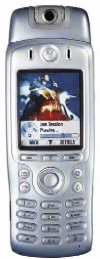
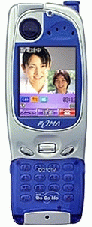
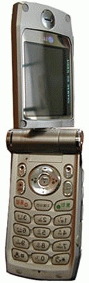
UMTS phones will be available in the second half of 2002. Nokia has announced
their launch date to be September 26, 2002. Motorola has said that they will
launch their phone before Nokia. Here are links to other 3G phone vendors products:
Do you need to test a web enabled wireless device?
www.umtsworld.com/tests.htm
page helps you to explore your device's capabilities! (6k) BETA
|
UMTS handsets UMTS handsets, operator web sites:
WCDMA (DoCoMo) FOMA handsets:
FOMA Handset links:
CDMA2000 1X EV-DO Handsets:
GSM EDGE Handsets:
3G Concept phone links:
|
|
What does the acronym UMTS stand for?
Universal Mobile Telephone System.
What is UMTS?
UMTS is one of the Third Generation (3G) mobile systems being developed within the ITU's IMT-2000 framework. It is a realisation of a new generation of broadband multi-media mobile telecommunications technology. The coverage area of service provision is to be world wide in the form of FLMTS (Future Land Mobile Telecommunications Services and now called IMT2000). The coverage will be provided by a combination of cell sizes ranging from 'in building' Pico Cells to Global Cells provided by satellite, giving service to the remote regions of the world. The UMTS is not a replacement of 2nd generation technologies (e.g. GSM, DCS1800, CDMA, DECT etc.), which will continue to evolve to their full potential.
What are the different types of 3G networks?
ITU Recommendation ITU-R M.1457 specifies five types of 3G radio interfaces:
For more information about 3G air interfaces, download ITU "What is IMT-2000" presentation (2.5Mb!). Note that page 3 does not classify CDMA2000 1X as 3G, but page 6 does.
Some 2.5G systems (GSM GPRS, IS- 95B and CDMA2000 1X (?)) will be able to deliver 3G services, so it will be difficult for users to see the difference.
What are the different types of 3G core networks?
The IMT-2000 family of 3G systems includes three types of Core Network technology:
What is the difference between cdma2000 and UMTS?
Cdma2000 and UMTS were developed separately and are 2 separate ITU approved 3G standards. Cdma2000 1xRTT, cdma2000 1xEV-DO (EVolution, Data Only) and future cdma2000 3x were developed to be backward compatible with cdmaOne. Both 1x types have the same bandwidth, chip rate and it can be used in any existing cdmaOne frequency band and network. Backward compatibility was a requirement for successful deployment for USA market. It is easy to implement because operators do not need new frequencies. [more about cdma2000]
UMTS was developed mainly for countries with GSM networks, because these countries have agreed to free new frequency ranges for UMTS networks. Because it is a new technology and in a new frequency band, whole new radio access network has to be build. The advantage is that new frequency range gives plenty of new capacity for operators. 3GPP is overseeing the standard development and has wisely kept the core network as close to GSM core network as possible. UMTS phones are not meant to be backward compatible with GSM systems. (but subscriptions (=SIM card) can be, and dual mode phone will solve the compatibility problems, hopefully). UMTS also has 2 flavors FDD (will be implemented first) and TDD.
Some harmonisation has been done between systems (like chip rate and pilot issues)
What are 1G, 2G, 2.5G, 3G and 4G?
Technically generations are defined:
1G networks (NMT, C-Nets, AMPS, TACS) are considered to be the first analog
cellular systems, which started early 1980s. There were radio telephone systems
even before that.
What have been the major milestones in 3G development and specification?
Here is a list of major 3G development milestones.
The Early Days
The Future The decision of the European Parliament and Council of Ministers dated 14 December 1998 requires that Member States take all necessary measures to allow the coordinated and progressive introduction of UMTS services by 1st January 2002 at the latest. The EU's suggestion is that operators must cover 80% of the national population by the year 2005. June 2003 is a target date for UMTS Release 6
|
What are all the different international organisations doing?
European Telecommunications Standards Institute (ETSI) is working in Europe to develop technical standards for UMTS. 3rd-Generation Partnership Project (3GPP) is a co-operation between international standards bodies will make UMTS and third generation mobile telephony technical specifications. The founding members are: ARIB and TTC of Japan, ETSI of Europe, T1 (ANSI) of the U.S. and TTA of Korea. The work of these organisations will be announced globally by the International Telecommunication Union (ITU). ITU coordinate world-wide spectrum and IMT2000 standardisation, harmonises regional regulatory policies and is a foundation and framework for 3G convergence across regions and technologies. UMTS Forum represents the opinions and views of the telecommunication industry and operators and GSM Associates is a mobile operator organisation. European Radiocommunications Committee (ECR) in European Conference of Postal and Telecommunications Administration (CEPT) handles European radio frequency related issues. European Union (EU) harmonises its 15 members UMTS implementation.
How is UMTS different from current second generation networks?
- Higher speech quality that current networks - Addition to speech traffic
UMTS, together with advanced data and information services, will be a multimedia
network.
- UMTS is above 2G mobile systems for its potential to support 2Mbit/s data
rates.
- UMTS is a real global system, comprising both terrestrial and satellite components.
- Consistent service environment even when roaming via "Virtual Home Environment"
(VHE). A person roaming from his network to other UMTS operators, user will
experience a consistent set of services thus "feeling" on his home
network, independent of the location or access mode (satellite or terrestrial)
Why is WCDMA called "Wideband"?
3G WCDMA systems have 5MHz bandwidth (one direction). 5MHz is neither wide nor narrow; it is just the bandwidth. New 3G WCDMA systems have wider bandwidth than existing 2G cdma systems (cdmaOne 1.25MHz), that's why the "Wide". There are commercial cdma systems with 20MHz bandwidth.
Are GSM/GPRS networks compatible with UMTS networks?
UMTS networks can be operated with GSM/GPRS networks. Systems use different frequency bands, so BTSs and mobiles will (should) not interfere with each other. Some vendors claim their core network (MSC/HLR/SGSN ect) and BSC/RNC are UMTS compatible, but most operators will prefer to build a totally separate/independent UMTS network. Some of the latest GSM BTSs can also have UMTS radio parts and share the same rack.
UMTS specification is design so that there is maximum compatibility between GSM and UMTS systems. Late 2002 there will also be dual/multi band phones that can be used in GSM and UMTS networks. Eventually phones will be able to do handovers between networks.
Is there a transition period between UMTS and the present system?
There will probably not be a "transition" period in that sense, because GSM systems will keep on operating at least next ten years. (some old 1G networks are still running round the world). Only limitations for operators are the GSM license terms and customer preferences. UMTS networks will just be added to mobile landscape.
My GSM operator did not get a 3G license. What is going on?
Several GSM operators (like in UK, Sweden, Denmark and France) failed / did not want / missed initially to get an UMTS license, but do not count them out yet. Existing operators have great assets like customer base, image, retail network, BTS site locations, transmission system etc., which help them to make deals with 3G license holders. Hutchison 3G in UK and Telia with Tele 2 in Sweden are good examples.
What is the 3G status in the USA?
Some operators have taken the path cdmaOne - cdma2000 1x - cdma2000 1x EV-DO - cdma2000 3x some D-AMPD - EDGE and some have chosen a GSM1900 - EDGE ( - possible UMTS) route. New cellular frequencies allocations have been postponed, so operators will have to use their existing frequencies, which naturally limits the available capacity. Read more about the USA 3G situation.
What is the 3G status in the China?
China has been testing the TD-SCDMA 3G system. License allocation and possible adaptation of other 3G technologies are still open. Read more about the China's 3G situation.
What is the "Beauty Contest" when 3G licenses are issued? ... and Why?
Beauty Contest means that the government asks all applicants to provide a plan how to build a network and manage their future 3G business. A plan typically includes things like: How many new jobs are created, what kind of services will be available and when, how much domestic products are used, how will less developed areas (rural areas) benefit from this, what kind of financial plan is in place to guarantee the success and avoid bankrupts etc. So government wants to decide what is best for the country, not who is willing to pay most. (In USA and Australia some highest bidding operators have gone bankrupt and government has to pay unemployment etc payments and it is also embarrassing for the government).
By charging high license fee government imposes an indirect tax which mobile uses have to bear by paying more for making calls. By giving "free" licenses government can create a good environment for technology start up companies, because operator has more money to invest and less up-front fees.
Which network vendors can build a turn key 3G network?
No network vendor can supply all equipment and components to the full a 3G network, but quite a few can be a main contractor to build a turn-key 3G network. Normally network vendors can bring in partners like service and applications providers, hand set manufactures, civil work and acquisition companies etc.
Current short list of main vendors for turn-key UMTS networks:
Current short list of main vendors for turn-key cdma2000 networks:
Who much does 3G network cost to build?
Good source of information is to contract announcements and annual reports. Those usually tell how much money an operator will spend on infrastructure. In every country each carrier has to spend around same amount of money to build a same size 3G network, so if you see one of the operator's spending figures, all other operators use similar sums of money per subscriber.
Sometimes spending figures include services (planning, logistics, commissioning, integration, testing etc.), but almost never civil works on base station sites. Press reports claim that operators in Europe have spend around 650 euro per 3G subscriber for infrastructure + planning services + site civil works, this figure should drop to around 400 euros within couple of years.
Infrastructure cost are only small part of total network related cost and operators also have license fees, financing fees, cost of running the organisation, sales and marketing costs etc. [More]
Tell me about UMTS / 3G electromagnetic radiation safety.
First thing is to get your hands on to the latest government EMR (electromagnetic radiation) standard. Check you government web site. [Links]
Your government pages should have more information and contact information where to order a booklet that gives guidelines at least of:
Local city councils might also have their own additional guidelines, check those.
Governments usually do not state exact values what is safe and what is not safe, for legal reasons. EU countries normally issue "guidelines" that are bit tougher than EU standards. In USA FDA has a clear statement: "Thus, the available science does not allow us to conclude that mobile phones are absolutely safe, or that they are unsafe. However, the available scientific evidence does not [emphasis FDA's] demonstrate any adverse health effects associated with the use of mobile phones." See: FDA Mobile Phones page
In most countries operators are required by law to calculate these safety zones. Ask your mobile operator if they can provide safety calculations.
According to recent news articles there have been over 700 studies related to EMR without a final conclusion, so don't hold your breath to get a final answer in a near future. People always forget that mobile antennas radiate about 40W power, but TV and radio towers use kilowatts of power and even a hair drier generates a nice EMR field from 1000W like a kitchen microwave oven.
WCDMA transmitter spread the 20-40W power over 5MHz, while GSM 40W transmitter uses 200kHz band, but GSM BTS need more radios to serve an area. Both systems use similar types of antennas, so EMR levels are similar. Both BTSs normally use power control to minimize the used power.
EMR Resources:
I want to buy a 3G / UMTS book. Which one should I buy?
See our book selection page. But before you buy, you should study a bit 3G / UMTS. Read our technology section. Then download 3GPP specifications content page and select the first specifications of each series like XX.001, XX.002 or XX.Y01, for example:
Once you know the basics well enough, you can buy the book that has the right technical level for you. You will also notice how some of the books have copied most of the content from the 3GPP specks. If you read a book from our list, please send us a 20-50 word opinion/description of it, and will add that to the books page. If you find a 3G related book that is not on the list, email: [email protected].
Where can I find additional reliable 3G information about ... ?
Best thing is to read the 3G specifications. It is actually easier to read
than you might think.
From 3GPP page http://www.3gpp.org/specs/titles-numbers.htm you can see specifications
titles and versions. For example if you want to know about USIM, following titles
can be seen:
You need to FTP them for example from ftp://ftp.3gpp.org/specs/latest/ . You can also type that to IE5.0 or later or use FTP program. If you use IE5.0 select File - Copy to Folder from the top menu to copy file so your computer.
Follow the folders and then for example:
ftp://ftp.3gpp.org/specs/latest/Rel-5/21_series/ has the latest 21.111 specifications.
(Jun 2002)
The Second best thing is to search Google, but then again the Internet is full of misinformation.
Where can I find details of UMTS call set up procedure?
Download 3GPP specification:
Tell me about WLAN and 3G interoperability.
Vendor as busy showing their WLAN-3G capabilities, roaming and network handovers are the hot topics. Lucent Technologies announced demonstration of 3G high-speed mobile data and voice capabilities, Nokia shows the WLAN implementation and British Telecom has announced the WLAN hot spot implementation.
3GPP specs show two related docs:
You can download 22.934 from: ftp://ftp.3gpp.org/specs/Latest-drafts/
Earlier FAQ Answer gives you some help how to download those
Other place to look technical data is IEEE 802.11 Group and search for "3G" etc.
You can find documents like:
http://grouper.ieee.org/groups/802/11/Minutes/Cons_Minutes_Mar-2002.pdf
and search for 3G in that document and you see the current status.
WLAN Resources:
80211 Planet
Will the future 3G handsets be compatible with 2G systems and PCs?
Some of the 3G mobiles will be dualband UMTS/GSM handsets (available late 2002?) and will be able to perform UMTS-GSM handovers. Current GSM phones will not work in 3G networks. Several SIM card manufacturers now offer cards compatible with 2G and 3G systems. Cellular3G, for example, will offer PCMCIA W-CDMA 3G-modem cards for PCs.
3G cdma2000 phones will be backward compatible and will work in cdmaOne networks. Airprime, for example, offers CDMA2000 1xEV-DO PC cards for 3G networks.
How many Base Stations are needed for an UMTS network?
There are several factors:
- Required coverage areas according to a license agreement (link budget will
determine the cell spacing)
- Required capacity according to license agreement and initial customer and
operator demands.
- Amount of frequencies carries have. (More frequencies, less interference,
longer cell spacing)
- Ability to get BTS site locations. (Normally co-location requirements with
used 2G sites)
- Financing available for network build.
- Economical factor to build sites.
- Design opinions and experience of companies and people bidding for the design
job and eventually implementing the plan.
- And probably in a long run the capacity, service, and coverage requirement
from customers.
Rollout will be very similar to 2G network rollouts. First phase of rollouts in UK size market will probably be 1000 base station in urban areas. Within 5 year about site count will increase to 5000 sites and eventually up to 10000 sites depending how successful the business is.
How to calculate a WCDMA link budget?
To calculate it you need to know:
- Type of service (data type and speed)
- Type of environment (terrain, building penetration)
- Behaviour and type of mobiles (speed, max power level)
- System configuration (BTS antennas, BTS power, cable losses, handover gain)
- Required coverage probability
Please see an example on Link Budget page.
What are the UMTS frequencies and channel spacing?
1900-1920 and 2010-2025 MHz Time Division Duplex (TDD, TD/CDMA) Unpaired, channel
spacing is 5 MHz and raster is 200 kHz. Tx and Rx are not separated in frequency
1920-1980 and 2110-2170 MHz Frequency Division Duplex (FDD, W-CDMA) Paired uplink
and downlink, channel spacing is 5 MHz and raster is 200 kHz. An Operator needs
3 - 4 channels (2x15 or 2x20 MHz) to be able to build a high-speed, high-capacity
network.
1980-2010 and 2170-2200 MHz Satellite uplink and downlink
What are the UMTS air interface logical channels?
Broadcast Control Channel (BCCH)
Paging Control Channel (PCCH)
Dedicated Control Channel (DCCH)
Common Control Channel (CCCH)
Dedicated Traffic Channel (DTCH)
Common Traffic Channel (CTCH)
For complete listing of logical, transport and physical channels including directions
and mapping see UMTS Channels page
What are the UMTS data rates of the services?
2.048Mb/s for pico-cell (and micro-cell) applications.
384kb/s for medium size cells. (micro and small macro cells)
144kb/s and 64kb/s for large cell applications. (Large macro cells)
14.4kb/s for continuous low speed data applications in very large cells.
12.2kb/s for speech (4.75kb/s - 12.2kb/s)
9.6kb/s globally (satellite)
How does UMTS paging work?
First, get the latest 3GPP specifications 25-211, 25-304 and 25-331
Note:
PI = Paging Indicator (value calculated by higher layers)
Pq = Paging Indicator (indicator set by physical layer)
25-304 Chapter 8 shows how Paging Occasion and PI is calculated:
Paging Occasion = {(IMSI div K) mod (DRX cycle length div PBP)} * PBP + n *
DRX cycle length + Frame Offset Where n = 0,1,2… as long as SFN is below
its maximum value.
PI = DRX Index mod Np Where DRX Index = IMSI div 8192
'In FDD mode, Np = (18,36,72,144) is the number of Page Indicators per frame, and is given in IE "Number of PI per frame", part of system information in FDD mode.'
25-211 (FDD) Chapter 5.3.3.10 shows how Pq is calculated for channel mapping, the structure of paging indicator channel and the mapping of paging indicators Pq to PICH bits.
25-331 is also worth reading.
Which modulation scheme is being used in UMTS?
UMTS WCDMA modulation is Quadrature Phase Shift Keying (QPSK) with Root-raised
cosine pulse shaping filters (roll off = 0.22)
Read more about UMTS technical details from our UMTS WCDMA page
Where can I find information about MAC and RLC protocols?
Download and read 3GPP documents about RLC/MAC, start with 25 series. Documents also show message mapping to channels:
Earlier FAQ Answer gives you some help how to download those
How is data compression done in UMTS?
Video and music compression will be done in application level. 3G phone (and network application servers) will have programs (or you will be downloading them) that records and displays video or music. Those programs have build-in data compression features. Good examples are MP3 and other music programs. MP3 codec includes data compression and most current music player understands it. For image and video there are several standards including JPEG, MPEG-4, H.263, Microsoft media player etc. available.
From 3GPP 26.234 7.4 Video:
ITU-T Recommendation H.263 [22] profile 0 level 10 shall be supported. This
is the mandatory video decoder for the PSS. In addition, PSS should support:
- H.263 [23] Profile 3 Level 10 decoder;
- MPEG-4 Visual Simple Profile Level 0 decoder, [24] and [25].
These two video decoders are optional to implement.
NOTE: ITU-T Recommendation H.263 [22] baseline has been mandated to ensure that video-enabled PSS support a minimum baseline video capability and interoperability can be guaranteed (an H.263 [22] baseline bit stream can be decoded by both H.263 [22] and MPEG-4 decoders). It also provides a simple upgrade path for mandating more advanced decoders in the future (from both the ITU-T and ISO MPEG).
Read more about video coding:
ftp://ftp.3gpp.org/specs/latest/Rel-4/26_series/26111-400.zip
ftp://ftp.3gpp.org/specs/latest/Rel-4/26_series/26911-400.zip
ftp://ftp.3gpp.org/specs/latest/Rel-4/26_series/26911-400.zip
ftp://ftp.3gpp.org/specs/latest/Rel-4/26_series/26233-400.zip
ftp://ftp.3gpp.org/specs/latest/Rel-4/26_series/26234-400.zip
Consider downloading the latest releases 5 (March2002) or release 6 (not yet frozen) files.
Is there any interface from UMTS core network to other mobile networks?
UMTS specifications do not have any special interface planned for other mobile networks, but all telephone networks can be connected to UMTS core network with standard S7 (or other) signalling system using E1s or T1s. Than enables voice calls to be made to all other telephone networks. If other networks support additional services like "call forwarding", "calling line identity", fax, slow-speed data ect, technically that is possible to implement this between networks.
All telephone networks are designed to work with each other and UMTS networks will use standard interfaces towards all other networks. S7 and IP (internet protocol) will be the most commonly used interfaces standard, but all UMTS vendors can offer tens of different country-specific interface protocols if required.
What will be a 3G Killer Application?
Most people have their own view what the 3G Killer Application(s) will be. Some say that there will not be a single application, but a palette of services. Most likely there will not be only a single application that becomes very popular and at the same time makes a lot of money to the operator. Email, voice(!), messaging, music/video streaming are popular bets for money making applications. If you look any reports about 3G services, m-commerce and location based services are predicted to become very popular. Maybe the pricing will decide what will be a popular service.
Old phrase is "The easiest way to predict the future is to invent it" will apply here. Operators and application providers have an opportunity to create their own killer applications.
What are the UMTS Mobile Multimedia services?
UMTS Forum's Market Aspects Group has identified seven common lifestyle attributes for mobile multimedia applications. Here is a list of possible type of services that will be available in 3G networks:
Fun: WWW, video, post card, snapshots, text, picture and multimedia messaging,
datacast, personalisation applications (ring tone, screen saver, desk top),
jukebox, virtual companion / pet ...
Work: Rich call with image and data stream, IP telephony, B2B ordering and logistics,
information exchange, personal information manager, dairy, scheduler, note pad,
2-way video conferencing, directory services, travel assistance, work group,
telepresence, FTP, instant voicemail, colour fax ...
Media: Push newspaper and magazines, advertising, classified ...
Shopping: E-commerce, e-cash, e-wallet, credit card, telebanking, automatic
transaction, auction, micro-billing shopping ...
Entertainment: News, stock market, sports, games, lottery, gambling, music,
video, concerts, adult content ...
Education: Online libraries, search engines, remote attendance, field research
...
Peace of Mind: Remote surveillance, location tracking, emergency use ...
Health: Telemedicine, remote diagnose and heath monitoring ...
Automation: Home automation, traffic telematics, machine-machine communication
(telemetry) ...
Travel: location sensitive information and guidance, e-tour, location awareness,
time tables, e-ticketing ...
Add-on: TV, radio, PC, access to remote computer, MP3 player, camera, video
camera, watch, pager, GPS, remote control unit ...
Can UMTS mobile location be tracked?
The wideband nature of the UTRA/FDD facilitates the high resolution in position location. The duration of one chip (3.84Mcps) correspond to approximately 78 meters in propagation distance. If the delay estimation operates on the accuracy of samples/chip then the achievable maximum accuracy is approximately 20 meters. There are other inaccuracies that will cause degradation to the positioning but 20 meters can be considered as best possible positioning performance. UMTS specifies that it will provide location information for mobiles to an accuracy of 50m. With GPS assistance, maybe even 10 meter accuracy is possible.
When are the UMTS networks in service?
Japan and Korea has 3G services running and in December 2001 two UMTS networks have been launched, but UMTS mobiles will arrive 3Q/2002. Quite a few UMTS networks will be launched in early 2003 in Europe.
Will 2G / 2.5G phones be able to use all UMTS' applications?
GSM (or other 2G) phones will not be able to use all features, because of data speed, build in memory and applications, display technology etc. Application providers and operators are very unlikely to try to implement complex feature to GSM, money is going to UMTS services. GPRS phone users will be able to use most of the UMTS services; probably only location based and very high rate data services cannot be implemented. But all this it depends on if operators want to implement those. All basic services like voice and messaging will flow between all systems.
Which level of UMTS standard will the network be launched in 2002?
All vendors have different software schedules and development status is a big secret. Now it looks like top vendors will probably have 3GPP Release 4 (with July 2001 correction) level software by the late 2002 launch date. (Some vendors were considering launching with '99 release in 2002)