Hawthorn
Amy Bigus, Deanna Massengil, and Christy Walker
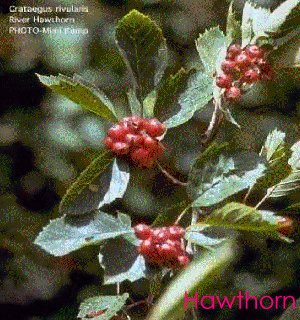
General Description
-
Crataegus oxyacantha from the greek Kratos (meaning hardness of the wood),
Oxus (meaning sharp), & Akantha (meaning a thorn.
-
Other species of Crataegus (C. Monogyna and C. Pentagyna) have similar
pharmacological actions and may be suitable alternatives.
-
Common names: hawthorn, haw, may bush, whitethorn
-
Spiny tree or shrub, may reach a height of 30 feet but is often grown as
a hedge plant.
-
Native to Europe, Member of the rose family.
-
The fruit (berries), leaves, flower blossoms and bark are used medicinally.
Chemical Composition
-
Hawthorn leaves, berries, and blossoms contain biologicaly active flavonoid
compounds: (1) anthocyanidins and (2) proanthocyanidins (also known as biflavans
or procyanidins).
-
Flavonoids are responsible for the red to blue colors of the hawthorn berries.
-
Crataegus extracts also contain
-
Cardiotonic amines: phenylethlamine, tyramine, isobutylamine,
o-methoxyphenylethylamine
-
Choline and acetylcholine
-
Purine derivatives: adenosine, adenine, guanine and caffeic acid
-
Amygdalin
-
Pectins
-
Triterpene acids (ursolic, oleonic, & crategolic acids)
History and Folk Use
-
Crataegus flowers & berries have been utilized as cardiac tonics and
mild diuretics used in organic and functional heart disorders.
-
Also utilized for their astringent qualities for relief of discomfort of
sore throats.
-
North American Indians use it to treat stomach aches, as a diuretic for kidney
& bladder ailments, to stimulate appetite, and to improve circulation.
Pharmacology
-
Centers on its flavonoid components
-
The proanthocyanidins are largely responsible for the cardiovascular activities
-
Flavonoids have strong "Vitamin P" activity (note: Vitamin P was renamed
flavonoids in 1950).
-
Have ability to:
-
Increase intracellular Vitamin C levels
-
Stabilize Vitamin C by protecting it from oxidation
-
Decrease capillary permeability & fragility
-
Have significant collagen stabilizing action
-
Collagen = body protein responsible for maintaining the integrity of ground
substance, tendons, ligaments & cartilage
-
Affect collagen metabolism
-
Crosslinks collagen fibers to reinforce the collagen matrix of connective
tissue.
-
Prevent free radical damage.
-
Inhibit enzymatic cleavage by enzymes secreted by leukocytes during inflammation
-
Prevents synthesis and release of compounds that promote inflammation
(histamines, serine proteases, prostaglandins, leukotrienes
Clinical Applications
Hawthorn is used to treat a wide variety of inflammatory conditions, but
primary use is generally the treatment of hypertension, atherosclerosis,
congestive heart failure and arrhythmias.
Cardiovascular Effects
Hawthorn preparations have been shown to:
1) Inhibit arrhythmia, 2) dilate coronary blood vessels, 3) reduce serum
cholesterol & triglyceride levers, 4)reduce symptoms of angina, 5) have
hypotesive action due to peripheral dilation of blood vessels (relaxes vascular
smooth muscle, 6) be useful in the prevention & treatment of
arteriosclerosis, 7) manage early stages of CHF, 8)treat diminished cardiac
performance – to lower a sensation of pressure or anxiety in the heart
area, 9) improve efficiency of blood pumping and aid in toning the contractions
of the heart muscles, 10) improve symptoms of angina pectoris, 11) aid long-term
recovery from heart attack, 12) slow tachycardia, 13) have indication for
mitral valve insufficiency in young women
-
By inhibiting phosphodiesterase, Hawthorn's flavans have a positive effect
on the myocardium's calcium metabolism to increase contractile power and
promote normal rhythm
-
Inhibits ACE
-
Cardiac Improvement is due to an increase in blood & oxygen supply to
the myocardium and due to flavonoic enzyme interactions which inhibit cyclic
AMP Phosphodiesterase.
-
Results in raised levels of cAMP within the myocardium to lead to a positive
inotropic effect
Toxicity
-
LD50 = 18-34 ml/kg with that of individual constituents being 50-2600 mg/kg
-
Acute oral toxicity reported at 18.5-33.8 ml/kg and 6 g/kg
-
Higher doses increase risk of induced hypotension and sedation.
-
No reports of adverse effects with low doses.
Drug Interactions
-
Interactions are likely with agents that have an effect on the cardiovascular
system.
-
Use of hawthorn with (-blockers may bring about a mild rise in blood pressure
in hypertensive patients as (-blockers decrease cardiac output in such patients.
-
Hawthorn has shown synergy with digitalis by enhancing the effect of cardiac
glycosides. This effect is thought to be due an inhibitory effect on cAMP-PDE
and thus effects on calcium channels.
Disease State Interactions
-
No significant disease-state interactions cited.
Dosage
-
High doses can decrease cardiac output whereas low doses increase CO.
-
Depends on preparation & the nature of the source herb.
-
Usual dose is 120-240 mg TID
-
Infusion of dried fruits: doses of 0.3 – 1.0 g
-
Fluid Extract: 1-2 ml of a 1:1 liquid extract in 25% alcohol
-
Tincture: 2-4 ml of 1:5 tincture in 45% alcohol