Dandelion
Taraxacum officinale
Chad Bradshaw
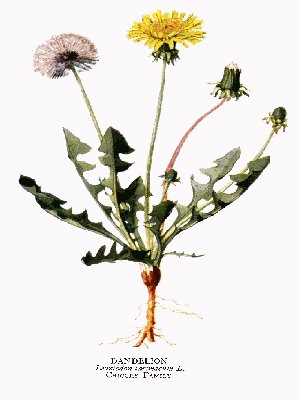
Dandelion is known worldwide by a variety of names including lion's tooth, fairy clock, priest's crown, swine's snout, blowball, milk gowan, wild endive, wet-a-bed, white endive, cankerwort, puffball, and Irish daisy. the plant is a variable perennial that grows to a height of around 12 inches. Its leaves resemble a spatula and are deeply toothed, shiny, hairless, and arranged in a ground-level rosette. For most of the year, the blooming yellow flowers can be seen. These are sensitive to light, as they open at daybreak and close at nightfall. The flowers are also sensitive to weather, opening and closing in fine and wet weather respectively. Upon maturation, the flower closes up, the petals wither, and it forms a puffball containing seeds that are dispersed by the breeze.
The plant most likely originated in Asia and spread throughout the world, preferring cooler climates and moist, nitrogen-rich soils at altitudes of less than 6,000 feet. The root is most commonly used, but the leaves and the whole plant may be used also. In addition to medicinal uses, dandelion can be used as a nutritious food and beverage. Leaves are used raw in salads and sandwiches, or are used for tea. The roots can be used to make a coffee substitute and the flowers are often used for wine and schnapps.
Chemical Composition
Therapeutic actions of dandelion are believed to be due to taraxacin, various terpenoids, inulin, and its excellent nutritional profile. Dandelion is a rich source of vitamins and minerals. The leaves have the highest vitamin A content of all greens (14,000 IU/100g raw greens) and also contain ample amounts of vitamins D, B complex, and C. Minerals such as iron, silicon, magnesium, sodium, potassium, zinc, manganese, copper, and phosphorus can also be found in the leaves. Dandelion also contains high levels of choline, an important hepatic nutrient.
History and Folk Use
Throughout history, dandelion has often been regarded as an unwanted weed. However in Europe, dandelion was used for the treatment of fevers, boils, eye problems, diarrhea, fluid retention, liver congestion, heartburn, and various skin problems. Historically, the Chinese used dandelion to treat breast problems (cancer, inflammation, lack of milk flow), liver diseases, appendicitis, and digestive ailments. Other areas of the world such as India and Russia have also used dandelion in much the same way.
Pharmacology:
Digestive effects:
The idea of aiding digestion is based on the belief that bitter principles stimulate the initial phase of digestion, particularly the secretion of salivary and gastric juices. Dandelion does this, as well as stimulates the release of bile by the liver and gallbladder.
Liver effects:
Dandelion root enhances bile flow, thus improving conditions such as liver congestion, bile duct inflammation, hepatitis, gallstones, and jaundice. Dandelion increases bile flow by 1) affecting the liver directly to cause an increase in bile production and flow to the gallbladder, and 2) exerting a direct effect on the gallbladder by causing a contraction and release of stored bile. Dandelion's hepatic tonic effect may be attributable to the high choline content. The ability of the plant to improve liver function most plausibly explains many of dandelion's historical uses.
Diuretic and Weight Loss
Dandelion leaves have confirmed diuretic activity. One study in mice showed that dandelion exerted a diuretic activity comparable to furosemide (a loop diuretic). Dandelion, however, retains potassium through diuresis, whereas furosemide does not. Therefore the potential side effects of furosemide are avoided. Mice in the study exhibited a 30% loss of body weight in a 30-day period. Much of the weight loss is attributable to the diuretic effects.
Cancer
In 1979, a Japanese study found that dandelion alcoholic extract administered to mice for 10 days markedly inhibited the growth of inoculated Ehrlich ascites cancer cells within a week after treatment. A similar US study in 1987 showed that dandelion produced antibodies to the active polypeptides in tumor-induced mouse ascites fluid.
Diabetes
Dandelion and inulin have demonstrated experimental hypoglycemic activity in animals. This may be due to the fact that inulin is composed of fructose chains which may act to buffer blood glucose levels, thus preventing sudden and severe fluctuations.
Clinical Applications:
Dandelion benefits the entire body. It is often used as a diuretic, laxative, cholagogue, general stimulant for the urinary system, choleretic, depurative (purifier), hypoglycemic, and antitumor agent.
Liver conditions
Two human studies have shown dandelion to have healing properties. A 1938 Italian study involved 12 patients with severe liver imbalances, all of which exhibited classic symptoms such as appetite loss, low energy and jaundice. These patients were treated with dandelion extract (one 5 mL injection per day for 20 days). Eleven of the twelve patients showed a considerable drop in blood cholesterol. In the other study, dandelion was used successfully to treat hepatitis, swelling of the liver, jaundice, and dyspepsia with deficient bile secretion.
It is postulated that dandelion may help in the treatment of premenstrual syndrome. PMS symptoms are believed to be caused by decreased hepatic clearance of estrogen and other hormones. Since dandelion can detoxify these hormones, symptoms may be improved.
Dosage:
General tonic and mild liver remedy (TID dosing):
Mild diuretic and weight-loss agent (TID dosing):
Toxicity
Dandelion is extremely safe. Research has shown its toxicity to be extremely low. No toxic or adverse effects have ever been reported, either for external or internal use.
References:
Murray, Michael T. The Healing Power of Herbs. Prima Publishing 1995.
Jones, Andrea and Arlen Rash. Dandelion. Presentation handout, Pharmacy 100, Fall semester, UNC School of Pharmacy, Chapel Hill, NC.