
Habitat Destruction and Biodiversity Loss
Bucky Wharton
GLY1073
Table of Contents
1. What is Biodiversity?
2. "Hotspots"
3. Threats to Biodiversity
4. Habitat Destruction
5. Extinction Rates
6. Focus on Florida
7. Solutions?
8. Closing
9. Works Cited
What is Biodiversity?
Biodiversity is the variety of ecosystems, species, and genes on planet Earth. Ecosystems are different habitats which include interaction between the biosphere, atmosphere, hydrosphere, and geosphere. Examples of ecosystems are tropical rain forests, temperate forests, and tundra. Each type of ecosystem houses different varieties of species. Species variety is extensive; according to the website http://www.eti.ova.nl/Database/WBD.html there are 1.7 million documented distinct species, and estimates of the total number of species (documented and undocumented) vary greatly. For a good investigation into the total number of species, click here: http://faculty.plattsburgh.edu/thomas.wolosz/homanysp.htm. One problem with documenting species is that the widest species variety occurs among small invertebrates and plants in remote tropical rain forest areas, which are not as exciting and also very difficult to study. Therefore, even the ability to know the limit of species diversity is limited. The last form of biodiversity relates to genes within a species. For example, all humans are of species homo sapiens, yet are genetically distinct.


Biodiversity "Hotspots"
As stated during one of our in-class presentations by Kendra Levine, over 1/2 of the world's biodiversity lies in the tropical rainforests. Small, highly concentrated areas such as the rainforests contain hugely important diversity. Here is a link which provides an interactive map of biodiversity "hotspots": http://www.biodiversityhotspots.org/xp/Hotspots. Click on the interactive map picture and scroll around to see which regions contain which varieties of species. Here is another picture of the location of biodiversity hotspots from MSNBC:

Threats to Biodiversity
Biodiversity is a precious commodity for humans, and not only economically. Imagine a world in which there were minimal differences among regions except temperature, fewer beautiful and exotic flowers, and less animals roaming the open spaces. This type of Earth is not too far off if humans continue rapidly altering ecosystems and other factors continue to grow more intense. The #1 cause of biodiversity loss is habitat destruction and fragmentation; invasive species and climate change are important factors as well. The next section will focus more heavily on habitat destruction; here I will detail the potential damage due to invasive species and climate change. Invasive species are defined by the website http://www.invasivespecies.gov/ as non-native species whose introduction is likely to cause environmental, economic, or human harm. Click on the link and areas within it also to learn more about the danger posed by invasive species around the world. Also, the following picture describes the behavior of one invasive species within America, the Leafy Spurge:

Climate change could also be troublesome for species on Earth. This link, http://www.nature.com/nature/links/040108/040108-1.html, believes that over 15% of worldwide biodiversity could be lost due to climate change. As we have learned in class, human dependence on fossil fuels will continue to be enormous in the coming years, and therefore climate change will continue.

Habitat Destruction
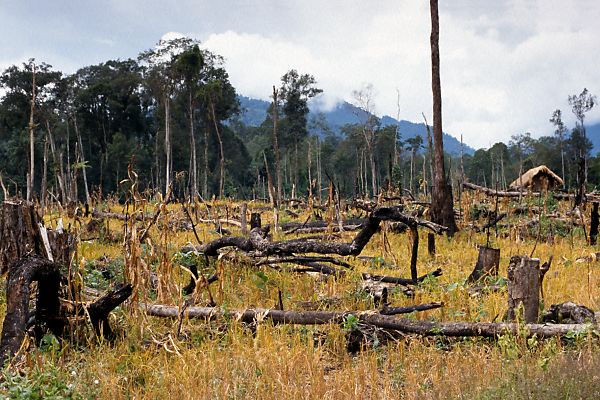
The number one worldwide cause of biodiversity loss is habitat destruction, and the number one cause of habitat destruction is conversion of land for agricultural use. In addition, mining, road building, and urban sprawl play a role. In tropical areas, home to the majority of the world's biodiversity, the conversion of land is often done for small-scale farming through slash-and-burn methods. Although the following site pertains specifically to birds, it is very informative regarding the threat posed by habitat destruction: http://www.birdlife.net/action/science/sowb/pressure/30.html. With a worldwide population of 6 billion people continuing to grow at an incredible rate, the strain on the world's farmers to provide more food supplies will grow. Hopefully mankind will be able to adapt in order to feed a growing population and also preserve biodiversity.


Extinction Rates
Some damage has already been done to Earth's variety due to all these factors coming together. Many of the "hotspots" are cooling due to the extensive damages. At the following website, the World Conservation Union estimates that species extinctions are occurring at a rate anywhere from 1,000 to 10,000 times faster than on a hypothetical, human-free planet. http://www.iucn.org/info_and_news/press/species2000.html Will other modern-day species go the way of the dinosaurs?


Focus on Florida
The state of Florida, and especially South Florida, contains much of the biodiversity of the United States. Numerous endangered species survive in the Everglades, such as the Florida Panther, American Crocodile, and many types of turtles and birds. The Everglades, in the past 100 years, has been damaged due to the massive growth of urban, suburban, and rural agricultural areas surrounding it. Conservationists and some legislators are fighting to rejuvenate and protect some of the wonderful, unique habitat in the Sunshine State. It will be very difficult, however, since the need for land and natural resources is so great. For a concise summary of the Everglades situation, click here: http://www.npca.org/across_the_nation/ten_most_endangered/everglades.asp.


Solutions?
Many changes are possible to help save the biodiversity of the planet, but all are difficult. For example, GMO's (Genetically Modified Organisms) could lead to larger crop yields, but could also create "superpests" which can dominate native species and allow only genetically modified ones to survive. Here is a summary of the GMO situation and numerous links to websites in the debate, courtesy of the Ohio State University: http://ohioline.osu.edu/gmo/ Another possible solution is government regulation, yet often governments coordinate their actions with large businesses, for whom it is very costly to implement stringent environmental standards. Many in the developing world argue that until the worldwide distribution of wealth is more equal, poorer individuals will be forced to exploit the environment, and members of wealthier nations will continue to use energy at an unsustainable rate. Men and women of all areas of the globe must continue to strive for environmentally stable lifestyles and solutions to the difficult problems facing us in the future.
Closing
"For if one link in nature's chain might be lost, another might be lost, until the whole of things will vanish by piecemeal." -Thomas Jefferson
"The bulldozer and not the atomic bomb may turn out to be the most destructive invention of the 20th century." -Philip Shabecoff.
Works Cited: Powerpoint and Web Page
In doing this project, I consulted numerous sources. Those that are the sources of images in both projects and are not already linked on this page are listed below:
http://www.nwf.org/wildlife/images/photo_panther3.jpg
http://www.hsdejong.nl/burma/putao/target_pages/deforestation.html
http://www.ci.berkeley.ca.us/animalservices/generalinfo.html
http://arizonaes.fws.gov/birds.htm
http://www.personal.psu.edu/users/c/m/cmh280/main/conclusion.htm
http://www.imagemagic.ca/photo/scans/slides/Summer%20Sunset.html
http://www.blueplanetbiomes.org/ images/rainforest.jpg
http://www.solitairhols.co.uk/photos/usa_large_florida_map.jpg
http://www.deskpicture.com/DPs/Art/Maps/WorldPoliticalMap2000_2.jpg
http://www.unicorndesigns.ca/tubes/animal/teddybear_sad.gif
http://starryskies.com/articles/2003/08/earth.oceans03a.jpg
http://www.dpent.ca/Images/20385.jpg
http://www.msnbc.com/news/wld/INTL/images/Biodiversity_hotspots.gif
http://www.antarcticconnection.com/antarctic/science/images/climate2.jpg
http://www.csuchico.edu/ba/Food%20Plate.jpg
http://www.dinosauria.com/gallery/joe/extinction.jpg
http://www.rainbowdolphin.com/dinosaurs/images/gal_extinction_comet.jpg
