 A
Problem from Lewis Carroll
A
Problem from Lewis Carroll
Problem Solving for CGS Geometry Students
Six problems are outlined below. One problem must be handed in to your math teacher. A grading rubric will be used to score your solution. Please consult this rubric to ensure you are handing in a complete and thoughtful solution. The honor code is to be followed in completing this assignment. Here are the problems to choose from:
1.
A
Problem from Lewis Carroll
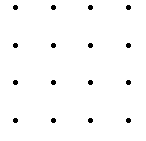
2. The figure shows a four-by-four grid of points. Each point is one unit from its nearest horizontal and vertical neighbors. Using pairs of these points a endpoints, what is the greatest number of segments that can be drawn so that no two segments are the same length?
©National Council of Teachers of Mathematics
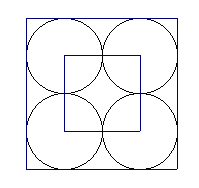
3. In the diagram, the congruent circles are tangent to the larger square and each other as shown below and their centers are vertices of the smaller square. The area of the smaller square is 4. Find the area of the larger square.
©Mathematics Leagues Inc.
4. The number in an unshaded square is obtained by adding the numbers connected with it from the row above. (The 11 is one such number.) What is the value of x?
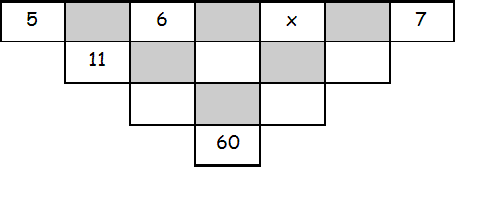
©National Council of Teachers of Mathematics
5. The numbers 1 to 10 inclusive are to be arranged in a circle and each one multiplied by its right-hand neighbor. How should they be arranged if the number of different products is to be a minimum?
6. What is the least
possible value of the sum |x - 1| + |x - 3| + |x - 5|
©Mathematics
Leagues, Inc.