A Brief History of Guitar
The contemporary guitar belongs to the Chordophone group of musical instruments, which are characterised by the production of sound through vibrating strings. The lineage from which these instruments descend extends back as far as ancient Greece, and back further to bowed harps, which were played as early as 3000BC in Egypt and Sumeria.
It was not until the Renaissance, during the 1600's, that the first true guitars appeared. These instruments were distinguished from others by having a waisted body shape, smooth curves, and vertical sides. Since these times the dimensions, materials used, and the music being played has changed, but the essential shape has remained.
The evolution of today's different guitars can be traced in a chronological fashion:
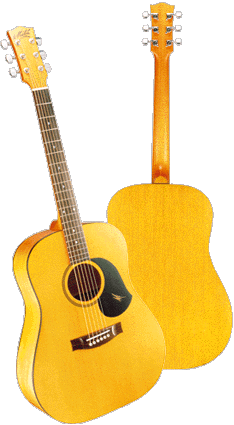
It can easily be seen that the guitar is a dynamic instrument, which has been changing in design and construction, and has itself changed the music that is popular today. It should therefore be no surprise that one of the modern forms of the guitar - the Flat Top Steel String Acoustic - is the most popular instrument in the world today. In terms of forestry, quality guitars are "one of the most value added things you can do with trees."
The historical origins of this guitar can be traced back to two men, Orville Gibson and CF Martin, who were responsible for the early development and differentiation from the existing European styles. Guitars built in the USA prior to this were of low quality, and were used primarily by women as a boudoir instrument. Gibson was struck by the inadequacies of American guitars as much as he was amazed at the comparative perfection of imported (usually European) violins. This gave him the idea, of using the steel strings from a mandolin to string a large, carefully fashioned guitar that he had made himself - to the construction standards he had observed in imported violins.
The result was a louder, much more resonant instrument - the American Steel Stringed guitar had been born.