
Background to wood use in guitar construction
Guitars are constructed from exotic, precious woods gathered from distant places - for example; Rosewood (Dalbergia sp.) from Brazil or East India, Spruce (Picea sp.) from Central Europe or the American and Canadian Northwest, and Mahogany (Swietenia sp.) from Central America. These are some of the main woods that have been used in guitar making since the early 1900s. Other woods, such as Morado (Machaerium scleroxylon), Cherry Koa (Acacia koa), Maple (Acer sp.), Larch (Larix sp.), Western Red Cedar (Thuja plicata), Blackwood (Acacia melanoxylon), along with a number of other woods, are also used in today's guitars. Rosewood-veneered plywood is also available for backs and sides of guitars, although plywood guitars are disappointing, which is partly due to the general cheapness of their manufacture. The sound tones in plywood guitars can be improved if the wood is two-ply rather than three-ply, which would reduce the rigidity and permit manual tapering or thinning if necessary. Soundboards are made of spruce; an even-grained, resonant wood that combines exceptional strength with lightness.
For generations in the past, forests of the Tyrol, Dalmatia, Bohemia and Rumania provided the spruce for guitar manufacture. Now the spruce used from these forests has been largely exhausted, and imported spruce is difficult to find and expensive. Sitka spruce is a large tree growing in the American north-west, western Canada, and Alaska. Its strength to weight ratio is lower than that of European spruce, but in all other respects it is a perfectly satisfactory replacement. Fingerboards are made of ebony or rosewood. Ebony is always preferred on guitars of high quality because of its durability and lack of grain, and also due to the elegant contrast it makes with nickel-silver frets. Soundboard struts and bracing are usually made of straight-grained, clear spruce, the stiffer the better. Honduras Mahogany is used for the cross struts on a rosewood back, Sitka spruce or maple on a maple back.
Wood stability
Dampness is the enemy of all stringed instruments, particularly the guitar. If moisture gets into wood, the wood swells. In a drier environment the moisture leaves the wood and the wood shrinks to its former size. A guitar can tolerate these changes if they are gradual and not extreme. Ideally, a guitar should be built in an atmosphere containing less moisture than the atmosphere in which it will most commonly be used because swelling (the absorption of atmospheric moisture) is a less serious hazard than shrinkage.
Physical and tonal properties of some woods used in guitars
The following list of woods is a guide, and does not nearly cover all the woods used in guitar manufacture:
Wood used for the back and sides
Brazilian Rosewood (Dalbergia nigra)
Brazilian Rosewood is scarce, and hence many commercial guitar manufacturers have switched to Indian Rosewood - it is unlikely that manufacturers will switch back to using Brazilian Rosewood. Sometimes referred to as "Jacaranda", several factors have made Brazilian Rosewood the ideal wood to use in guitar manufacture. Due to its exceptional strength and density, yet thinness without sacrificing rigidity, along with a high resin content, Brazilian Rosewood has a superior resistance to decay and warp. Its lustrous, dark-grained beauty is a prized asset in an instrument where visual appearance is an important consideration. Brazilian Rosewood ranges in colour from pale red-brown to deep chocolate. The grain is often wild, with pores that can be large or small.
Brazilian Rosewood image
Indian Rosewood (Dalbergia latifolia)
Indian Rosewood has a grain that is more uniform and its colour ranges from pale grey-brown to deep red-brown or sepia with a vaguely purple haze. Its grain is generally more open-pored than Brazilian Rosewood and its lustre is duller. Indian Rosewood is resinous, stable and generally more consistent in grain than other rosewood species. It is extremely resonant producing a deep warm projective bass response that accentuates on large bodied guitars.
Mahogany (Swietenia macrophylla)
Mahogany is a heavy wood, which is considered to be porous. There are two types of mahogany - Honduras (Brazilian) and African. The most common is Honduras and it has a golden brown appearance. African, on the other hand, comes in more of a reddish brown colour. Mahogany is consistently clear and light in weight, and yields a strong sustained sound with an emphasis on clear bright trebles. The wood is easy to machine and finish, possessing both a spiral and interlocking grain pattern, making it an exceptionally stable wood.
European Flamed Maple (Acer campestre)
European Flamed Maple naturally occurs in Germany. In some rare individual maple trees there is a characteristic alternating soft and hard rippling appearance that runs perpendicular to the grain, that is sometimes referred to as curly, flamed, tiger shaped, or "Fiddleback" maple. This particular species of European maple is very hard in texture and reflective, producing a loud, powerful projective sound. The uniquely textured "Birdseye" maple displays characteristics and tonal properties similar to European Flamed Maple. Maple is a strong, heavy wood that is light in colour, and can be used for both the neck and the body of guitars. Maple finishes well and can be steamed and bent. Maple also has very densely aggregated pores, a feature that simplifies finishing.
Cherry Koa (Acacia koa)
Koa is an expensive hardwood that naturally occurs in Hawaii and has a golden brown to dark red colour with dark streaks and a lustrous sheen. Sometimes known as "flamed" Koa, the wood occasionally develops a curly or flamed appearance. Koa is considered to be porous. It has a bass response that is slightly less than that of rosewood and a treble response that is slightly less than that of mahogany. This results in a very equally balanced instrument.
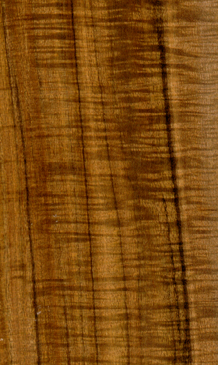
Cherry or "flamed" Koa image
Morado (Machaerium scleroxylon)
Morado occurs naturally in Bolivia. Also known as Bolivian or Santos "rosewood", Morado ranges in colour from a light violet brown to reddish brown with occasional olive and black streaks. It is finer in texture than most rosewood species, and is a close visual substitute for Indian Rosewood, having very similar tonal properties.
Blackwood (Acacia melanoxylon)
Blackwood is excellent for back and sides sets. It is light ochre in appearance to dark with reddish brown streaks. This species occurs naturally in Australia from Tasmania to Queensland, and is used for guitar manufacture by the Maton guitar company. Blackwood prefers drainage areas (e.g. gullies) and high rainfall, taking about 90 years to grow to a utilisable size, by which time it is often 'piped' or rotted in the core and almost at the end of its life cycle. The grain is usually straight though sometimes figured or 'flamed', especially the buttresses or stumps of the tree. Blackwood is a relatively stable, strong hardwood, that has been experimented with in the construction of guitar necks with excellent results. This timber is beginning to be highly valued abroad as it is almost identical to the Hawaiian species Cherry Koa (Acacia koa) used in traditional luthier construction.
Wood used for the top (soundboard)
Sitka Spruce (Picea sitchensis)
Sitka spruce naturally occurs in Canada's north-west and Alaska. It has a consistent quality in the grain, being straight and uniform, is durable and long lasting, with good tensile strength. Tonally, Sitka spruce is extremely vibrant, providing an ideal medium for transmission of sound on any size of stringed instrument.

Sitka Spruce image
Englemann Spruce (Picea engelmannii)
Englemann spruce naturally occurs in the USA. It is prized for its similarity in colour to European (German) White spruce, as well as its extreme lightness in weight. This produces a slightly louder and more projective or "open" sound than Sitka spruce. Englemann spruce grows in high altitudes in the Rocky Mountains and the Pacific Cascades, and is considerably more limited in supply than Sitka spruce.
Western Larch (Larix occidentalis)
Western Larch naturally occurs in the USA. It has clearly marked annual rings and a fine uniform texture. Larch is harder and stronger than most conifers, including spruce. It has a close visual resemblance to Sitka Spruce and due to its increased stiffness, it is an appropriate choice for scalloped braced models, yielding a projective and crisp response.
Western Red Cedar (Thuja plicata)
Western Red Cedar naturally occurs in the USA. It has long been utilised as a soundboard material by classical guitar makers for its vibrancy and clarity of sound. It is extremely light in weight compared to spruce and the tonal result is generally a slightly louder, more open response. It is a poor choice of wood for steel-string guitar construction, because of its low inherent strength - a misdirected pick will abrade and scar this soft-fibre wood.
Timber treatment and seasoning
The nature of wood makes it responsive to changes in temperature and humidity. In a musical instrument such as a guitar, these tendencies can be unwanted, as the slightest change in the different wood types within each guitar lead to tonal variation - to the musician's ear warping of different parts means it is out of tune. These tendencies cannot be restrained by using larger pieces of wood, as the guitar needs to be very responsive to musical vibrations.
The first step in curtailing this problem is the cut of timber from the log. All timbers for guitar construction should be taken from boards cut as nearly as possible along the radius of the log. If a plank is cut radially to the log, so that the end grain runs straight up and down, the tendency to move will be purely along the three main axes of the plank. If on the other hand the plank is slab-cut, with the end grain running skew across the thickness of the wood, the forces exerted when it moves will twist and warp the plank. To get as much of the timber as possible in the form of radially cut planks it is quarter sawn. Unfortunately, the higher the proportion of truly radial planks the greater the wastage.
The proper seasoning of timber does more than just reducing its tendency to warp, as it ages, its strength increases and its tonal responses improve. Air drying is preferred to kiln drying, as it allows time for chemical changes which "cure" the wood. The economics of doing this means that only small luthiers can afford to air dry timber, whereas larger producers can only afford kiln drying, this is because much more time and energy is spent on each guitar by an small luthier. Some soundboards are air dried for up to thirty years. Martin Guitars instead take a two step approach to seasoning their timber. Kiln drying is followed by chemical seasoning to artificially recreate the effects of extended air-drying.
Basic theory of guitar construction
The volume of sound produced by a guitar depends mainly on the volume of air enclosed by the resonating sound cavity or box. Large, deep boxes tend to produce a louder sound and give a deeper bass response than small, shallow boxes, which tend to produce a greater treble sound and hence suffer a proportional loss in volume or loudness. In the traditional construction of a classic guitar, great importance is attached to the character and wood use of soundboard bracing. Bracing patterns are designed to promote the flow of sound vibrations across the diaphragm like the effect of a stone dropped in the centre of a pond; concentric circles of sound vibrations ripple out from the bridge, meeting less and less resistance as they reach the diaphragm perimeter. A properly constructed guitar has a vibrant, well-braced body and a soundboard especially designed to vibrate. A top that does not vibrate produces a muffled, insubstantial sound. A guitar constructed with thin back and sides tends to have a louder sound than a guitar made of thicker wood. However, a thin guitar also produces disturbing overtones and excessive noise unless securely and strategically braced. Hence, the guitar maker's basic job then, is to build a sound box enclosing an adequate volume of air within walls thin enough to ensure sufficient loudness, yet stable enough to prevent harmonic difficulties and with a top that will flex properly to lend body and presence to the sound. It is therefore essential that suitable wood types are used for the various components of guitars, such as the soundboard, back and sides, neck etc., as different wood types have varying densities. The wood types used should suit the function of the component, in order to achieve a good resonance, and so that the guitar is durable and will last for a long period of time.
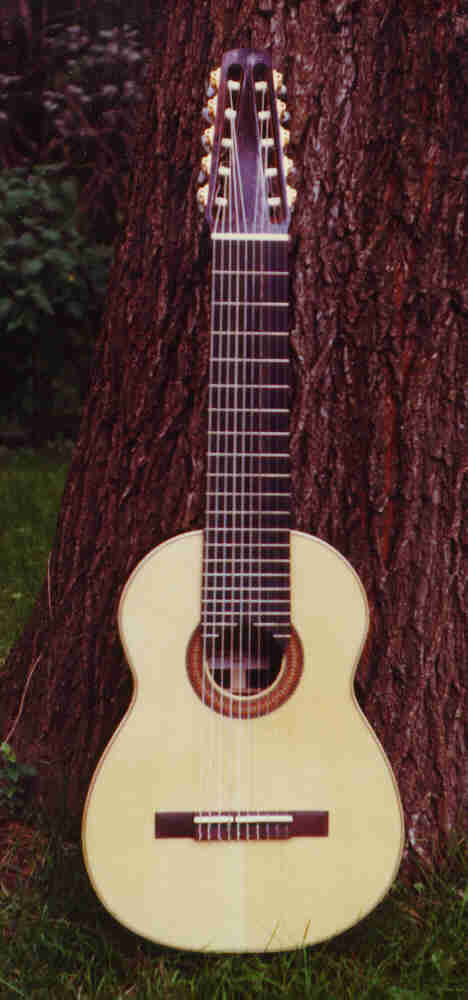
A 10-string classical guitar made from Honduras Mahogany, German Spruce and African Ebony
Conclusion
The future of the steel string guitar industry looks bright for guitar producers. This is a result of supply and demand factors. From the supplier's perspective, there appears to be no immediate deficit of required materials, considering that timber is a renewable resource, and that any shortfalls in an individual species can be dealt with through substitution of another, as the Brazilian Rosewood crisis exemplifies.
Strengthening this is the current demand for guitars. The guitar is one of the most accessible musical instruments, being relatively easy to learn, and easily transportable. As well as these properties, modern music is currently dominated by "guitar music", as a glance through the recording sales charts will testify.