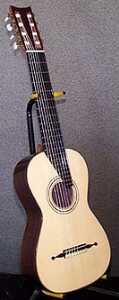
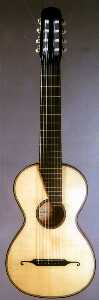
The 8-string guitar is a good compromise between the limited 7-string and the unwieldy 10-string. The 8-string was popularized by the late, great Jose Tomas in Spain. To improve playability, my duet partner, an amateur luthier, had the brilliant idea of making slight adaptations to early 19th-century designs, so that a fully-fretted 8-string neck can be custom adapted to the 19th century guitar body with great success. Kenny Hill built a fine 8-string Panormo-based design to my duet partner's specifications (first picture to the left). Based on observations of the Hill guitar and several other multi-bass guitars, as well as extensive correspondence with luthier Bernhard Kresse, Mr. Kresse built my personal guitar to my specifications based on an adaptation of the Anton Stauffer design to the 8-string, a fantastic concert guitar in every aspect (second picture to the left). This is a modernization of the 19th century design; they did not build frettable 8-strings back then. The 8-string is usually tuned 7=D 8=A. However, some pieces require one string tuned to C; for example, Legnani's 8-string pieces call for an open low C.
Advantages:
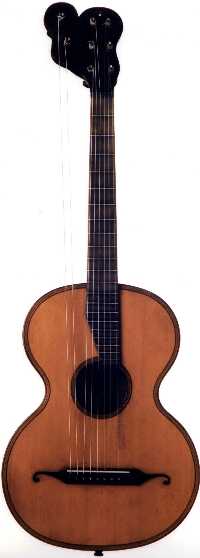
This period floating 8-string guitar made by Reis in approximately 1840 is a rare surviving example of the multi-bass guitars.
It is patterned after the famous Viennese builder Anton Stauffer, as many Viennese builders copied Stauffer's design. This guitar has a robust tone and is recorded on the CD Romantic Guitar - Brigitte Zaczek. Note that the extra 2 strings are not fretted and only the open string can be played. The headstock is a typical figure 8 shape, where the assembly for the 7th and 8th strings is interlocked with the figure 8.
Although the extra bass notes provide the Drop-D and Drop-A, the lower bass notes vary in distance from the sixth string. This design can cause playing accuracy problems when playing tasto or ponticello. The bass notes can be tuned to G, B, C or any note which suits the music.