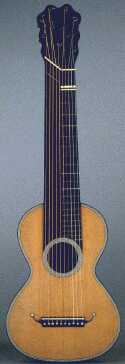
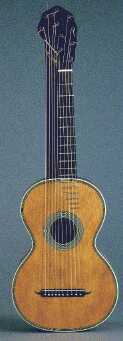
The 10-string guitar was called the Decacorde. Rene Lacote made several 10-string guitars, which were played by Carulli and others. Shown are a Lacote 1826 and 1830 from Musee de la Musique.
According to Dr. James Buckland, Carulli called the 10 string guitar the "Decacorde" and wrote a method for it. Tuning: a "C" and "B" between the 4th and 5th string and a "G and "F" between the 5th and 6th string. From 1 to 10: E B G D C B A G F E. Scordatura was intended for the basses as needed by key.
The early 10-string guitar is strung with frets on the first 6 strings as normal, with additional floating bass strings. Romantic tuning, we can assume from surviving instruments and written period music, was chromatic natural notes, e.g. 10=A 9=B 8=C 7=D, followed by the normal 6 strings. Modern 10-strings, popularized by Narciso Yepes, have frets on all 10-strings. According to John McCormick, "The "Yepes" tuning is intended for the purpose of utilizing the extra strings mainly as sympathetic ones. They are tuned as follows: 7- C below the 6th E, 8 - A#, 9 - G#, 10 - F#. None of these are normally fretted with the left hand. They are all intended to resonate when other strings are played, similar in principle to the baroque Viola D'amore which employed seven bowed strings with seven sympathetic strings under them."