According to Levine's report, the "[i]ncidence of Anemia Anemia is very common in HIV-infected individuals, occurring in approximately 30% during the initial asymptomatic years of infection and found in 80% to 90% of patients over the course of disease."
Levine reported on studies showing that anemia was associated with a higher death rate, and that treatment of anemia was associated with a reduced death rate and an "improved quality of life."
Levine reported on the percentage of HIV patients with anemia. She reported that anemia seemed to be more frequent in patients with full-blown AIDS than in patients with HIV but without AIDS. She stated that, using a definition of anemia as a hemoglobin level < 10 g/dL or a physician's diagnosis of anemia, researchers (Sullivan and his colleagues in a project funded by the Centers for Disease Control and Prevention*) calculated the 1-year incidence of anemia as a function of the stage of HIV disease.
According to these calculations, the 1-year incidence of anemia was 37% among patients with clinical AIDS, 12% among patients with immunologic AIDS, as defined by a CD4+ cell count < 200 cells/mm3 in the absence of an AIDS-defining clinical condition; and 3% among HIV-infected individuals with neither clinical nor immunologic AIDS.
Possible Reasons for Anemia
According to Levine, reasons for anemia in HIV/AIDS patients may include (1), insufficient absorption of folic acid (necessary to produce B12; B12 like iron is essential to healthy red blood cells)--due to failure/inability to eat enough leafy green vegetables, or due to infections that affect digestion; (2), HIV infection** or apopstosis (cellular death as a result of HIV or the immune system's response to it) of the cells that produce red blood cells, the precursor cells--located in the bone marrow; (3), drugs used to treat HIV/AIDS and associated illnesses, including the anti-retroviral AZT/Zidovudine, the anti-viral used to treat Herpes Foscarnet, the anti-microbial sulfa-trimethoprim used to treat PCP (pneumonia), and the immune modifier Interferon Alpha! Other drugs may also result in anemia (see table)!
Anemia might be caused by a vitamin B-12 deficiency in the diet, too--Vitamin B-12 is only available in certain foods and is needed for healthy red blood cells. Levine noted that patients with HIV may fail to eat a proper diet. (Chicken, fish, shellfish, and some other foods, including sea kelp and fermented tempe are rich in B-12; red meat has some B-12; other foods have only traces of or no B-12.) Levine reported that,
"Since B12 deficiency may also cause neurologic dysfunction (subacute combined degeneration of the cord), with motor, sensory, and higher cortical dysfunction, the possibility of vitamin B12 deficiency should also be considered in HIV-infected patients with these neurologic symptoms."
(It is this writer's (CEW's) understanding that a B12 deficiency may ultimately result in decreased ability to absorb nutrients including folic acid and B12, and hence, increased anemia.)
Drugs Used to Treat HIV or AIDS-Associated Illnesses and Anemia: Possible Benefits and Harm
Combination HAART therapy, though initially associated with increased anemia, is ultimately associated with decreased anemia, according to Levine. It was possible, Levine claimed, that when HAART decreased viral load, HIV may have infected fewer cells needed for the growth of healthy red blood cells!
The protease inhibitor ritonavir, was " associated with decreased apoptosis of hematopoietic progenitors and direct stimulation of progenitor cell growth in vitro," according to Levine. (How ritonavir works in the body in relation to anemia is not documented by Levine; Levine does not give information about all protease inhibitors.)
Other drugs used to treat HIV and infections associated with AIDS, as noted above, were associated with an increased incidence of anemia.
Table 1. Drugs That Commonly Cause Myelosuppression in the Patient With HIV (Myelosuppression Is A Possible Cause of Anemia)
Reported by Levine in Medscape/Reuter's Health
| Antiretrovirals |
|
|---|---|
| Antivirals |
|
| Antifungals |
|
| Anti-microbials/Anti-PCP |
|
| Anti-neoplastic |
|
| Immune Response Modifier |
|
Notes:MY NOTES ON THE EXCERPTS & TABLE:
*"According to Levine, Sullivan and colleagues evaluated data derived from the case records of 32,867 HIV-infected persons who received medical care from January 1990 through August 1996. This cohort, termed the Multistate Adult and Adolescent Spectrum of HIV Disease Surveillance Project, consists of individuals who receive HIV care in hospitals and HIV clinics in 9 US cities and is funded by the Centers for Disease Control and Prevention (CDC)."
**Levine reported on the infectability of specific cells by HIV, noting that, ". . . while initially controversial, there is recent evidence to indicate that the hematopoietic stem cell or CD34+ progenitor cell is resistant to infection by HIV. However, more committed myeloid progenitor cells may be infectable, and are clearly functionally abnormal, with markedly decreased colony growth. Likewise, the microenvironment of the marrow, necessary for normal blood cell growth and development, is also abnormal. The multiple cells such as T cells and macrophages that comprise this microenvironment ("stroma") are infectable by HIV, resulting in decreased production of various hematopoietic growth factors and further abnormalities of progenitor cell growth," according to Levine (2002).
*** Some M.D.'s prescribe these drugs with a B-vitamin supplement (leucovorin rescue) that eases some of the side effects; I am not sure whether this supplement would be associated with a reduced incidence of anemia or not.
I am not sure whether short-term use (a few weeks or less) of any of the drugs listed in the table above is associated with anemia or not!
* * *
Levine provided the following diagram of possible causes of anemia based on various symptoms:
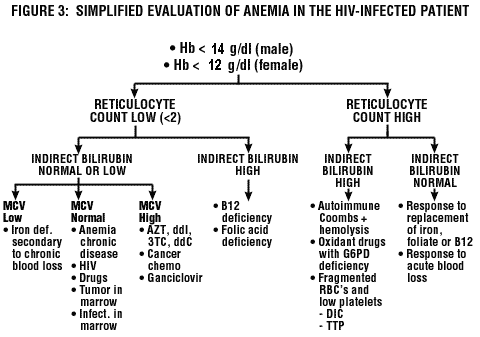
Copyright on this image is held by Levine and Reuter's Health, not by me; it's here for now!
Possible Treatments
Possible treatments for anemia in HIV/AIDS patients listed by Levine include HAART, red cell stimulators (which are being studied in HIV/AIDS patients), and blood transfusion.